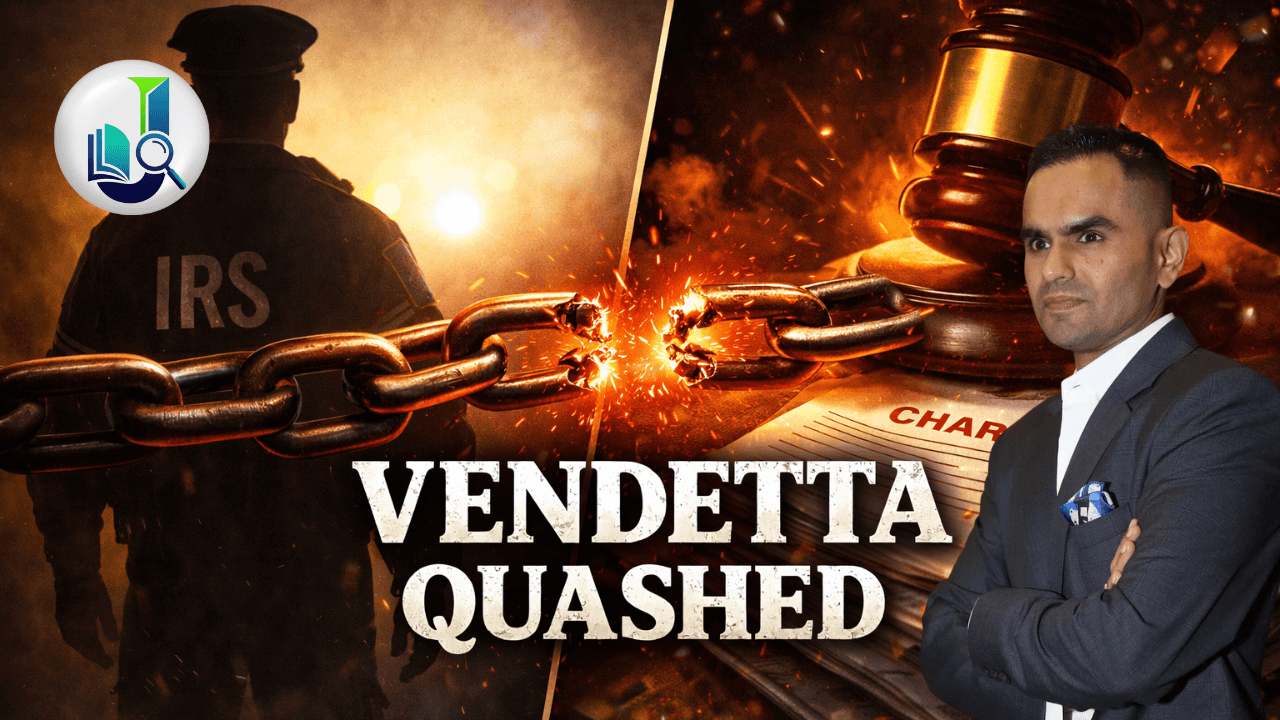
New Delhi: In a blistering verdict that raises serious questions about the impartiality of departmental inquiries, the Central Administrative Tribunal (CAT), Principal Bench, has quashed the disciplinary charge memorandum issued against IRS officer Sameer Wankhede. The Tribunal not only set aside the charges but also heavily criticized the Central Board of Indirect Taxes and Customs (CBIC), terming its actions as being driven by "malice in law" and "personal vendetta."
The Bench, comprising Justice Ranjit More (Chairman) and Rajinder Kashyap (Member–Administrative), restrained authorities from proceeding further with the Charge Memorandum dated August 18, 2025, granting Wankhede all consequential benefits.
The case traces back to Wankhede's tenure as the Mumbai Zonal Director of the Narcotics Control Bureau (NCB), during which the high-profile Cordelia Cruise drug case involving Aryan Khan was registered. Following allegations of procedural lapses, a Special Enquiry Team (SET) was constituted to probe Wankhede.
Wankhede had previously challenged the SET report, arguing that the officer heading the inquiry had himself supervised the Cordelia investigation, violating the principles of natural justice. In August 2023, the CAT accepted this, ruling that an officer actively involved in the investigation could not be part of the inquiry team. Despite this, and a pending FIR by the CBI based on the same material, the CBIC issued a fresh Charge Memorandum in August 2025.
The Tribunal found that the new charges were essentially a repackaged version of the preliminary inquiry that had already been discredited. The Bench observed that the department's persistence in issuing a major penalty charge sheet, despite judicial stay orders and findings against the SET report, reeked of bias.
The Tribunal noted:
"The motive involved in the issuance of the charge sheet is driven by biased considerations, and the inquiry would be a mere farcical show, the conclusion of which is already well known. Hence, we interfere at this stage itself to avoid further harassment and humiliation of the applicant."
In a rare move, the Tribunal explicitly linked the timing of the charge sheet to Wankhede’s career progression. It observed that the "chain of events unmistakably demonstrates" that the charges bore no real nexus to the allegations but appeared to be a retaliation intended to stall his promotion.
"Such conduct is ex facie demonstrative of malice in law and personal vendetta and colourable exercise of power."
This ruling is a significant precedent for administrative law in India. It reinforces the doctrine that disciplinary authority cannot be weaponized to settle personal scores or bypass judicial findings. By calling out the "colourable exercise of power," the CAT has drawn a red line: the state cannot be a litigant that ignores its own rules of fairness just to persecute an officer.
Although the Tribunal refrained from imposing heavy costs on the CBIC, it expressed hope that the department would "mend its ways and establish an administrative mechanism that upholds the rule of law."