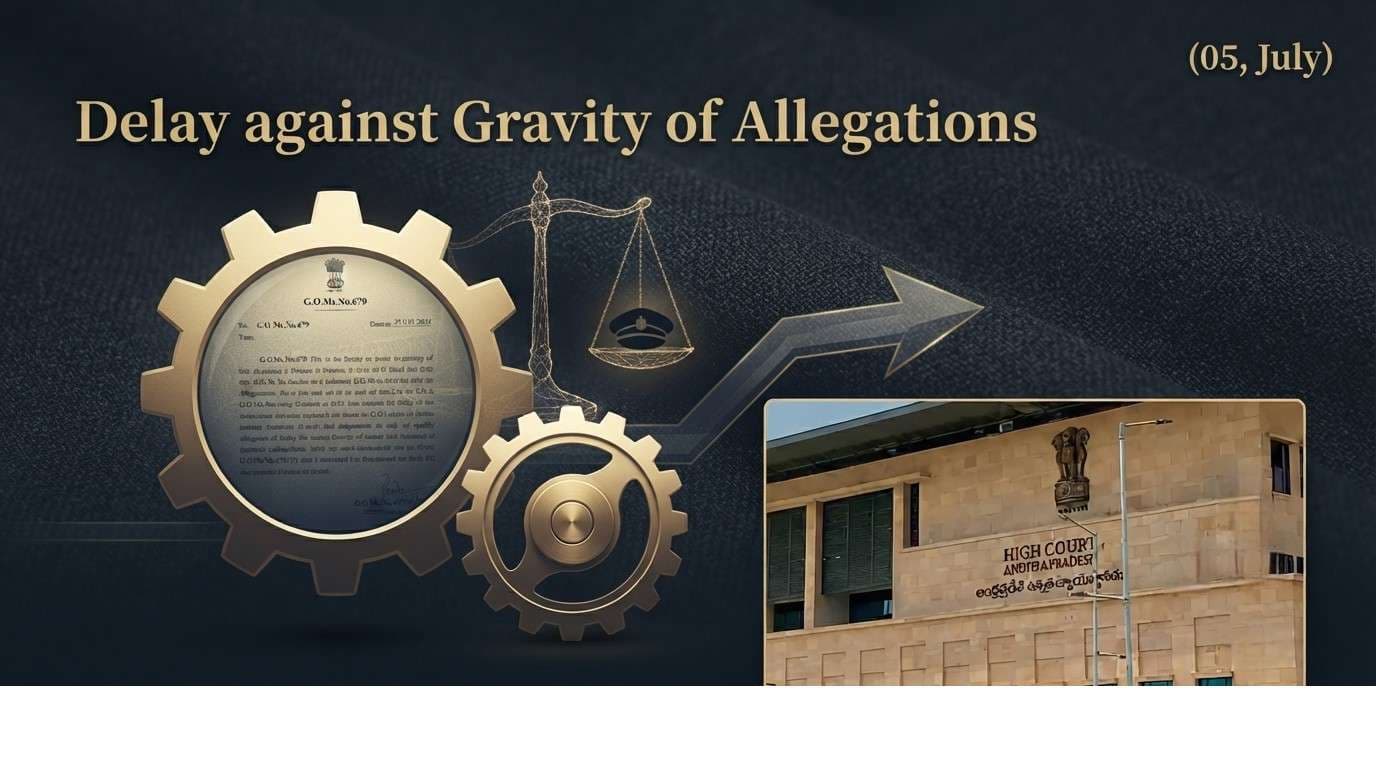
A Division Bench of the Andhra Pradesh High Court comprising Chief Justice Lisa Gill and Justice Ninala Jayasurya delivered a judgment clarifying the limits of judicial interference in departmental enquiries on the ground of delay. The Bench held that departmental proceedings cannot be set aside merely because they have not been concluded within the stipulated period; any delay must be evaluated against the seriousness of the allegations and the procedural rules governing such enquiries.
The case arose from a writ petition filed by a former Inspector of Police, Traffic‑II, who challenged the continuation of disciplinary proceedings against him. The charge memo accused him of corrupt practices, illegal collection of money from lorry drivers, misuse of official authority, harassment of traffic personnel, demanding money from oil industries under the pretext of printing flexi banners, and accumulating dues to various business establishments. An Enquiry Officer and a Presenting Officer were appointed to conduct the inquiry.
The petitioner failed to appear for the oral enquiry on several dates despite receiving summons. He submitted a written statement of defence but thereafter did not participate in the proceedings. The inquiry stalled after his conviction in Criminal Case No.114 of 2005 led to his dismissal from service. Although his criminal appeal was allowed, a subsequent remand resulted in another conviction and dismissal. A second criminal appeal was again allowed, leading to his reinstatement. By the time the enquiry could be resumed, the petitioner had attained superannuation.
The petitioner contended that the delay in completing the enquiry was attributable solely to the department, citing transfers of Enquiry Officers and his intermittent dismissals. He argued that the non‑completion of the proceedings deprived him of promotion opportunities after he reached the age of superannuation in 2019. He sought a declaration that the ongoing departmental enquiry was contrary to G.O.Ms.No.679, illegal, and violative of Articles 14 and 21 of the Constitution.
The Single Judge allowed the writ petition, set aside the proceedings, and relied primarily on the decision in P.V.Mahadevan’s case. The State filed a writ appeal, asserting that the Single Judge had not examined the matter in proper perspective. The State submitted that the delay was due to administrative factors and the petitioner’s own non‑cooperation, and cited the Supreme Court judgment in Chairman, LIC of India & Ors. v. A.Masilamani, which holds that a disciplinary enquiry cannot be quashed merely on the ground of delay in its conclusion.
The Division Bench observed that the Single Judge had not recorded any finding on whether the delay was attributable to the petitioner or to the department. It further noted that the effect of G.O.Ms.No.679, which prescribes a six‑month limit for concluding disciplinary proceedings, had not been examined. The Bench held that the Single Judge’s reliance on P.V.Mahadevan’s case was misplaced because that decision dealt with delay in the initiation of enquiries, whereas in the present case there was no delay in initiation—the crime was registered in 2011 and the departmental proceedings commenced in 2012. The delay, if any, related only to the conclusion of the enquiry.
Drawing on Chairman, LIC of India & Ors. v. A.Masilamani, the Bench emphasized that a charge‑sheet or show‑cause notice in disciplinary proceedings cannot ordinarily be set aside on the basis of delay in their conclusion. The court must consider all relevant facts, including the gravity of the charges. The Bench also referred to Depot Manager, APSRTC v. Mohd. Yousuf Miya & Ors., which clarified that crime constitutes an act of commission in violation of law or an omission of public duty, and that departmental enquiries serve to maintain discipline and efficiency in public service.
Regarding G.O.Ms.No.679, the Division Bench held that the provision requiring completion of proceedings within six months is directory in nature and not mandatory. Consequently, mere non‑compliance with the time limit does not automatically render the proceedings invalid. The Bench stressed that delay per se is insufficient to warrant quashing; the court must weigh the delay against the seriousness of the allegations and the reasons for the delay.
The Division Bench therefore set aside the order of the Single Judge and remitted the matter for a fresh consideration, directing that the enquiry proceed in accordance with the principles laid down. The judgment reaffirms that departmental inquiries enjoy a presumption of validity and that judicial intervention on the ground of delay is limited to cases where the delay is unreasonable, unjustified, or prejudicial to the delinquent officer, after taking into account the nature and gravity of the charges.