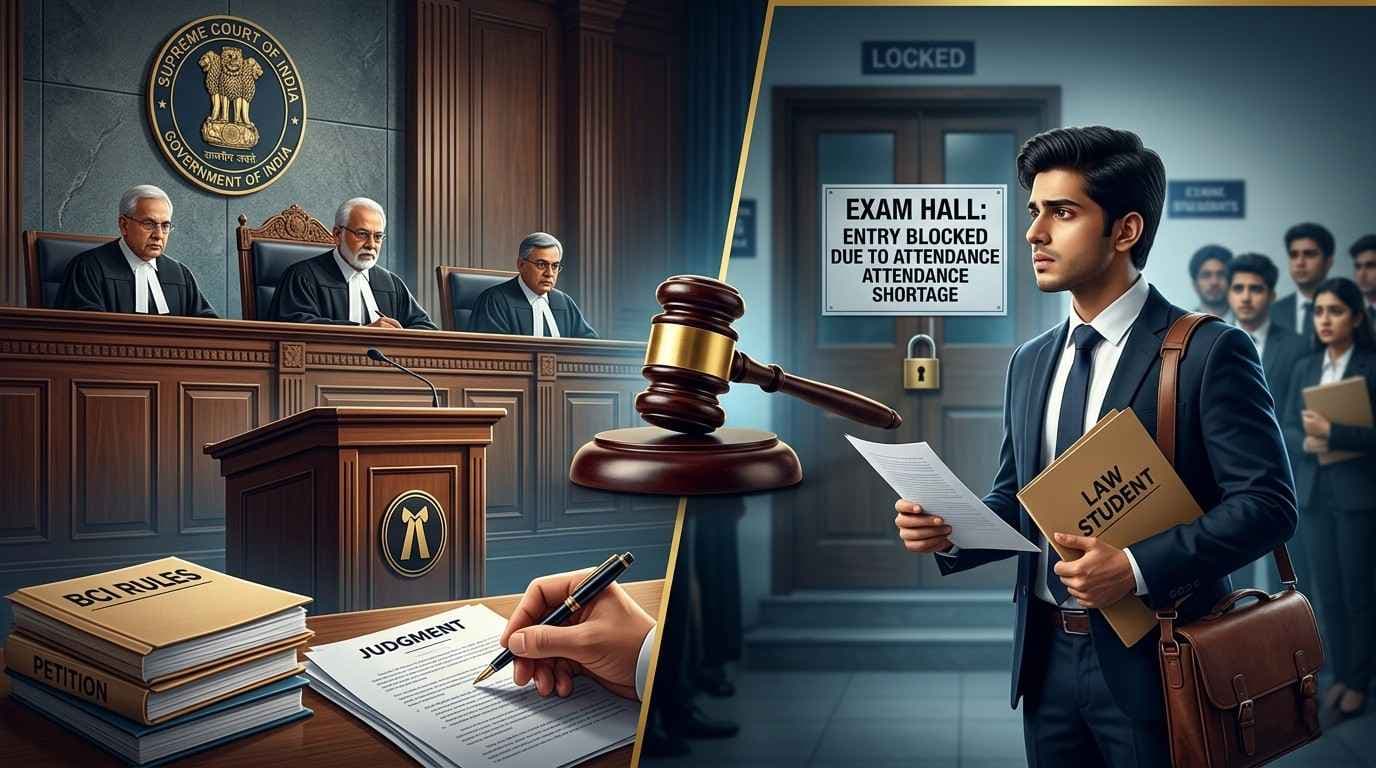
The Supreme Court of India has taken up a pivotal question that could redefine the academic landscape for legal education: can law students be barred from appearing in examinations solely due to a shortage of attendance? The apex court has sought a response from the Bar Council of India (BCI) regarding a plea filed by the Narsee Monjee Institute of Management Studies (NMIMS). This case challenges a significant Delhi High Court judgment which held that students should not be penalized by being barred from exams based on attendance criteria alone.
A three-judge Bench, comprising Justices Vikram Nath, Sandeep Mehta, and Vijay Bishnoi, notably refused to stay the Delhi High Court's ruling for the time being. The Bench clarified, "We are not suspending that order. We will hear the matter, decide and lay down the correct position of law." This indicates that while the legal debate continues at the highest level, the immediate relief granted to students by the High Court remains operational, preventing educational institutions from enforcing strict attendance-based exclusions during the interim period.
The core of the dispute revolves around the interpretation of the BCI's "Rules of Legal Education," which traditionally mandate a minimum percentage of attendance for students to be eligible for exams. The Delhi High Court’s ruling, suggests a more student-centric approach, potentially prioritizing academic performance and the fundamental right to education over rigid administrative metrics. This shift challenges the long-standing belief that physical presence in a classroom is an indispensable prerequisite for a professional degree in law.
The case of Narsee Monjee Institute of Management Studies vs. Bar Council of India serves as a focal point for a broader debate on modern education. Critics of strict attendance rules argue that they are archaic and fail to account for the diverse ways modern students learn, including internships, research, and moots that often take them outside the lecture hall. From a judicial perspective, the question is whether such "blanket bans" on exam entry violate the principles of fairness and the Right to Education under the Indian Constitution.
Furthermore, the Supreme Court's decision to "lay down the correct position of law," as suggests that the final verdict will have far-reaching implications for all law colleges across the country. It will set a precedent on whether professional bodies like the BCI can impose non-academic hurdles that result in the loss of a semester or a year for an aspiring lawyer. This case is not just about one institute; it is about the autonomy of educational bodies versus the individual rights of students.
The BCI's response will be crucial, as they are expected to defend the necessity of attendance as a measure of professional discipline and holistic learning. They often argue that legal education is not merely about passing a test but involves peer interaction and clinical training that can only be achieved in person. The Supreme Court must now balance these "standards of profession" against the "rights of the student" to ensure that administrative rules do not become tools of academic harassment.
For students currently facing attendance-related hurdles, the Supreme Court's refusal to stay the High Court order brings significant, though temporary, relief. It signals that the judiciary is willing to scrutinize educational policies that appear punitive. As the matter moves to a merits-based hearing, the legal community awaits a definitive answer on whether the "sanctity of the classroom" can legally override a student’s right to demonstrate their knowledge in the examination hall.
In conclusion, this legal battle marks a critical juncture in the evolution of Indian legal education. By addressing the "attendance vs. examination" conflict, the Supreme Court is poised to modernize the rules governing how future lawyers are trained and evaluated. The transition from a rigid administrative focus to a more nuanced legal position will likely redefine the relationship between law schools and their students for years to come.