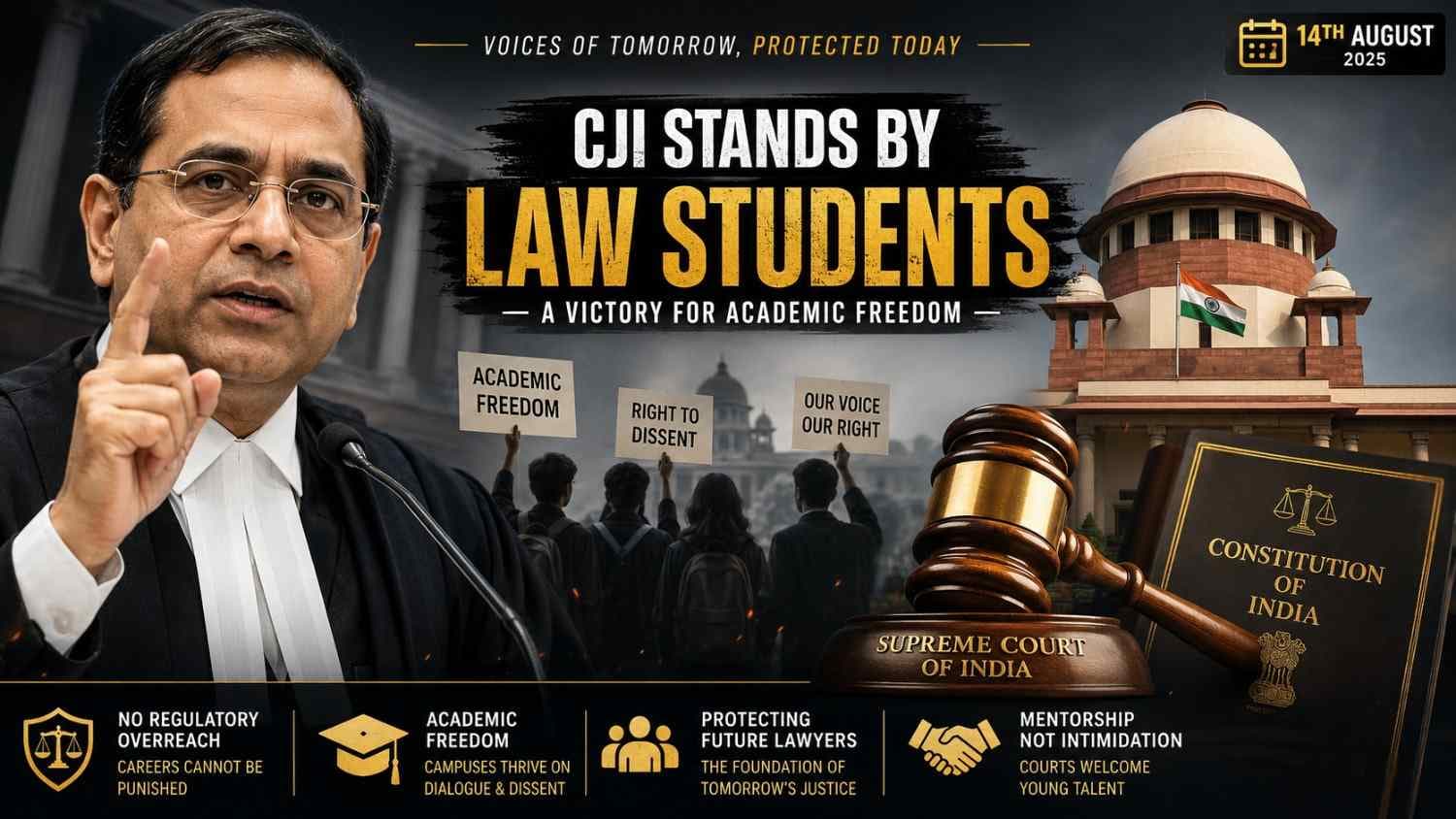
The courtroom witnessed a rare and powerful moment of institutional accountability when the Chief Justice of India firmly stood by graduating law students, delivering a sharp rebuke to the regulatory overreach of legal bodies. The controversy erupted after a directive was issued instructing state bar councils to pause the enrolment of graduating law students following their peaceful objections regarding a university convocation ceremony. Reaffirming the fundamental ethos of academic freedom, the country's highest judicial authority made it unequivocally clear that the voice of young learners must never be stifled.
The dispute began when students at a premier national law university formally expressed reservations and organized a lawful campaign regarding guest invitations for their upcoming convocation. In an abrupt and unprecedented reaction, the regulatory council stepped in, directing state councils to halt the professional licensing of the entire graduating batch pending an inquiry. The move threatened to derail the careers and hard-earned aspirations of hundreds of young legal scholars before they could even step into the courtroom.
When the matter was urgently brought before the Supreme Court bench, the response from the bench was swift and decisive. The Chief Justice questioned the very authority of the regulatory body to meddle in internal academic matters, emphasizing that communication between students and judicial leadership is a direct dialogue that requires no outside interference. In a striking observation, the court asked who authorized the council to place hurdles between the judiciary and the student community.
Drawing upon personal experiences from his own student days, the Chief Justice reminded everyone that student activism and healthy dissent are natural parts of academic life. The court observed that so long as students raise their voices lawfully and peacefully, their right to protest remains protected—even when their views or arguments may be subject to disagreement. Institutions, the bench noted, must show large-heartedness and emotional maturity rather than reacting with punitive impulses.
Legal representatives arguing against the directive pointed out that regulatory authorities hold no arbitrary disciplinary jurisdiction over what transpires within the campus walls of a university. Barring graduates from entering the profession over campus-level discourse represents a severe overstep that endangers livelihoods. Moreover, taking collective punitive action against an entire graduating class goes against the very tenets of natural justice.
Recognizing the gravity of the situation, the Supreme Court issued formal notices to the regulatory body and strictly ordered that no coercive or punitive actions be initiated against any students, faculty members, or university administrators. Although the controversial circular was subsequently withdrawn following widespread public pushback, the apex court directed the council to submit a detailed explanatory affidavit regarding how such a sweeping directive was issued in the first place.
In an inspiring gesture of mentorship, the Chief Justice encouraged the young graduates not to feel intimidated by systemic hurdles. He urged the upcoming lawyers to complete their official registrations at the earliest and enter the legal profession with pride, assuring that avenues such as legal aid representation stand open to welcome their talent and dedication.
This landmark intervention serves as an enduring reminder of constitutional principles: academic campuses thrive on inquiry, critical thought, and dialogue. By upholding the right of law students to express their views without fear of professional retaliation, the highest court has reinforced that the foundation of justice begins with protecting the voices of tomorrow's legal guardians.