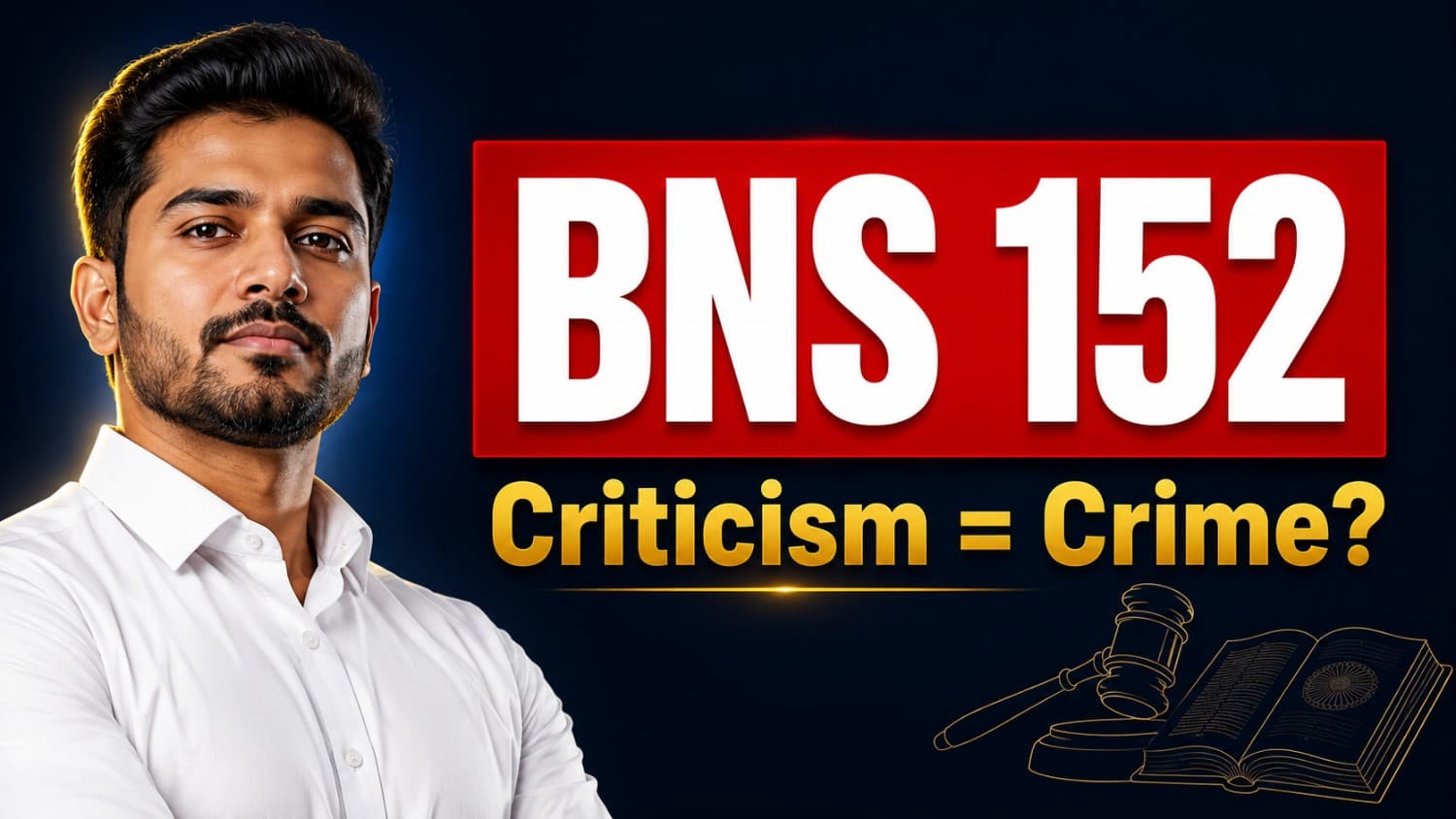
Short answer: Sedition under IPC Section 124A no longer exists, but a similar offence survives as Section 152 of the Bharatiya Nyaya Sanhita (BNS), in force since 1 July 2024. Criticising the government by lawful means is still not a crime: the Explanation to Section 152 expressly protects it.
TL;DR
The colonial sedition law (IPC 124A) was repealed with effect from 1 July 2024 and replaced by Section 152 BNS, "Acts endangering sovereignty, unity and integrity of India."
Lawful criticism of the government is protected. You commit no offence merely by disapproving of a policy, demanding its withdrawal, or campaigning against a law through lawful means.
Section 152 is cognizable and non-bailable, triable only by a Court of Session. Punishment: life imprisonment, or up to seven years, plus fine.
The Supreme Court is hearing constitutional challenges to Section 152 (latest hearings July–August 2026). No provision has been struck down as of 24 August 2026.
What Happened to the Sedition Law?
If you've searched "sedition law India" recently you may have seen conflicting answers. Here is the clear timeline:
May 2022: In S.G. Vombatkere v. Union of India, the Supreme Court put all proceedings under IPC Section 124A (sedition) on hold and asked the Centre to reconsider the provision.
1 July 2024: The IPC itself was replaced by three new codes: the Bharatiya Nyaya Sanhita (BNS), the Bharatiya Nagarik Suraksha Sanhita (BNSS) and the Bharatiya Sakshya Adhiniyam (BSA). The word "sedition" appears nowhere in the new code; its territory now falls under Section 152 BNS.
February to August 2026: Constitutional challenges to Section 152 are being heard by the Supreme Court (details below). Until the Court rules, the section remains in force.
What Exactly Does Section 152 BNS Punish?
Under Section 152, you commit an offence if you purposely or knowingly:
excite or attempt to excite secession (separating territory from India),
excite or attempt to excite armed rebellion,
excite or attempt to excite subversive activities,
encourage feelings of separatist activities, or
otherwise endanger the sovereignty, unity or integrity of India, through spoken words, writing, signs, visible representations, electronic communication, or financial means. Punishment: imprisonment for life, or imprisonment up to seven years, plus fine.
What Is Protected: Your Right to Criticise the Government
This is what most citizens worry about, and Section 152 addresses it directly in its Explanation:
Comments expressing disapprobation of the measures, or administrative or other action of the Government, with a view to obtain their alteration by lawful means, do not constitute an offence. In plain terms, all of this is lawful:
Writing, posting, tweeting, or vlogging that a policy is wrong
Demanding a law's repeal or a minister's accountability
Peaceful protest and campaign against government action
Satire and sharp criticism aimed at change by lawful means What crosses the line is content that excites secession, armed rebellion, subversive activity, or incites violence, not criticism, however harsh. Courts have long read this protection into sedition-type laws. In Kedarnath Singh v. State of Bihar (1962), the Supreme Court held that only speech connected to incitement to violence or public disorder can be punished; disaffection expressed strongly is not enough.
A Real Case Where the Protection Worked
In Tejender Pal Singh v. State of Rajasthan, the Rajasthan High Court quashed an FIR against a Sikh preacher who had been booked under Section 152 over a Facebook video sympathising with a jailed separatist leader. The court held that "purposely or knowingly" requires proof of malicious intent to excite rebellion; mere expression of sympathy is not enough. It is the clearest example yet of courts applying Section 152 narrowly.
Why Section 152 Is Controversial
Constitutional challenges are pending before the Supreme Court (Azad Singh Kataria v. Union of India and batch petitions, including one filed by S.G. Vombatkere). Petitioners argue:
Terms like "subversive activities" and "encourages feelings of separatist activities" are undefined anywhere in the BNS, making the section vaguer than IPC 124A.
The section extends to acts done through financial means, potentially sweeping ordinary transactions into scope.
The exemption for lawful criticism is narrower than the section's breadth.
Unlike IPC 124A, Section 152 carries no judicially written incitement-to-violence threshold on its face. The government's counter-position, accepted verbally by the Court in February 2026: Parliament was not bound by the Centre's 2022 undertaking to reconsider sedition, so the legislature could enact a fresh provision, and its constitutionality is for courts to test.
Supreme Court Challenge: Case Status
Date | Development |
|---|---|
31 Jul / 1 Aug 2026 | CJI-led bench heard Azad Singh Kataria v. UoI challenging Sections 152 BNS, 173(3) and 187(3) BNSS; Court said it will examine the provisions but cautioned against "imaginary apprehensions." |
12 Aug 2026 | Interim protection from arrest granted to journalists facing FIRs citing "acts against unity and integrity." |
21 May 2026 | Old IPC 124A trials allowed to proceed where the accused consents (Kamran-linked clarification). |
28 Feb 2026 | Court observed Parliament is not bound by the Centre's sedition-reconsideration undertaking. |
As of 24 Aug 2026: Section 152 has not been struck down. It remains in force. |
Old Sedition vs Section 152 BNS: Quick Comparison
IPC 124A (old) | BNS Section 152 (current) | |
|---|---|---|
Focus | Hatred/contempt/disaffection toward Government | Sovereignty, unity & integrity of India |
Maximum sentence | Life, or up to 3 years + fine | Life, or up to 7 years + fine |
New elements | None | Subversive activities; electronic communication; financial means |
Protection for criticism | Three Explanations | Explanation retained |
Classification | Cognizable, non-bailable | Cognizable, non-bailable; triable only by Court of Session (BNS First Schedule) |
Status today | Repealed w.e.f. 1 July 2024 | In force; under constitutional challenge |
Your Rights if an FIR Is Filed Under Section 152
Arrest safeguards apply. Police must inform you of the grounds of arrest and produce you before a magistrate within 24 hours (BNSS Sections 35–38). A notice under BNSS Section 35 may precede arrest in eligible cases.
Anticipatory bail can be sought in the Sessions Court or High Court under BNSS Section 482 if you apprehend arrest.
Regular bail lies under BNSS Section 480. Courts consistently grant bail where the material shows criticism rather than incitement. Remember: the offence is non-bailable, but that means bail is discretionary, not impossible.
Quash the FIR at the threshold. If the impugned content plainly amounts to lawful criticism, move the High Court under Article 226 / BNSS Section 528 to quash, as succeeded in Tejender Pal Singh.
Preserve full context. Save the complete post, article, or video. Courts assess the whole content and its intent, not cherry-picked lines.
Do not delete-and-flee. Deletion can be construed adversely; consult a lawyer first.
FAQ
Is sedition still a crime in India?
No. Sedition under IPC Section 124A was repealed with effect from 1 July 2024. Its successor survives as Section 152 of the Bharatiya Nyaya Sanhita, "Acts endangering sovereignty, unity and integrity of India."
Can I be arrested for criticising the Prime Minister or a government policy on social media?
Not lawfully, if your post is criticism or disapproval aimed at change by lawful means; the Explanation to Section 152 protects that. Arrest becomes arguable only where content excites secession, armed rebellion or subversive activity, or incites violence.
Is Section 152 BNS bailable?
No. It is a non-bailable, cognizable offence triable only by a Court of Session. Bail is discretionary, under BNSS Section 480 (regular) or 482 (anticipatory), but courts grant it where the accusation involves criticism rather than incitement.
What is the punishment under BNS Section 152?
Imprisonment for life, or imprisonment up to seven years, plus fine. The alternative maximum is higher than the old sedition law's three years.
Has Section 152 been struck down by the Supreme Court?
Not as of 24 August 2026. Constitutional challenges were heard in July–August 2026 and remain pending. Check the case status table above for the latest development.
Does old sedition case law like Kedarnath Singh still apply to Section 152?
Courts are likely to draw on Kedarnath Singh's incitement-to-violence threshold when interpreting Section 152, because the Explanation preserves a similar safety valve. But this is precisely what the pending challenges will settle.
Which police procedure applies after a Section 152 FIR?
The BNSS governs everything after the FIR: arrest information duties, production before a magistrate within 24 hours (Sections 35–38), anticipatory bail (Section 482), regular bail (Section 480), and quashing (Section 528).
What replaced IPC Section 124A?
Section 152 of the Bharatiya Nyaya Sanhita, 2023, effective 1 July 2024. The word "sedition" was dropped; the substance shifted from "disaffection against government" to "acts endangering sovereignty, unity and integrity."
Sources
Last verified: 24 August 2026 · This page is updated after every Supreme Court hearing in the pending challenges.