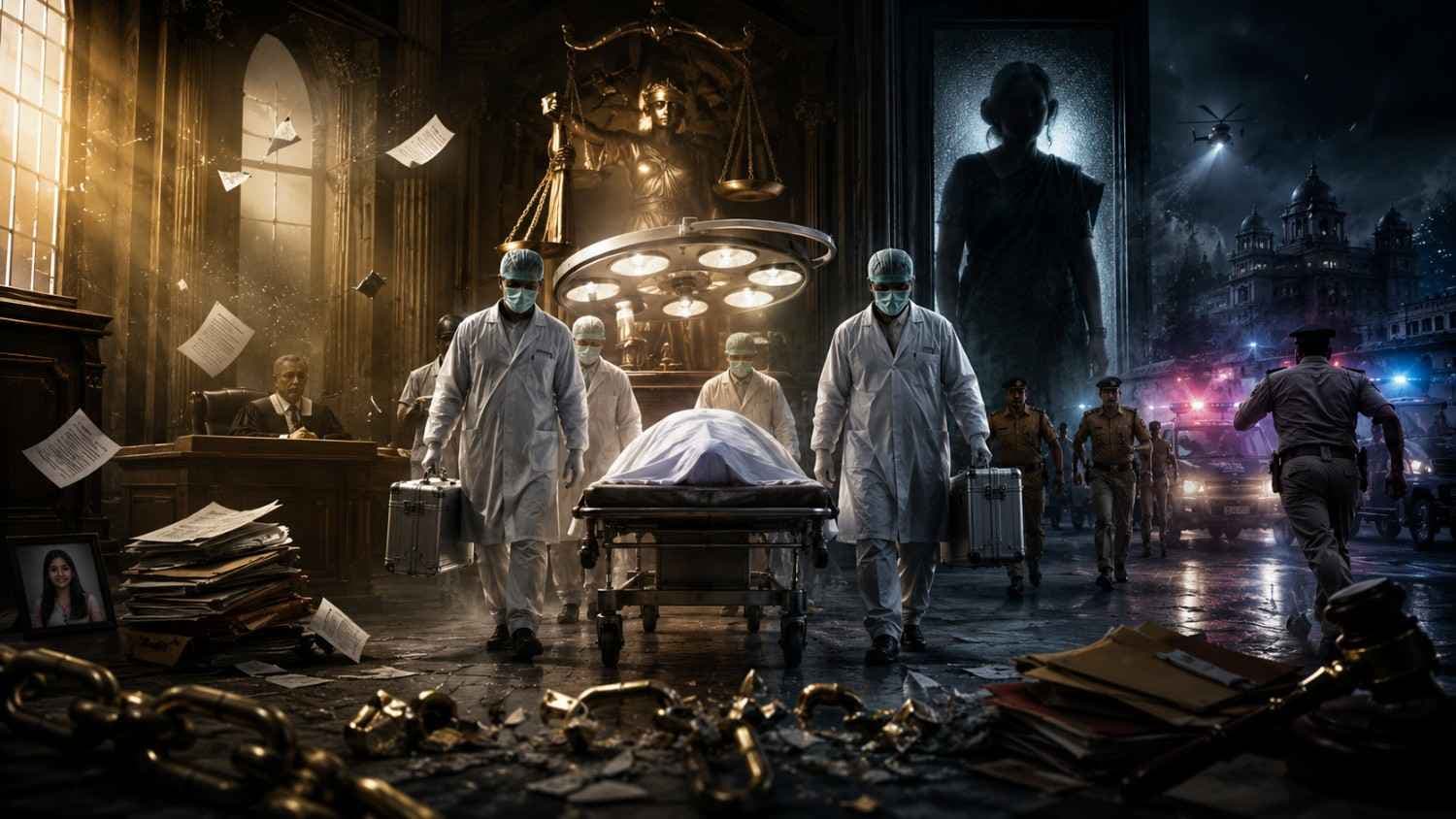
In a stunning and highly significant legal development, the Madhya Pradesh High Court has stepped in to break a critical deadlock that has kept the body of 33-year-old former actor Twisha Sharma in a mortuary freezer for over ten days. Partially setting aside a lower court's jurisdictional refusal, a single-judge bench of Justice Avanindra Kumar Singh has formally ordered a second post-mortem examination. To ensure absolute transparency and erase any lingering doubts of regional administrative tampering, the High Court has directed that a premier medical board from the All India Institute of Medical Sciences (AIIMS), New Delhi, be deployed to conduct the procedure on the ground in Bhopal.
The landmark directive follows a desperate, high-stakes petition moved by Twisha’s father, Navnidhi Sharma, an Indian Army veteran who has been camping in Bhopal seeking a clean investigation. The family had previously faced a severe procedural setback when a local sessions court flatly rejected their plea for a re-autopsy, ruling that it lacked the territorial jurisdiction to send the deceased's body outside state borders to New Delhi. By ordering a special flight to bring the country's top central forensic experts directly to the local facilities in Bhopal, the High Court bypassed the bureaucratic impasse, providing a rare and aggressive blueprint for ensuring judicial transparency in highly sensitive domestic investigations.
The push for a secondary independent examination stems from the severe lack of trust surrounding the initial investigation conducted by local authorities. Twisha's family has openly and repeatedly accused the local police and the original medical team at AIIMS Bhopal of operating under the deep institutional influence of the accused household—noting that Twisha’s mother-in-law, Giribala Singh, is a highly connected retired district judge, while her absconding husband, Samarth Singh, is an established local advocate. The family’s legal counsel highlighted glaring procedural lapses in the first autopsy report, most notably that the primary "ligature material"—the belt allegedly used in the hanging—was never provided to the initial doctors for technical matching before they hastily closed the file as a standard suicide.
The state administration, represented during the emergency high court hearing by Solicitor General Tushar Mehta, chose to actively support the father’s petition for a fresh autopsy. While the state's legal representatives clarified that the government was not explicitly casting aspersions on the clinical competence of the local Bhopal doctors, they emphasized that ordering an elite, external board was absolutely necessary to satisfy the conscience of the court and restore public faith in the integrity of the ongoing probe. The state’s alignment with the grieving family marks a significant shift, especially following a public promise by Madhya Pradesh Chief Minister Mohan Yadav to facilitate a full central investigation if required.
The High Court's aggressive intervention has placed immense logistical pressure on local law enforcement and hospital administrators, who must now coordinate the emergency arrival and forensic setup for the Delhi medical board at the earliest possible hour. The order has also forced a renewed focus on the preservation of the physical evidence, as the local Katara Hills police had recently warned the family that the body was beginning to face severe decomposition risks due to the lack of specialized, ultra-low temperature storage facilities within the state. With the high court's definitive mandate now locked in, forensic teams are working around the clock to protect the integrity of the remains until the central specialists touch down.
While the legal battle over the forensic data intensifies inside the courtroom, the ground-level search for the primary accused has turned into an aggressive multi-state manhunt. The Bhopal Police Commissioner has significantly increased the cash reward and set up six specialized tracking teams to locate Twisha’s husband, Samarth Singh, whose electronic footprints disappeared almost immediately after a local court rejected his anticipatory bail application. Simultaneously, Twisha's family has filed a parallel petition in the High Court seeking the immediate cancellation of the pre-arrest bail granted to the retired judge mother-in-law, accusing her of using her legal freedom to engage in an aggressive media campaign aimed at defaming the deceased and destroying vital electronic call records.
Ultimately, the Madhya Pradesh High Court's extraordinary decision to fly in a team from AIIMS Delhi elevates the Twisha Sharma case into a defining study on institutional accountability. It sends a loud, clear signal across the state’s judicial ecosystem that the family connections or past institutional status of an accused household will not be permitted to dictate the pace or transparency of a criminal investigation. As the country's top forensic minds prepare to re-examine the physical evidence under a national spotlight, the unfolding process moves the case past localized narratives, ensuring that the final determination of how this young life ended will be built on an unassailable foundation of absolute science.