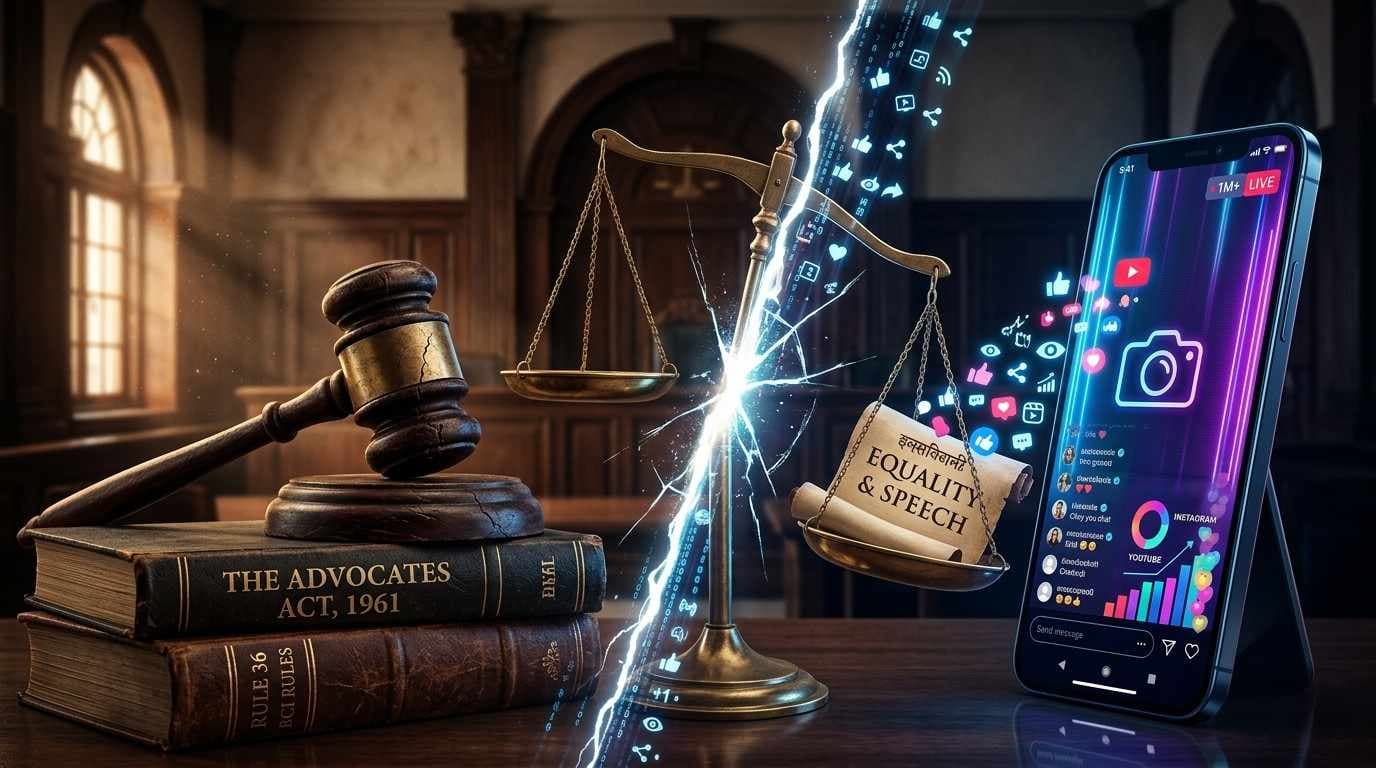
A profound institutional conflict is fracturing the Indian legal fraternity, exposing an unbridgeable gulf between colonial-era professional etiquette and the hyper-connected digital age. The Bar Council of India (BCI) has launched an uncompromising regulatory offensive against what it terms "self-styled legal influencers," issuing severe warnings and demanding that state bar councils initiate immediate disciplinary proceedings under Section 35 of the Advocates Act against practitioners soliciting work online. However, what began as a routine enforcement of professional standards has quickly escalated into a complex constitutional showdown, raising a fundamental question: Can an ancient code of ethics structurally survive in an era where public visibility is entirely inseparable from professional existence?
The foundational architecture of legal ethics in India is rooted in an idealistic, non-commercial philosophy. Formulated under Rule 36 of the Bar Council of India Rules, this traditional framework views advocacy as an elite, noble calling dedicated to public service rather than a standard commercial trade. Rule 36 imposes an absolute prohibition on advocates directly or indirectly advertising their services, soliciting briefs, or inspiring media commentary. The historical rationale behind this restriction was to safeguard the ultimate sanctity of the courtroom, ensuring that a lawyer’s reputation develops organically through intellectual integrity and forensic competence, entirely isolated from market-driven publicity and the vulgarities of commercial canvassing.
However, the rapid democratization of the internet has birthed a massive "attention economy" that directly challenges this cloistered approach. Thousands of young, tech-savvy lawyers have taken to platforms like LinkedIn, YouTube, and Instagram, accumulating millions of followers by translating complex statutory amendments, delivering real-time commentary on landmark judgments, and analyzing high-profile trials. While the BCI frames this phenomenon as a dangerous, commercialized slide toward unauthorized solicitation and algorithmic performance, the digital bar strongly defends it as essential public interest advocacy and legitimate legal literacy, exposing a deep fracture in how the role of a modern lawyer is defined.
This regulatory friction has moved past internal disciplinary boards and directly implicated fundamental constitutional protections. The first major point of legal vulnerability lies within Article 19(1)(a) of the Indian Constitution, which guarantees the fundamental freedom of speech and expression. Modern digital advocates argue that using online platforms to disseminate legal knowledge, debate constitutional policy, and break down systemic corruption forms the absolute core of democratic participation. An overly broad, heavy-handed application of Rule 36 that treats educational legal commentary as disguised commercial advertising acts as a severe form of state-sanctioned digital censorship, chilling essential public discourse.
Furthermore, the BCI’s rigid digital prohibition faces an equally serious challenge under Article 14, which mandates absolute equality before the law. Historically, the traditional legal hierarchy concentrated visibility, prestige, and lucrative corporate briefs within elite, hereditary institutional networks concentrated in metropolitan high court corridors. Digital platforms, despite their algorithmic excesses, have radically disrupted this monopoly, providing a powerful, cost-effective avenue for first-generation lawyers, women practitioners, and advocates from tier-2 and tier-3 cities to showcase their domain expertise to a national audience. Blanket restrictions on digital participation threaten to artificially preserve an exclusive, exclusionary hierarchy, disproportionately penalizing those who lack access to conventional old-boy networks.
The judiciary has already signaled its growing impatience with the wild-west nature of online legal marketing, heavily driving the BCI's current defensive stance. In landmark directives, the Madras High Court categorically denied online aggregator platforms safe-harbor protections under Section 79 of the IT Act for facilitating prohibited legal listings, firmly reminding the fraternity that the commodification of legal services compromises the integrity of justice. Yet, as regulatory bodies issue warnings targeting everything from law firm videos featuring mainstream celebrities to local practitioners setting up promotional banners at public gatherings, the enforcement mechanism is increasingly criticized for treating a systemic technological shift as a mere disciplinary aberration.
Ultimately, the escalating warfare between the Bar Council of India and the attention economy cannot be resolved through a simplistic, binary choice between preserving institutional decorum and unleashing unrestricted commercialization. The ongoing digital transformation of the public square is entirely irreversible. The true constitutional and ethical challenge ahead lies in constructing a modern, nuanced regulatory framework that possesses the sophistication to target genuine commercial exploitation, predatory solicitation, and the spread of legal misinformation without criminalizing digital visibility itself, ensuring that the nobility of the bar does not become synonymous with institutional exclusion.