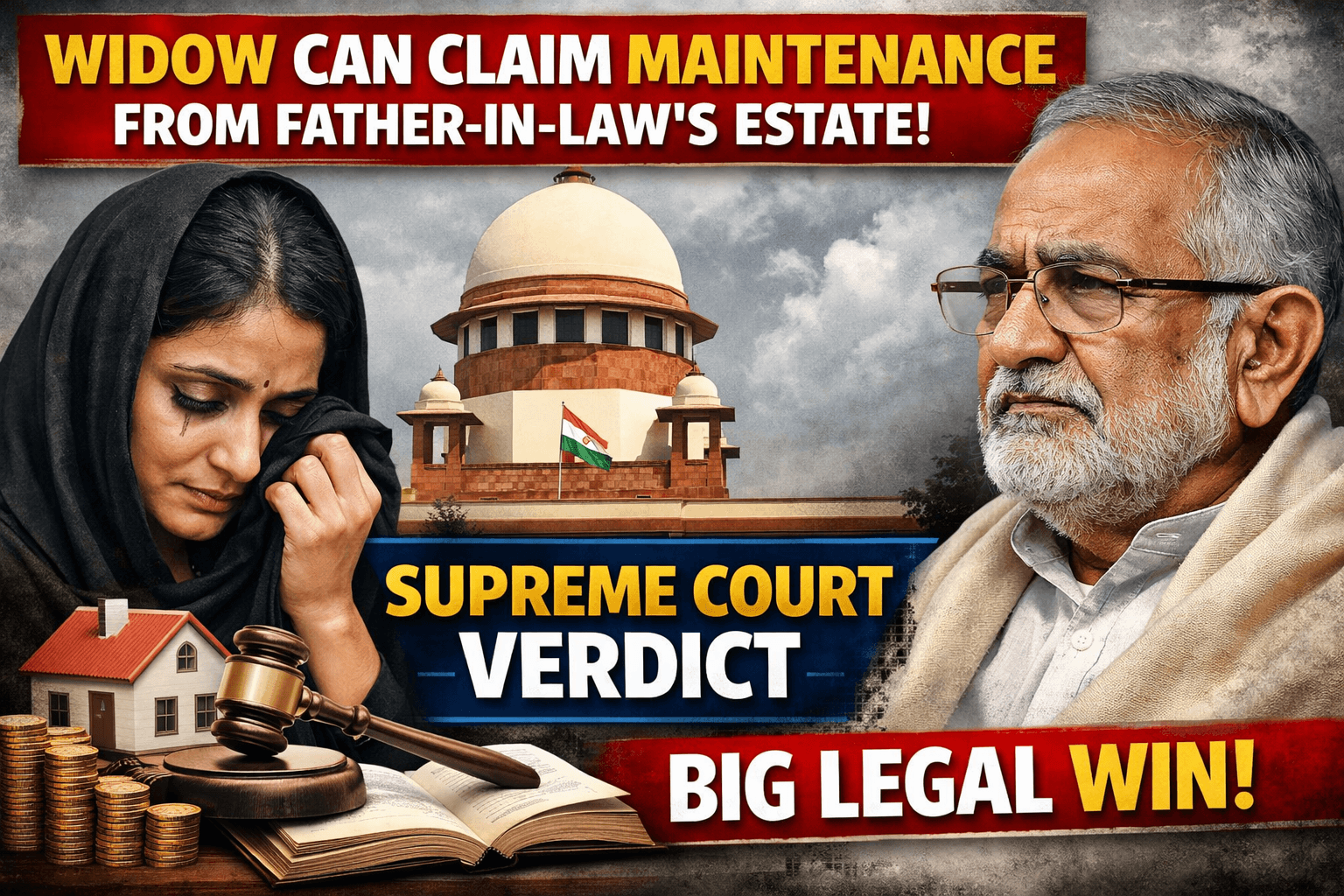
In a significant judgment that reinforces the social security net for vulnerable women, the Supreme Court of India has held that a Hindu widowed daughter-in-law is entitled to seek maintenance from the estate of her deceased father-in-law.
The Court observed that denying such a claim based on a narrow or technical reading of the law would lead to destitution and social marginalization, violating her fundamental right to live with dignity under Article 21 of the Constitution.
A Bench comprising Justices Pankaj Mithal and S.V.N. Bhatti was dealing with a crucial legal question: Whether a daughter-in-law who becomes a widow after the death of her father-in-law can be treated as a "dependant" and claim support from his inherited property?
The case arose from a family dispute following the death of Dr. Mahendra Prasad. One of his sons, Ranjit Sharma, passed away after Dr. Prasad’s demise. When Ranjit’s widow, Geeta Sharma, sought maintenance from her father-in-law's estate, the Family Court initially rejected her plea. The court reasoned that she wasn't a widow when the father-in-law died, and therefore couldn't be called a "dependant" on his estate. However, the High Court reversed this, leading to the appeal in the Supreme Court.
The Supreme Court focused its analysis on the Hindu Adoptions and Maintenance Act, 1956 (HAMA). Specifically, it looked at Section 21, which defines who qualifies as a "dependant" of a deceased Hindu.
The Bench noted that Section 21(vii) explicitly lists "any widow of his son" as a dependant. The Court highlighted two critical points:
- No Restrictive Language: The law does not use the word "predeceased" before "son." This means the legislature intentionally included any widow of a son, regardless of whether her husband died before or after the father-in-law.
- Clear Mandate: The definition is clear and unambiguous. Courts cannot "add or subtract" words to change the meaning of a statute when the plain language is simple.
The Bench took a strong stand on constitutional grounds, stating that classifying widows into two categories—those whose husbands died before the father-in-law and those whose husbands died after—would be "manifestly unreasonable and arbitrary."
“In both situations, the women are similarly placed, having suffered widowhood, being without spousal support, and facing comparable financial vulnerability,” the Court remarked.
Denying maintenance based on such a "fortuitous circumstance" would violate the guarantee of equality under Article 14. Furthermore, the Court emphasized that the Right to Life (Article 21) includes the right to basic sustenance. A technical interpretation that leaves a woman in destitution would be a failure of social justice.
The Court also touched upon traditional Hindu values, referring to the Manu Smriti. The ancient text states that "no mother, father, wife or son should be forsaken." The Bench noted that this underscores the moral and legal duty of a family head to support female members.
The Court clarified the distinction between two key sections of the Act:
- Section 19: Governs the maintenance of a widowed daughter-in-law by the father-in-law during his lifetime.
- Section 22: Governs the maintenance of dependants from the estate after the father-in-law’s death.
The Bench held that even if a son dies after the father-in-law, his widow remains a "dependant" of the father-in-law’s estate if she cannot maintain herself from her husband’s or children’s resources.
The Supreme Court dismissed the appeals and upheld the High Court’s decision. It ruled that Geeta Sharma’s petition for maintenance was maintainable. The Family Court has now been directed to decide the case on its merits and determine the appropriate amount of maintenance.
Case Title: Kanchana Rai Vs Geeta Sharma & Ors
Judgment Date: January 13, 2026
Bench: Justices Pankaj Mithal and S.V.N. Bhatti
This article is intended for informational purposes and provides a summary of the legal principles established by the Hon'ble Supreme Court.