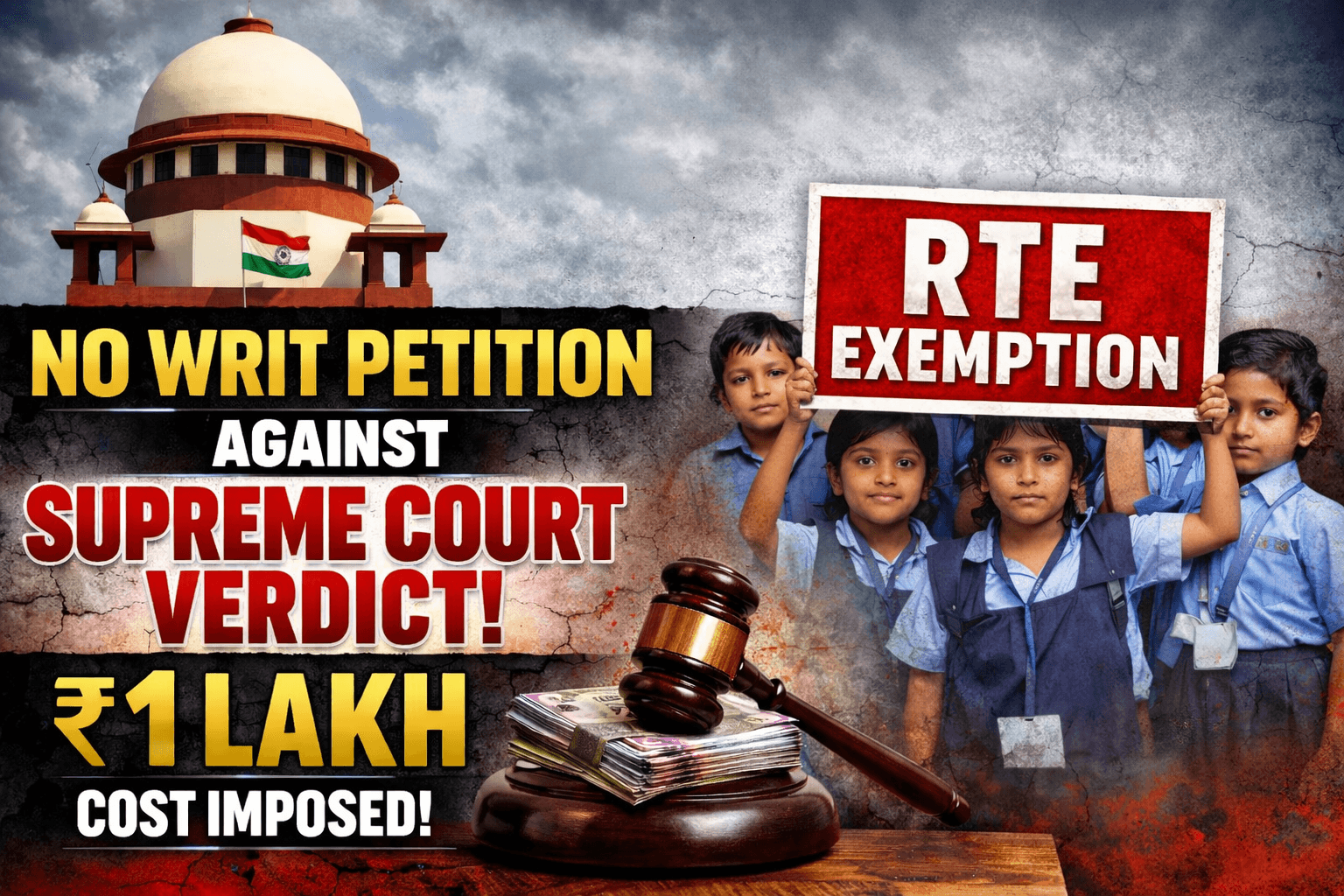
New Delhi: The Supreme Court of India has once again clarified a fundamental principle of judicial finality: no writ petition can be filed to challenge or "undo" a judgment previously delivered by the Supreme Court itself.
Terming such a legal attempt as the "grossest abuse of the process of law," a Bench of Justices B.V. Nagarathna and R. Mahadevan dismissed a petition that sought to challenge the exemption granted to minority schools from the Right to Education (RTE) Act—a matter already settled by a Constitution Bench in 2014.
To deter such "wholly impermissible" litigation, the Court imposed a cost of ₹1,00,000 (Rupees One Lakh) on the petitioner organization, United Voice for Education Forum.
The petitioner had approached the Apex Court under Article 32 of the Constitution (which allows citizens to move the Supreme Court for the enforcement of Fundamental Rights).
The organization specifically sought a Writ of Mandamus to declare that the exemption of minority educational institutions from the Right of Children to Free and Compulsory Education (RTE) Act, 2009, was unconstitutional.
However, this exact legal issue had already been decided by a five-judge Constitution Bench in the landmark case of Pramati Educational and Cultural Trust vs. Union of India (2014). In that case, the Supreme Court had upheld the validity of the 93rd Constitutional Amendment, which excluded minority institutions from the purview of the RTE Act to protect their rights under Article 30 (Right of minorities to establish and administer educational institutions).
The United Voice for Education Forum raised the following arguments and requests:
- Challenging Immunity: It argued that the Pramati judgment granted "blanket immunity" to minority schools, which it claimed was unconstitutional.
- Regulatory Compliance: It sought a direction that all minority institutions, whether aided or unaided by the government, should comply with Section 12(1)(c) of the RTE Act (which mandates 25% reservation for children from economically weaker sections).
- Expert Committee: It requested the Court to form an Expert Committee to find a balance between the rights of minorities (Article 30) and the State’s obligation to provide free education (Article 21A).
Upon examining the petition, the Bench was quick to note that the prayers were not merely seeking a new direction but were effectively asking the Court to set aside its own earlier judgment through a fresh writ petition.
The Court observed:
"In substance, the petitioner is seeking to undo a judgment of this Court by filing a writ petition which is wholly impermissible in law. As against the judgment of the Supreme Court, no writ petition is maintainable."
The Bench emphasized that allowing such petitions would undermine the finality of judicial decisions and create an endless loop of litigation. By labeling the filing as the "grossest abuse of the process of law and of this Court," the judges signaled that the judicial time of the highest court cannot be wasted on settled issues through improper channels.
While dismissing the petition, the Court directed the petitioner to pay ₹1,00,000 to the Supreme Court Legal Services Committee within four weeks.
Interestingly, the Court also noted that such an act could have invited contempt of court proceedings. However, the Bench chose to be lenient in that specific regard, stating:
"We restrain ourselves from issuing any notice to the petitioner with regard to any contempt proceedings that could have been initiated as against the petitioner herein."
In the Indian legal system, the Supreme Court is the final arbiter. Once a judgment is delivered, the primary remedy available to an aggrieved party is a Review Petition under Article 137. If the Review is dismissed, in rare circumstances involving a gross miscarriage of justice, a Curative Petition can be filed as per the guidelines in Rupa Ashok Hurra vs. Ashok Hurra (2002).
However, filing a fresh Writ Petition under Article 32 to challenge a previous judgment is legally barred. This is because the Supreme Court, acting as a judicial body, does not fall under the definition of "State" while performing judicial functions, and one cannot seek a writ against the "Court" itself to quash its own decree.
This order serves as a stern reminder to litigants and legal practitioners that the hierarchy and finality of the Supreme Court must be respected. By imposing a heavy cost, the Court has sent a clear message: experimental litigation that seeks to re-open settled constitutional law through improper procedural routes will not be tolerated.
Case Title: United Voice for Education Forum Vs Union of India & Ors.
Writ Petition (Civil) No: 1194/2025
Date of Order: December 12, 2025
Bench: Justice B.V. Nagarathna and Justice R. Mahadevan