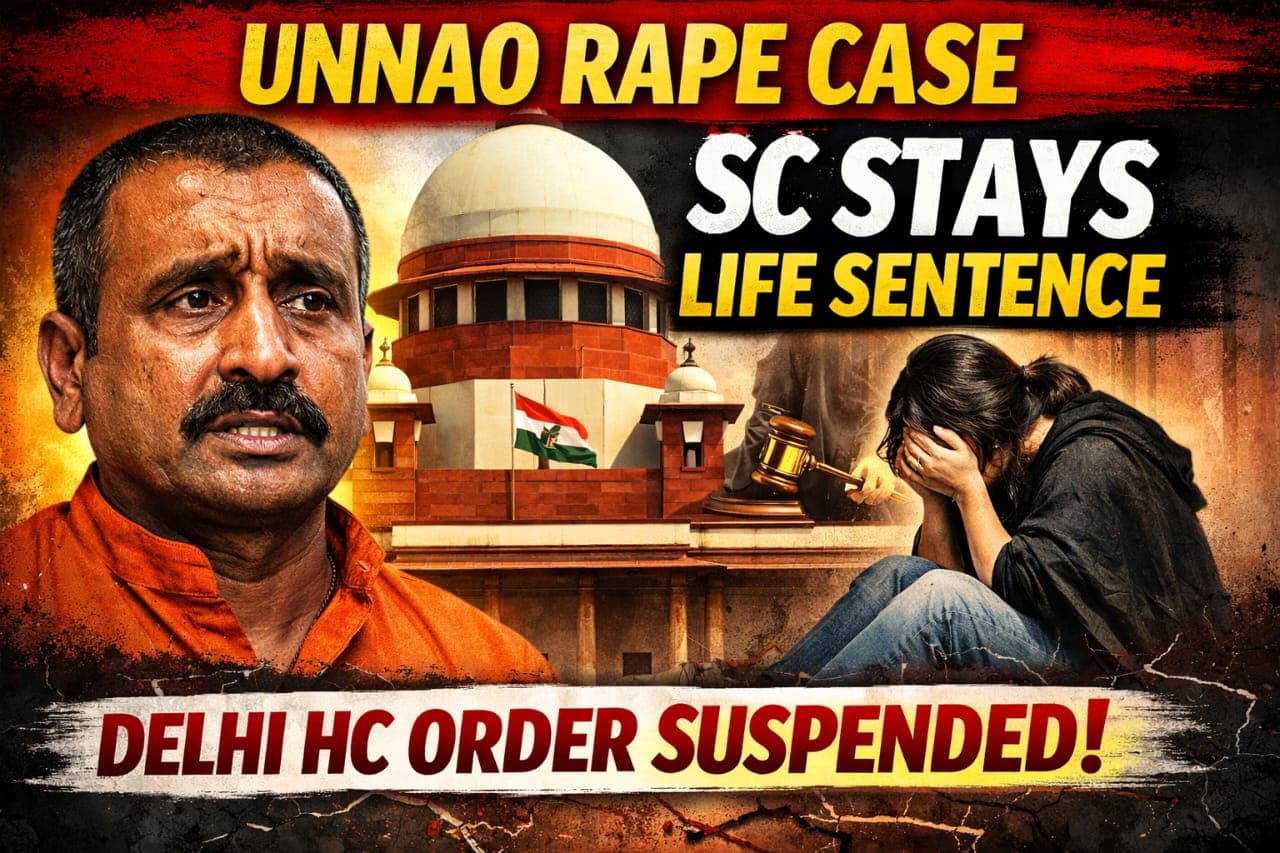
In a significant development during the winter vacation, the Supreme Court of India has stayed the Delhi High Court’s order that had suspended the life imprisonment sentence of former Uttar Pradesh MLA Kuldeep Singh Sengar. Sengar was convicted in the 2017 Unnao rape case, a matter that had sparked nationwide outrage regarding the safety of minors and the accountability of powerful public officials.
A special vacation bench, led by the Chief Justice of India (CJI) Surya Kant, and including Justices J.K. Maheshwari and Augustine George Masih, passed this interim order on Tuesday. The bench emphasized the gravity of the offence and raised critical legal questions regarding the interpretation of the Protection of Children from Sexual Offences (POCSO) Act.
Kuldeep Singh Sengar, a former influential politician from Uttar Pradesh, was convicted in December 2019 by a Delhi trial court. The court found him guilty of raping a minor girl and committing aggravated penetrative sexual assault. Under the POCSO Act and the Indian Penal Code (IPC), he was sentenced to life imprisonment. At the time of sentencing, the trial court noted that there were no "mitigating circumstances" to favor Sengar, highlighting that as a public servant, he had betrayed the immense trust placed in him by the public.
However, on December 23, 2025, a Division Bench of the Delhi High Court, comprising Justices Subramonium Prasad and Harish Vaidyanathan Shankar, granted Sengar a "suspension of sentence" under Section 389(1) of the Code of Criminal Procedure (CrPC). This effectively meant Sengar could be released on bail while his appeal against the 2019 conviction was still being heard.
The High Court’s rationale was based on a technical interpretation: the bench ruled that Sengar could not be categorized as a "public servant" under specific sections of the POCSO Act or the IPC for the purpose of this case. This decision led to an immediate challenge by the Central Bureau of Investigation (CBI) and the victim’s legal team in the Supreme Court.
During the special hearing, Solicitor General (SG) Tushar Mehta, representing the CBI, launched a strong argument against the High Court’s decision. He described the incident as a "horrific case of rape of a child" and reminded the bench of the extreme gravity of the crime.
"There is no doubt that he is convicted for rape," SG Mehta told the Bench. He argued that the law regarding sexual offences against children had been strengthened to provide a minimum of 20 years or life imprisonment. He further contended that letting a convict walk free while his appeal is pending—especially in a case involving such depravity—undermines the entire justice system and the severity of the law.
A central point of discussion was whether Sengar’s status as an MLA at the time of the crime added "aggravated" weight to the offence. CJI Surya Kant asked whether the concept of a "public servant" under the POCSO Act is relevant when the victim is a minor.
SG Mehta replied in the affirmative, explaining that while penetrative sexual assault is a standalone crime, the law treats it more severely when the offender is in a position of power or dominance over the victim, such as a public servant or a police officer. He urged the Supreme Court to adopt a "contextual and purposive interpretation" of the law, suggesting that the definitions of a public servant in the IPC should be applied harmoniously with the POCSO Act to ensure that powerful individuals do not escape the harshest penalties.
After hearing the detailed submissions, the Supreme Court bench expressed its inclination to intervene. CJI Surya Kant noted, "Tentatively, we are inclined to stay the suspension of sentence of Kuldeep Singh Sengar."
The Court officially stayed the Delhi High Court’s December 23 order, ensuring that Sengar remains in prison. The bench noted that there is a significant "legal issue that needs consideration" regarding how public servants are treated under the POCSO framework.
SG Mehta emphasized the emotional and moral weight of the case, stating, "I urge my lordships to stay the order. We are answerable to the child who was 15 years old."
In a notable turn during the proceedings, Senior Advocates N. Hariharan and Siddharth Dave, representing Sengar, brought to the court’s attention that the High Court judges who granted the bail were being targeted online. They reported that photos of Justice Subramanium Prasad and Justice Harish Vaidyanathan were being circulated with malicious captions, urging the public to "identify" them.
The Solicitor General, despite being the party that "lost" the argument at the High Court level, came out in strong defense of the judges. He described them as "brilliant judges with unimpeachable integrity" and "some of the finest in the country."
SG Mehta stated:
"Any attempt to malign these two judges must be strongly condemned. There are always some elements who attempt to browbeat honest judges. Such devious forces must not be encouraged."
CJI Surya Kant echoed these concerns, calling the social media behavior "very unfortunate" and warning that people should not try to "browbeat the system" for political advantage.
The Supreme Court also clarified that the rape survivor has a statutory right to file her own Special Leave Petition (SLP) against the High Court’s order. The bench ensured that the victim would not be left without support, stating that the Supreme Court is available to provide free legal aid if needed, or she may continue with her own counsel.
This ensures that the victim's voice remains central to the proceedings, even as the state (through the CBI) leads the primary challenge.
The Supreme Court has issued a formal notice to the parties involved to further examine the legal questions raised. For now, the "stay" means that the Delhi High Court's decision to let Sengar out of prison is on hold. Kuldeep Singh Sengar will remain in custody while the apex court decides whether the High Court’s interpretation of the law was correct.
This case continues to be a landmark in Indian legal history, testing the limits of judicial discretion in suspending sentences for heinous crimes and defining the accountability of public officials under the POCSO Act.
Case Details:
- Case Title: CBI Vs Kuldeep Singh Sengar and Anr.
- Bench: CJI Surya Kant, Justice J.K. Maheshwari, and Justice Augustine George Masih
- Date of Hearing: December 29, 2025