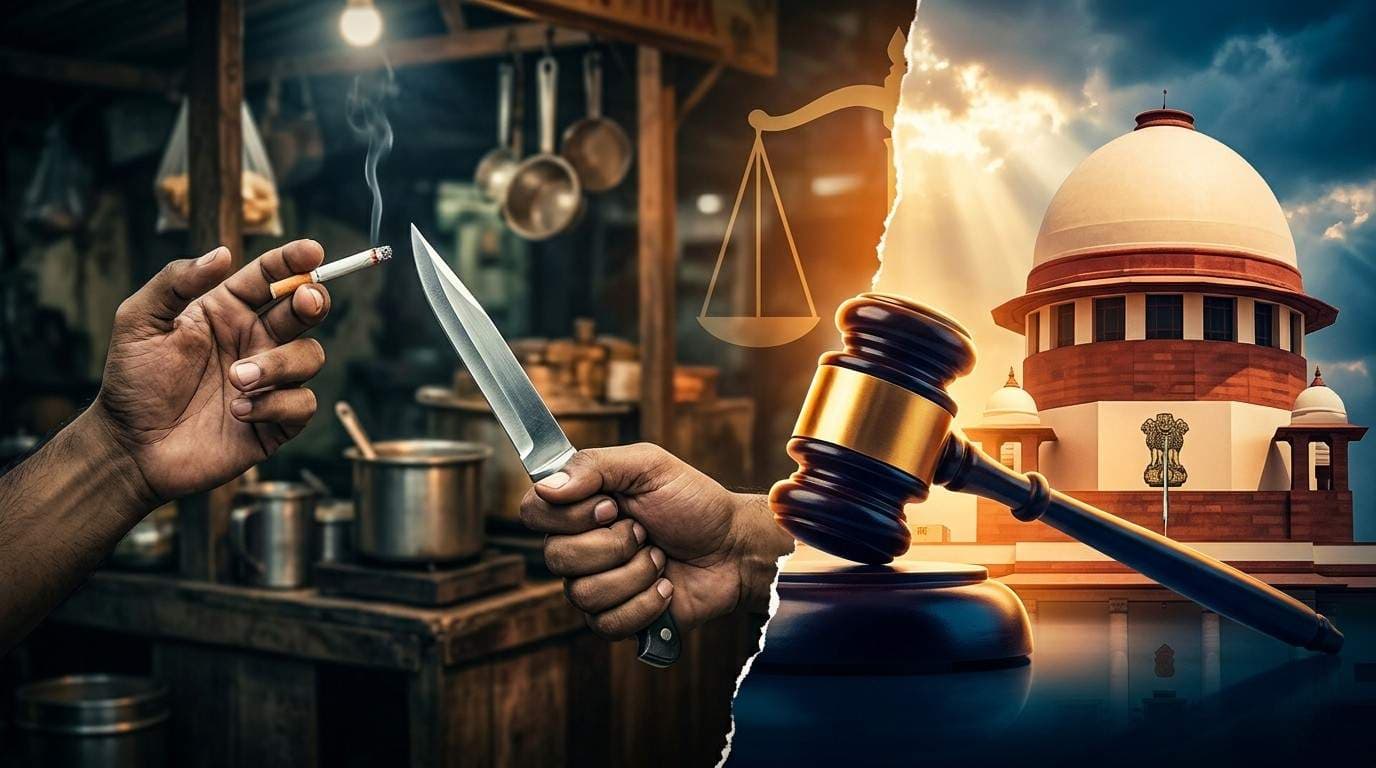
The Supreme Court of India has once again reinforced the strict boundaries of the "sudden provocation" defense in a case that began with a trivial dispute over a lit cigarette. By upholding the murder conviction of a man who stabbed a tea stall owner to death, the apex court has sent a powerful message: the law will not tolerate extreme violence as a response to minor social frictions. This judgment serves as a sobering reminder that the sanctity of life far outweighs momentary flashes of temper in the eyes of the judiciary.
The tragedy unfolded at a local tea stall, where a seemingly minor disagreement escalated into a fatal encounter. The appellant had argued that the act was committed in the heat of the moment, seeking to have his charge downgraded from murder to culpable homicide not amounting to murder. However, the Court meticulously dissected the timeline of events, concluding that the nature of the weapon used and the vital parts of the body targeted indicated a clear intent to cause death or bodily injury sufficient to cause death.
Central to the Court’s reasoning was the distinction between a "sudden fight" and an "intentional attack." For a crime to be mitigated under the exceptions of Section 300 of the Indian Penal Code, the provocation must be both grave and sudden enough to deprive a person of self-control. In this instance, the Bench found that a row over a cigarette did not meet the legal threshold of "grave provocation" that would justify or explain the use of a lethal weapon against an unarmed vendor.
The judgment emphasizes that the proportionality of the response is a key factor in determining criminal liability. Stabbing an individual over a verbal spat is viewed by the law as a disproportionate and malicious act. By upholding the life sentence, the Supreme Court has protected the principle that the law must act as a deterrent against the culture of casual violence that often erupts in public spaces over insignificant issues.
Furthermore, the Court relied heavily on the consistency of eyewitness testimonies and medical evidence. The forensic reports confirmed that the injuries were not accidental or superficial but were delivered with enough force to be fatal. This technical clarity allowed the Bench to dismiss the plea for leniency, reinforcing the idea that when evidence clearly points to a murderous intent, the legal consequences must be absolute and uncompromising.
This ruling also provides vital clarity for trial courts and High Courts dealing with similar "heat of the moment" pleas. It establishes that the "lit cigarette" row was merely a precursor to the crime, not a legal shield for the perpetrator. The judiciary's refusal to categorize this as a lesser offense ensures that the gravity of taking a human life is not diluted by the circumstances of a petty argument.
Beyond the legal technicalities, the decision stands as a testament to the pursuit of justice for the victim. The tea stall owner, a common citizen earning a livelihood, was protected posthumously by a legal system that refuses to overlook the brutality of his end. It reaffirms the social contract where the state promises that those who resort to lethal violence will face the full extent of the law, regardless of how "sudden" they claim their anger was.
In conclusion, the Supreme Court’s affirmation of the murder conviction is a victory for the rule of law over impulsive brutality. It draws a firm line in the sand, stating that personal irritation or minor disputes can never serve as a license to kill. As this case closes, it leaves behind a significant legal precedent: in the balance between a moment of rage and the permanence of death, the law will always weigh heavily in favor of the victim’s right to life.