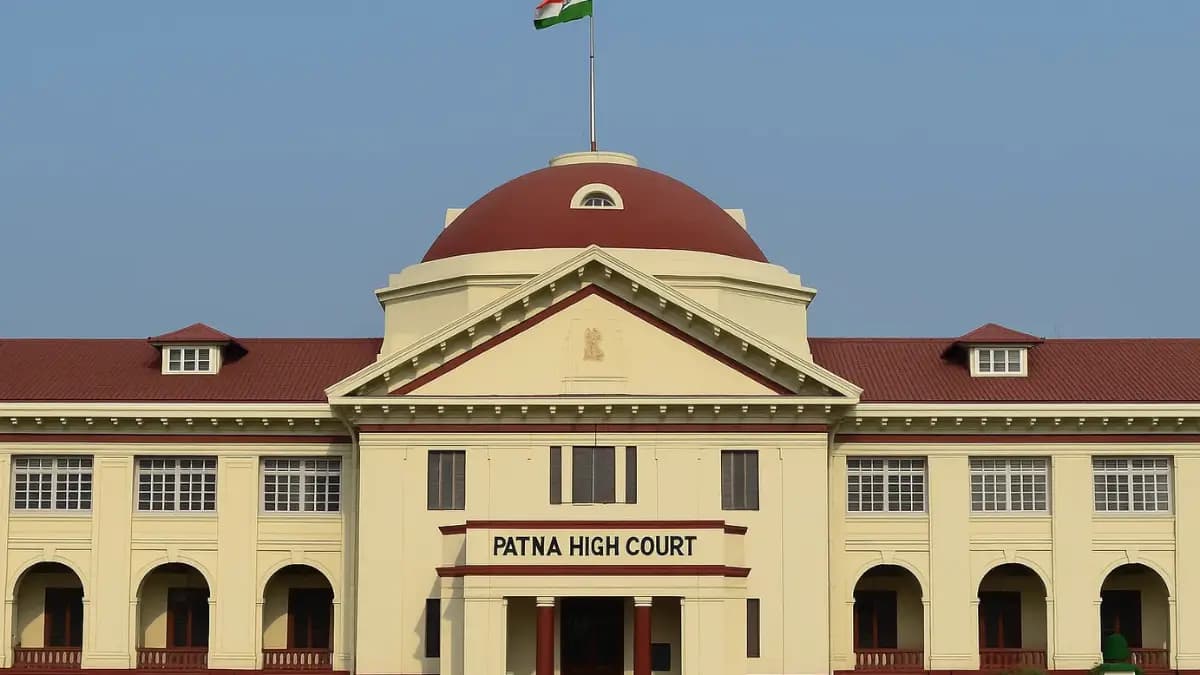
The appellant, Meghnath Choupal @ Medhnath Choupal Sharma, was convicted by the Additional Sessions Judge, Madhepura, for the offences punishable under Sections 302 and 34 of the Indian Penal Code and Section 27 of the Arms Act. The conviction arose from an incident on 22 July 2014, when the informant and his son were allegedly intercepted by a group of persons on motorcycles while returning home after attending the last rites of a relative. According to the prosecution, the appellant fired a shot at the informant’s son on the instruction of another accused, causing the victim’s death from a gunshot injury.
The trial court relied principally on the testimony of a solitary eye‑witness to record a finding of guilt, holding that a conviction could be sustained on the evidence of a single witness if found reliable. The appellant preferred a criminal appeal before the Patna High Court challenging the judgment of the trial court.
Observations of the High Court
A Division Bench comprising Justice Bibek Chaudhuri and Justice Rana Vikram Singh took up the appeal. Before examining the merits, the Bench made a preliminary observation that the present appeal constitutes a classic example of improper, lackadaisical and indifferent investigation on the part of the Investigating Officer, which left material lacunae in the prosecution case.
The Court noted that the informant, who had lodged the First Information Report as an eye‑witness, did not support the prosecution case during the trial and did not implicate the appellant. Despite this, the prosecution did not declare the informant hostile. The Bench further examined the testimony of the prosecution’s alleged eye‑witness and found material contradictions between his examination‑in‑chief and cross‑examination, concluding that his evidence could not be regarded as of sterling quality. Consequently, the High Court held that the conviction could not be sustained solely on such evidence.
Regarding the seizure of articles, the Bench observed that the Investigating Officer had recovered a motorcycle, a Samsung mobile phone and an empty cartridge from the scene of occurrence. However, the Officer failed to ascertain the ownership of either the motorcycle or the mobile phone. Moreover, the recovered empty cartridge was never sent for forensic examination to determine whether it had been fired from the weapon allegedly used in the offence. The Court remarked that these were primary duties of the Investigating Officer in a case of this nature and that the omission either reflected ignorance of basic investigative principles or a purposeful withholding of evidence that could have benefited the accused.
The Bench also pointed out procedural irregularities in the handling of the seizure list. The witnesses who had purportedly signed the seizure list were not confronted with their signatures during trial. One witness deposed that he had signed a blank paper at the instance of the Investigating Officer. Such conduct, in the view of the Court, further undermined the reliability of the prosecution evidence.
Operative Outcome
Having found that the prosecution had failed to establish the guilt of the appellant beyond reasonable doubt, the High Court set aside the conviction and sentence imposed by the trial court and allowed the appeal. The appellant was acquitted of the charges.
Taking serious note of the deficiencies in the investigation, the Court directed that an inquiry be initiated against the Investigating Officer for the lapses identified. The order expressly states that the inquiry should examine the Officer’s conduct in relation to the failure to establish ownership of seized articles, the omission to send the empty cartridge for forensic analysis and the irregularities concerning the seizure list signatures.
Implications
The judgment underscores the obligation of investigating agencies to adhere to fundamental investigative procedures, particularly in cases involving offences under the Indian Penal Code and the Arms Act. It reinforces the principle that a conviction cannot be based on unreliable or contradictory eyewitness testimony, especially when the prosecution does not treat a hostile witness appropriately. The direction for an inquiry against the Investigating Officer serves as a reminder that investigative shortcomings can attract judicial scrutiny and may lead to departmental proceedings.
The case, titled Meghnath Choupal @ Medhnath Choupal Sharma v. State of Bihar, bears the case number Criminal Appeal (DB) No. 762 of 2018. The appearance for the appellant was Mr. Amarnath Jha and for the respondent Mr. Abhimanyu Sharma. The order of the Division Bench reflects a careful appraisal of the evidence and a commitment to safeguarding the rights of the accused against flawed investigations.