Introduction
In a key ruling interpreting India’s new criminal procedure framework, the Supreme Court of India on Wednesday dismissed a constitutional challenge to provisions of the Bharatiya Nagarik Suraksha Sanhita, 2023 (BNSS) that permit judicial officers to be appointed as Directors of Prosecution.
A Bench comprising Chief Justice Surya Kant, Justice Joymalya Bagchi, and Justice Vipul M. Pancholi held that the plea lacked legal foundation and clarified that the law merely prescribes eligibility, not simultaneous exercise of judicial and prosecutorial powers.
What Was Challenged
The petition questioned the constitutional validity of Section 20(2)(a) and 20(2)(b) BNSS, which allow:
- A person with 15 years’ advocacy experience or who is/has been a Sessions Judge to become Director or Deputy Director of Prosecution
- A person with 7 years’ practice or a First Class Magistrate to become Assistant Director of Prosecution
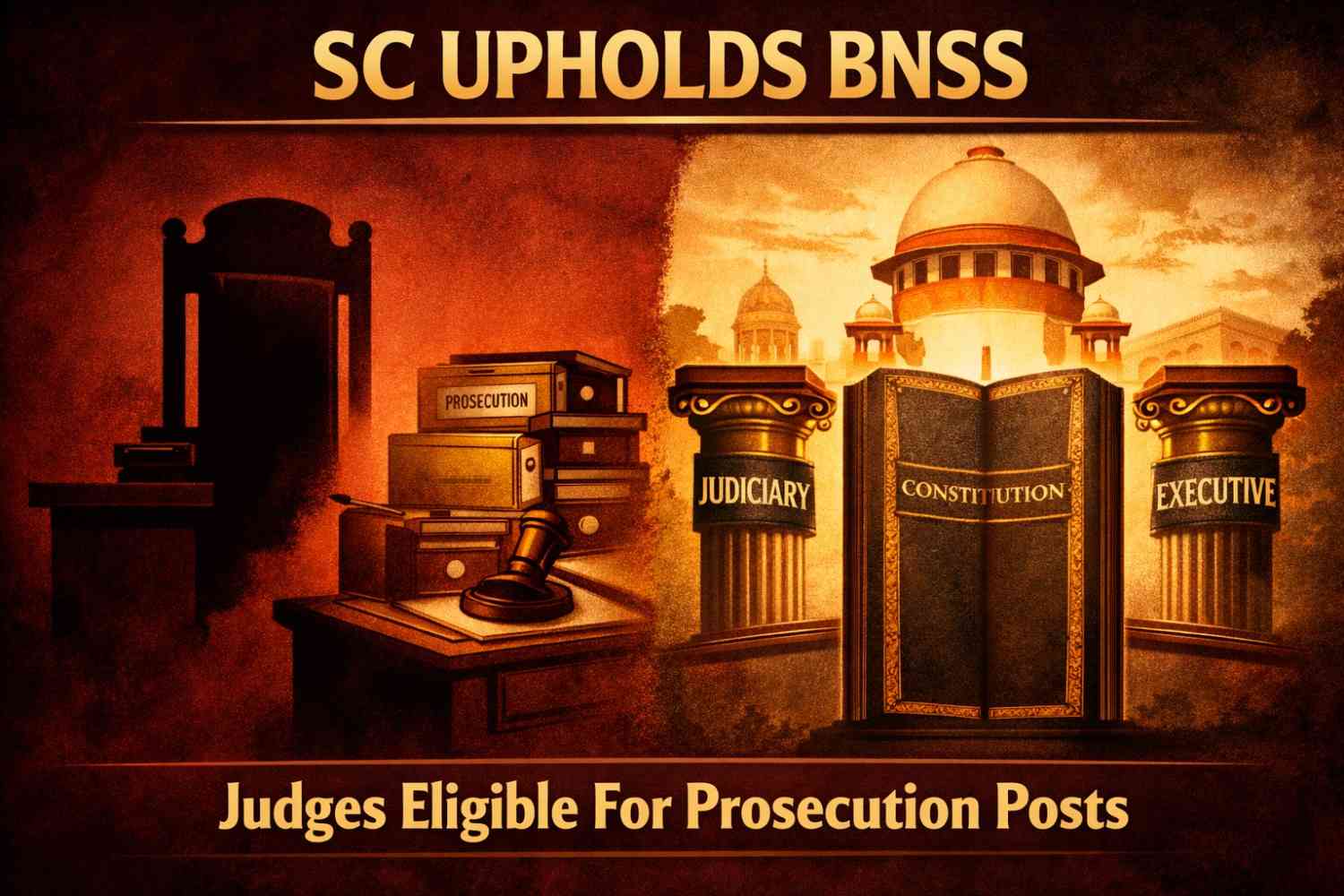
The petitioner argued the provision violated Article 50 of the Constitution — the directive principle mandating separation between judiciary and executive — and allegedly weakened prosecutorial independence and fair trial guarantees under Articles 14 and 21.
Court’s Reasoning
The Bench firmly rejected the argument that the provision merges judicial and executive powers.
“The misconceived challenge has no legal foundation.”
The Court explained that the statute only creates an eligibility criterion. A judicial officer does not function simultaneously as judge and prosecutor.
“The only requirement is that at the same time you should not be a judge and a prosecutor.”
The judges further observed that former judicial officers may even strengthen prosecution quality due to their experience in criminal adjudication.
“What is wrong if a person who has been a Sessions Judge is considered eligible? He is better qualified than a lawyer with fifteen years’ experience.”
Justice Bagchi clarified that the wording “is or has been” must be read as qualification — not current dual office holding.
Separation of Powers Argument Rejected
The Court held that apprehensions of institutional overlap were speculative.
The BNSS framework does not transfer adjudicatory power to the executive — it only broadens the pool of qualified candidates for prosecutorial leadership.
Thus, the doctrine of separation of powers remains intact so long as a serving judge does not simultaneously perform prosecutorial duties.
This ruling is one of the first major constitutional interpretations of the BNSS, India’s replacement for the Code of Criminal Procedure.
Key implications:
- Strengthens professionalisation of prosecution departments
- Recognises judicial experience as valuable in criminal administration
- Clarifies limits of Article 50 in service eligibility matters
- Prevents blanket challenges to structural reforms in new criminal laws
The judgment signals judicial endorsement of the new criminal law architecture — and confirms that administrative reforms will not be struck down merely on theoretical institutional concerns.
In short, the Court drew a line between eligibility and functional overlap — and upheld reform without compromising constitutional balance.