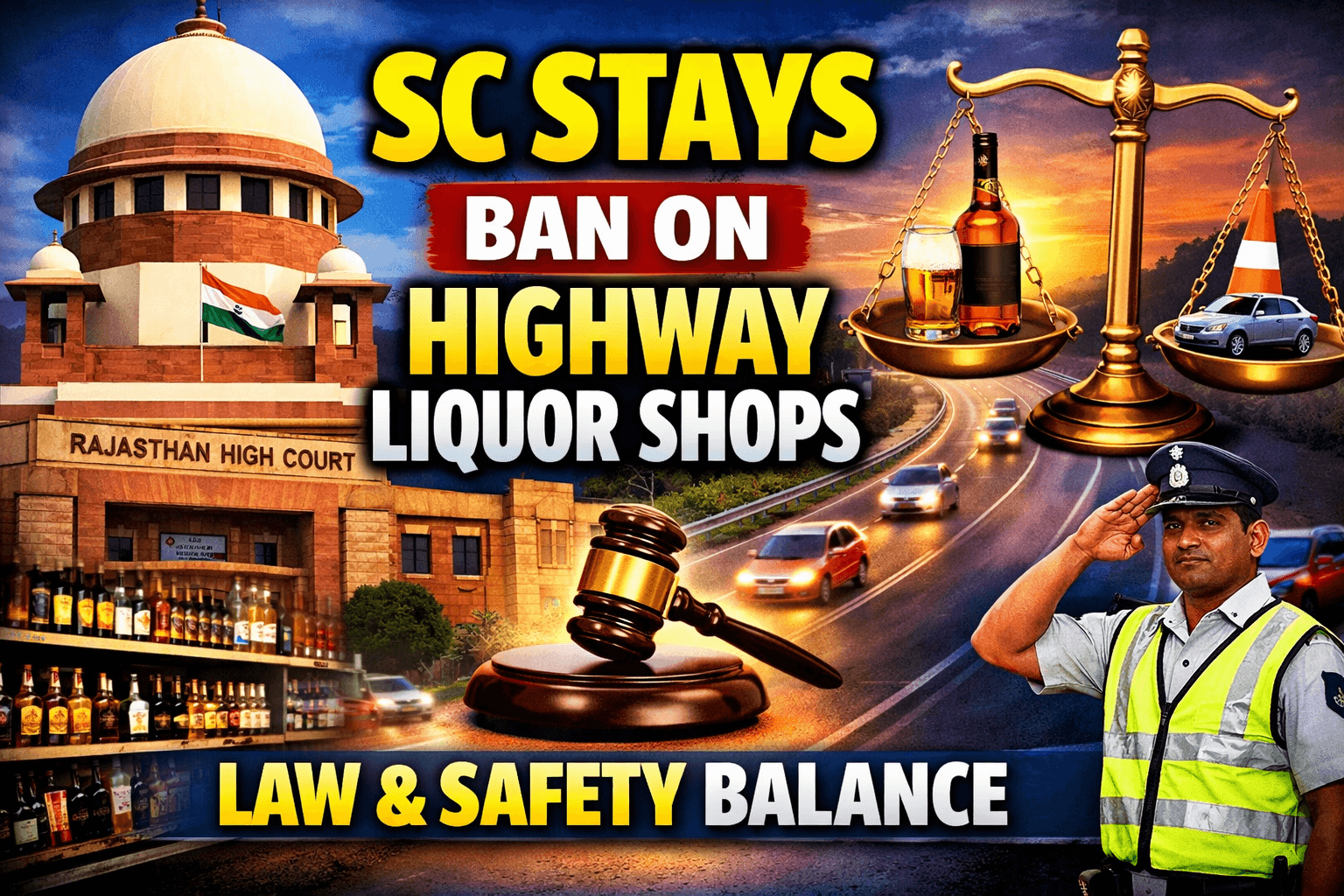
In a significant development for the hospitality and liquor industry in Rajasthan, the Supreme Court of India has stayed a controversial and sweeping directive issued by the Rajasthan High Court. The High Court had previously ordered the immediate removal or relocation of over 1,100 liquor vends situated within 500 meters of National and State Highways, regardless of whether they were located within city limits.
The Supreme Court bench, comprising Justices Vikram Nath and Sandeep Mehta, acknowledged that while the High Court’s intentions regarding road safety were "genuine," the judicial order appeared to have overstepped established legal precedents and ignored specific exemptions previously granted by the Apex Court itself.
The legal battle began in 2023 when two residents of Sujangarh in the Churu district filed a petition expressing deep concern over the presence of liquor shops near highways. The petitioners argued that easy access to alcohol on high-speed roads was a primary catalyst for drunk driving, leading to a surge in fatal road accidents across the state.
Taking a proactive stance, the Rajasthan High Court expanded the scope of this petition. Instead of looking only at the seven shops mentioned by the residents, the Court began a deep dive into the state's overall road safety data. The statistics were grim: 2025 had seen a sharp rise in drunk driving cases in Rajasthan, with several high-profile accidents claiming dozens of lives within a matter of days.
Driven by these alarming figures, the High Court relied on the landmark 2016 Supreme Court judgment in State of Tamil Nadu v. K. Balu, which famously banned the sale of liquor along highways to curb the "menace of drunk driving."
The Rajasthan State government, however, presented a different perspective. In its affidavits, the State argued that it was strictly following the Supreme Court's guidelines. It pointed out that out of the 7,665 liquor shops in the state, the 1,102 shops located on highways were only there because those specific stretches of the road passed through municipal or local body areas (cities and towns).
The State relied on a crucial clarification issued by the Supreme Court in the past, which stated that the 500-meter ban does not apply to shops within municipal limits. The reasoning behind this exception is that city roads, even if they are part of a highway network, have different traffic patterns and lower speeds compared to open stretches of National Highways.
Furthermore, the State highlighted a significant economic factor: these 1,102 shops contribute over ₹2,200 crore in annual revenue to the state exchequer.
The Rajasthan High Court was not convinced by the State’s revenue-based arguments. It held that treating highway stretches as "municipal areas" was a technicality being misused to defeat the spirit of road safety. The High Court then issued a "sweeping" order: remove all liquor shops within 500 meters of highways across the entire state within two months, with no exceptions for municipal boundaries.
This order sent shockwaves through the state administration and the business community, leading to a flurry of appeals in the Supreme Court.
When the matter reached the Supreme Court on Monday, the courtroom witnessed a mix of intense legal arguments and light-hearted banter.
Senior Advocate Mukul Rohatgi, representing one of the affected parties, argued that the High Court had passed a "drastic" statewide order without even hearing the shop owners. He criticized the High Court judge for ignoring the Supreme Court’s existing exemptions. When Rohatgi quipped that "A judge cannot do that," Justice Vikram Nath jokingly replied, "A judge can do everything," prompting laughter in the court.
Solicitor General Tushar Mehta, appearing for the State of Rajasthan, pointed out that a case involving just seven shops in a small village had been converted into a statewide crackdown. He also touched upon the "ingenuity" of liquor shop owners in bypassing advertising bans.
SG Mehta shared a humorous anecdote about a beggar who found more "generosity" outside a liquor shop than outside places of worship, highlighting the social reality of the alcohol trade in India. He noted that even without big hoardings, "shadow advertisements"—like simple arrows or signs for soda and water—effectively guide customers to the vends.
Despite the humor, the Bench remained focused on the legal technicality. Justice Sandeep Mehta noted that while road safety is a serious concern, the High Court could not simply ignore the Supreme Court’s earlier ruling that exempted municipal areas from the highway ban.
The Supreme Court’s decision to stay the High Court order is based on three primary observations:
- Legal Precedent: The High Court cannot overrule a clarification provided by the Supreme Court regarding municipal limits.
- Scope of Litigation: A petition regarding seven shops should not necessarily result in a statewide policy shift without proper hearing and data.
- Balance of Interests: While safety is paramount, the State’s revenue and the rights of licensed vendors cannot be dismissed through a blanket order that ignores existing law.
By staying the High Court’s order, the Supreme Court has provided temporary relief to over 1,100 liquor shop owners in Rajasthan. These vends can continue to operate for now. However, the Supreme Court has issued a "notice" to all parties involved, meaning it will hear the case in detail before passing a final judgment.
Justice Mehta’s concluding remarks suggest that the Court is still very much concerned about the "death toll" on highways. The Court has urged the State to record a commitment that, in the future, better planning will be done to ensure liquor shops are not positioned in a way that compromises road safety.
For the residents of Rajasthan and the legal community, this case serves as a vital reminder of the tension between Judicial Activism (the High Court’s attempt to fix a social problem) and Judicial Discipline (the Supreme Court’s insistence on following established legal rules).
Case Title: Raja Ram vs. State of Rajasthan
Bench: Justice Vikram Nath and Justice Sandeep Mehta