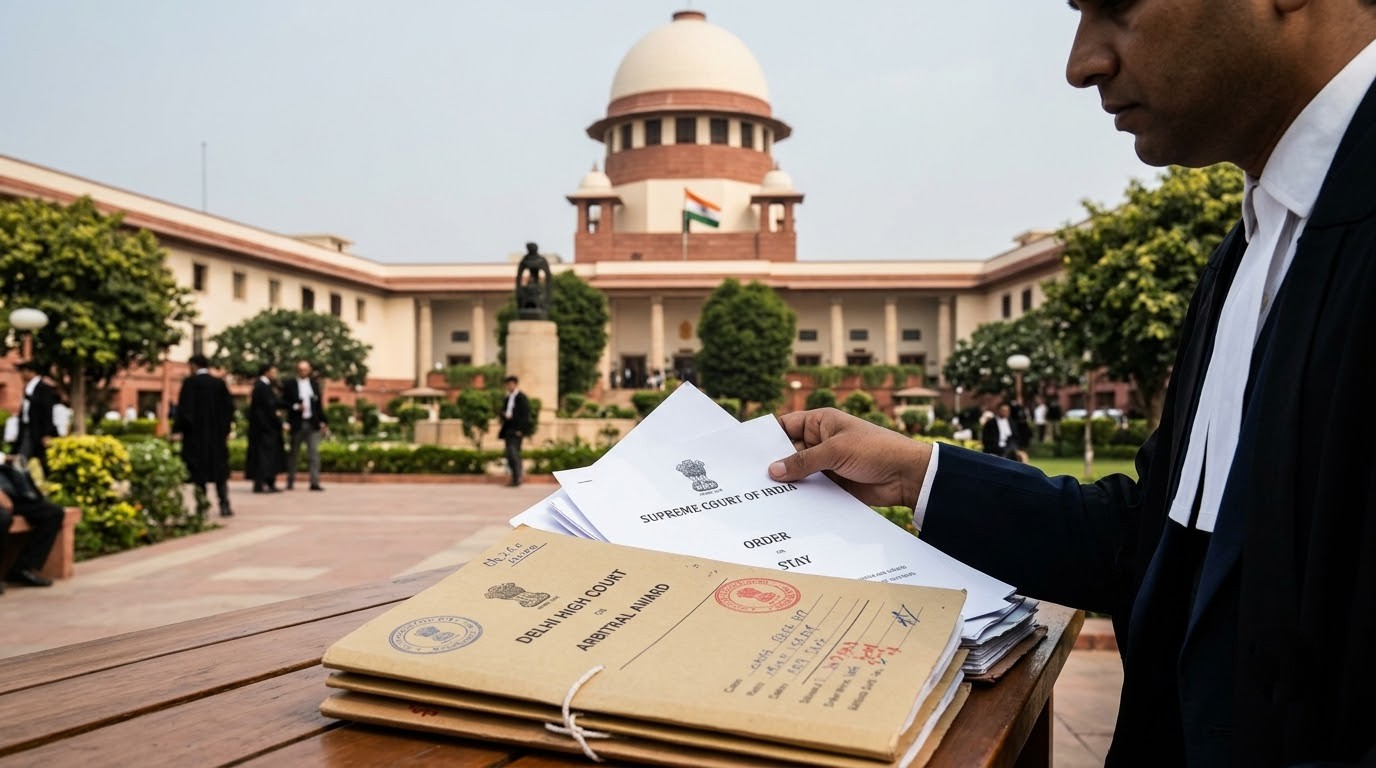
The Supreme Court on Tuesday stayed a Delhi High Court order directing the impounding of domestic arbitral awards presented for enforcement on the ground of deficient stamp duty. A Bench comprising Justices KV Viswanathan and Arun Palli passed the interim order in URC Construction Private Limited v. Airports Authority of India, halting the operation and effect of the High Court’s September 1 and September 7 orders until further directions.
The Bench clarified that the pendency of the proceedings before the Supreme Court would not prevent the High Court from continuing with execution proceedings. It further directed that the practice directions issued by the Delhi High Court on July 13, 2026, concerning the payment of stamp duty on arbitral awards, would continue to operate.
What was the Delhi High Court’s September 1 ruling on stamp duty and arbitral awards?
The Delhi High Court held that a domestic arbitral award attracts stamp duty at the time it is signed, not when presented for enforcement. It ruled that unilateral payment of deficient stamp duty more than a month after signing does not cure the defect, mandating impounding under the Indian Stamp Act, 1899. The registry was directed not to list enforcement petitions without proof of sufficient stamp duty payment.
The controversy originated from an enforcement petition filed by URC Construction Private Limited against the Airports Authority of India (AAI). In its September 1 ruling, the High Court determined that the liability to pay stamp duty on a domestic arbitral award arises upon its signing. The court further held that a unilateral attempt to pay the deficient stamp duty more than a month after the award was signed would not rectify the defect. Consequently, such an award was liable to be impounded under the Indian Stamp Act, 1899.
The High Court issued specific directions to its registry regarding the processing of enforcement petitions. It mandated that petitions would not be listed unless proof of payment of sufficient stamp duty was furnished. For petitions filed after August 13, 2026, involving insufficiently stamped awards, the registry was directed to return them under objections and place them before the Joint Registrar for impounding. For petitions filed on or before that date, the matters were to be placed before the Joint Registrar. The High Court also observed that an enforcing court lacks the power to waive or reduce the statutory penalty for deficient stamping, though the Collector of Stamps retains discretion in determining the penalty amount.
On what grounds did the petitioners challenge the High Court’s directions?
The petitioners argued that the directions contravened Section 33 of the Indian Stamp Act, which permits impounding only when an instrument is produced before an authority competent to receive evidence. They contended that registry officials scrutinising petitions at the numbering stage do not qualify as such authorities. They also asserted that the stamping complied with the July 13, 2026 practice directions, removing any occasion for impounding.
Challenging these directions before the Supreme Court, the petitioners, represented by Senior Advocate Sunil Kumar and a team of advocates, argued that the High Court’s directions were contrary to Section 33 of the Stamp Act. It was submitted that an instrument could be impounded only when produced before an authority competent to receive evidence, and that authority found it to be insufficiently stamped. The petitioners contended that officials of the High Court registry scrutinising enforcement petitions at the stage of numbering of cases could not be considered authorities competent to receive evidence under the Stamp Act.
They further pointed out that the stamping of the awards in question was consistent with the Delhi High Court’s practice directions dated July 13, 2026. The petitioners maintained that there was no occasion to direct impounding of the awards in view of these practice directions. They also questioned the validity of the other administrative directions issued by the High Court regarding the listing and return of petitions.
After hearing the submissions, the Supreme Court issued notice on the petitions and stayed the operation and effect of the September 1 and September 7 High Court orders until further orders. The respondents, including AAI, were represented by advocates Anshul Rai, Digvijay Rai, Archit Goel, and others.
Aspect | Delhi High Court Directions (Sept 1 & 7) | Supreme Court Interim Order |
|---|---|---|
Impounding of Awards | Mandatory impounding of insufficiently stamped awards by Joint Registrar | Stayed; enforcement proceedings may continue |
Stamp Duty Liability Point | Arises at the time of signing the award | Not adjudicated; proceedings stayed |
Curing Deficiency | Unilateral payment after one month does not cure defect | Stayed; practice directions of July 13 remain in force |
Registry Role | Registry to screen petitions for stamp duty compliance at numbering stage | Stayed; July 13 practice directions continue to govern |
The Supreme Court’s interim relief effectively restores the status quo governed by the July 13 practice directions, permitting parties to proceed with enforcement while the constitutional and statutory validity of the High Court’s September directions remains under consideration.