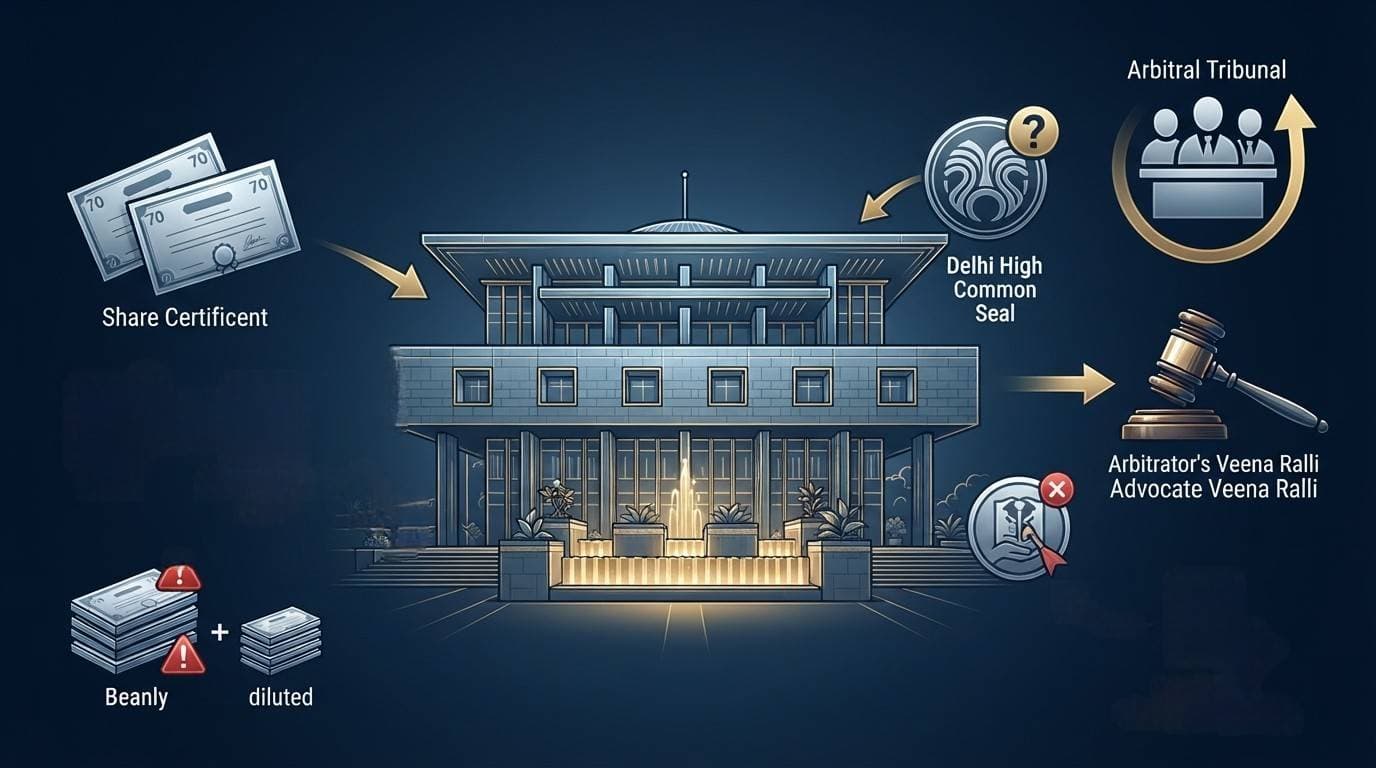
The Delhi High Court, presided over by Justice Mini Pushkarna, declined to remove Beanly Beverages Private Limited from the arbitration proceedings initiated by Chirag Jain, popularly known as Papa CJ, concerning a share transfer dispute. The court’s order was passed in two petitions filed by Jain against Rahul Jain and Samayesh Khanna, the promoters of Beanly, wherein Jain sought specific performance of two Share Purchase Agreements dated 27 April 2024.
Under the agreements, Jain agreed to acquire seventy equity shares from each of the two sellers at a price of Rs 1,225 per share, amounting to a total consideration of Rs 1.71 lakh. Jain asserted that he had discharged the entire sale consideration, yet the sellers failed to deliver the signed share transfer deeds and the physical share certificates. He further contended that, subsequent to the alleged payment, Beanly issued additional shares to third parties, thereby diluting his entitlement under the original agreements.
The sellers, Rahul Jain and Samayesh Khanna, had consented to refer the dispute to arbitration before a sole arbitrator, despite the arbitration clause in the Share Purchase Agreements providing for a three‑member tribunal. Beanly, however, objected to its inclusion in the arbitral process. It argued that, as a non‑signatory to the Share Purchase Agreements, it had not given its consent to arbitrate and could not be compelled to participate in what it described as a private disagreement between Jain and its promoters.
Justice Mini Pushkarna examined Beanly’s objections and observed that Jain’s case rested on the assertion that Beanly’s corporate machinery was integral to the transaction. The shares subject to the agreement were shares of Beanly; the transfer required entry in Beanly’s register of members and, according to Jain, necessitated the approval of Beanly’s Board. Jain also relied on a clause in the agreements which recorded that the company had affixed its common seal to a duplicate of the Share Purchase Agreements. Beanly denied having affixed any such seal.
The Court noted that the factual disputes concerning the alleged affixation of the common seal, the necessity of Board approval, and the effect of any subsequent share issuance required evidentiary determination. It stated that the question of whether a non‑signatory could be treated as a party to the arbitration agreement, in the facts and circumstances of the present case, would necessitate a more comprehensive enquiry that was not suitable at the interim stage. Consequently, the Court held that such an inquiry was best left to the arbitral tribunal.
In addition, Beanly contended that no notice invoking arbitration had been served upon it under Section 21 of the Arbitration and Conciliation Act, 1996, and that this omission should preclude its referral to arbitration. The Court rejected this argument, holding that the non‑issuance of notice under Section 21 specifically to Beanly could not constitute an impediment to referring the matter to arbitration.
Accordingly, Justice Mini Pushkarna appointed Advocate Veena Ralli as the sole arbitrator to adjudicate the disputes raised in the petitions. The order makes clear that the arbitral tribunal will have to decide, after hearing evidence, whether Beanly can be bound by the arbitration agreement despite not being a signatory to the underlying Share Purchase Agreements.
The decision underscores the principle that, at the stage of referring a dispute to arbitration, courts should refrain from undertaking a detailed analysis of complex factual and legal questions concerning the applicability of an arbitration agreement to non‑signatories. Such determinations are reserved for the arbitral tribunal, which is better placed to evaluate the evidence and render a reasoned award.