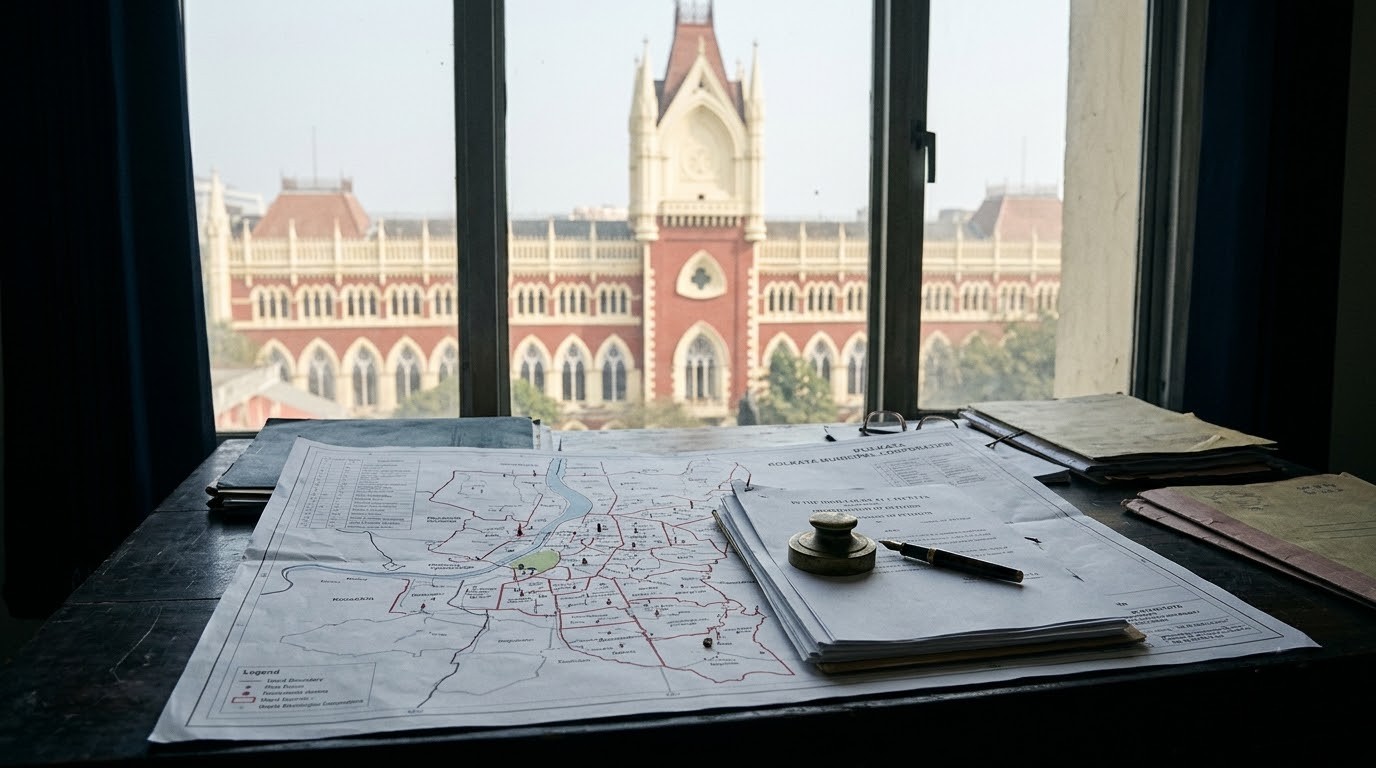
The Calcutta High Court has issued an interim order restraining the West Bengal Government from issuing any official notification for elections to the Kolkata Municipal Corporation until November 6. A vacation bench of the High Court reserved its orders on a legal challenge directed against the delimitation of wards and the expansion of their total count from 144 to 209 ahead of the scheduled civic polls. The judicial intervention followed prima facie observations by the bench that statutory powers belonging to an elected municipal corporation ought not to be transferred to a government-appointed administrator by the State.
Can an Administrator Exercise Legislative Powers of an Elected Municipal Corporation?
The Calcutta High Court observed that the statutory framework of the Kolkata Municipal Corporation Act requires the State Government to act based on recommendations originating from the Corporation itself, raising significant legal doubts regarding whether a state-appointed administrator possesses the jurisdictional competence to exercise those legislative functions.
Senior Advocate Bikash Ranjan Bhattacharya, representing the petitioners, submitted that the contested delimitation notification was promulgated in September during a period when no elected municipal council remained in existence. The previous Corporation had been dissolved earlier on June 8, and the former Chairperson, Smita Pandey, was designated as the Administrator restricted purely to administrative duties. The petitioners argued that an administrator cannot legally usurp the legislative authority of a democratically elected municipal body, particularly when the administrator functions as an employee of the Corporation. Counsel contended that allowing the State to vest such sweeping powers in an administrator vitiates the entire decision-making architecture.
The bench noted that the statutory wording creates a distinct anomaly because the State is mandated to rely upon recommendations made by the Corporation. If an administrator appointed directly by the State is permitted to wield the powers of the Corporation, it effectively results in a scenario where the State Government issues instructions to itself. The petitioners additionally submitted that the delimitation exercise lacked proper application of mind, omitted any mandatory assessment of financial implications, and amounted to unconstitutional gerrymandering in contravention of established Supreme Court precedents.
Legal Parameter | Petitioner Submissions | State Government Submissions |
|---|---|---|
Status of Administrator | Cannot exercise legislative powers of an elected body or make structural recommendations. | Vested with all statutory powers of the Corporation to act on its behalf. |
Necessity of Approval | Mandatory involvement of an elected council or its valid recommendation is required. | State is not legally required to obtain approval from the municipal council for delimitation. |
Constitutional Bar | Delimitation process is legally vulnerable due to procedural flaws and lack of application of mind. | Challenge is barred under Article 243ZG, restricting challenges to post-election election petitions. |
Advocate General Surajit Nath Mitra, appearing on behalf of the State Government, strongly opposed the petition. He contended that the State was under no legal obligation to secure the approval of the municipal council to carry out the delimitation exercise. He further maintained that the appointed administrator was validly vested with all corporate powers and asserted that the present challenge was barred by Article 243ZG of the Constitution, which dictates that delimitation matters concerning municipal polls can only be questioned through an election petition after the conclusion of the elections.
During the proceedings, the bench clarified that its primary focus was restricted to examining whether any consequential administrative action originating from the contested delimitation notification warranted a stay. Upon inquiring whether the electoral process had formally commenced, the Advocate General confirmed it had not. When the bench indicated its inclination to restrain the State, the Government requested the court to withhold formal orders, prompting the court to ask whether the State would provide an undertaking not to issue any election notification in the interim. The counsel representing the Election Commission stated that it lacked information regarding the timing of the elections, noting that the final decision rested entirely with the State Government.
Concluding the hearing, the High Court formally recorded the interim restraint prohibiting the issuance of any notification calling for municipal elections based on the disputed delimitation notification until November 6. The matter remains reserved for pronouncement of orders on that date.