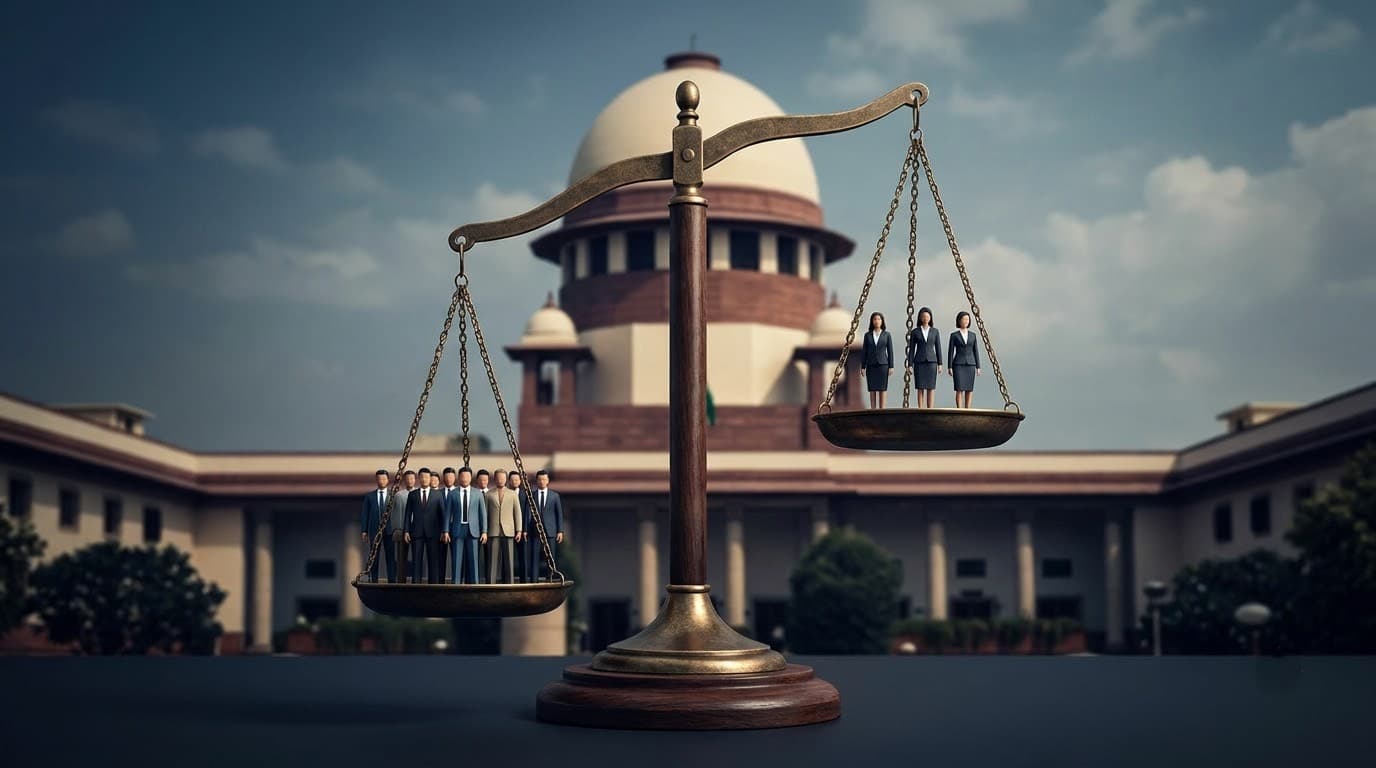
The Milon K Banerji Centre for Arbitration Law at NALSAR University of Law released a report examining court-made arbitrator appointments in the Supreme Court, Bombay High Court, and Delhi High Court. The study analysed 3,688 cases registered in 2025 before these courts, with data collected until June 30, 2026, and found that of the 2,283 appointments for which gender information was recorded, 1,598 appointments, or 70.03%, went to men, while 685 appointments, or 29.97%, went to women.
The gender disparity was consistent across all three forums. At the Supreme Court, men accounted for 79.17% of recorded appointments. At the Bombay High Court, the figure was 71.30%, and at the Delhi High Court, it was 68.88%.
Regarding professional background, of the appointments where such details were recorded, 73.21% went to advocates, 23.73% to retired judges, and only 3.10% to technical experts. The Supreme Court showed a distinct pattern, with retired judges constituting 88% of its recorded appointments, although the researchers noted the dataset for this court was relatively small. In Bombay High Court, technical experts made up just 1.43% of appointments, and in Delhi High Court, 4.14%.
The study also highlighted a significant concentration of appointments among a small number of arbitrators. Out of 1,060 distinct arbitrators identified, just 54 individuals—representing 5.09% of the pool—received seven or more appointments each. Together, these arbitrators accounted for 548 appointments, or 24% of the total 2,283 recorded appointments.
The concentration was most pronounced at the Bombay High Court, where 11.21% of arbitrators received 38.24% of court-made appointments. One arbitrator, identified as a male retired judge, received as many as 34 appointments from petitions in the 2025 dataset. In the Delhi High Court, the most-appointed arbitrator, a female retired judge, received 19 appointments. The three most-appointed arbitrators in Bombay collectively secured 67 appointments, compared to 46 appointments obtained by their counterparts in Delhi.
The report clarified that repeated appointments do not inherently indicate favouritism, bias, or improper conduct. It stated: 'The dataset does not establish that repeat appointments are improper, preferential, or indicative of bias; it nevertheless demonstrates a significant concentration of court appointments within a relatively small segment of the arbitrator pool.'
To address these findings, the researchers recommended that courts and arbitral institutions broaden their pools of eligible arbitrators. They specifically suggested including more qualified technical experts, particularly in disputes related to specialised sectors such as construction and infrastructure.
Further, the report proposed establishing a national database containing details of arbitrators' qualifications, professional experience, recent appointments, and existing workloads. It also suggested that courts require proposed arbitrators to disclose their pending assignments and availability prior to appointment.
The researchers emphasized that the goal should not be to prohibit repeat appointments but to ensure that any concentration is transparent, explainable, and capable of being monitored. The report concluded by noting that 'The disparity in the appointments on the basis of gender are particularly concerning and need to be addressed.' The study was conducted under the chairmanship of former Supreme Court Justice Rohinton Fali Nariman, with Senior Advocate Ritin Rai as Co-Chair and Advocate Dr. Amit George as Director (Research). Senior Advocate Gourab Banerji serves as Donor and Patron, while Advocates Shreya Parikh and Chand Chopra are Associate Directors (Research).