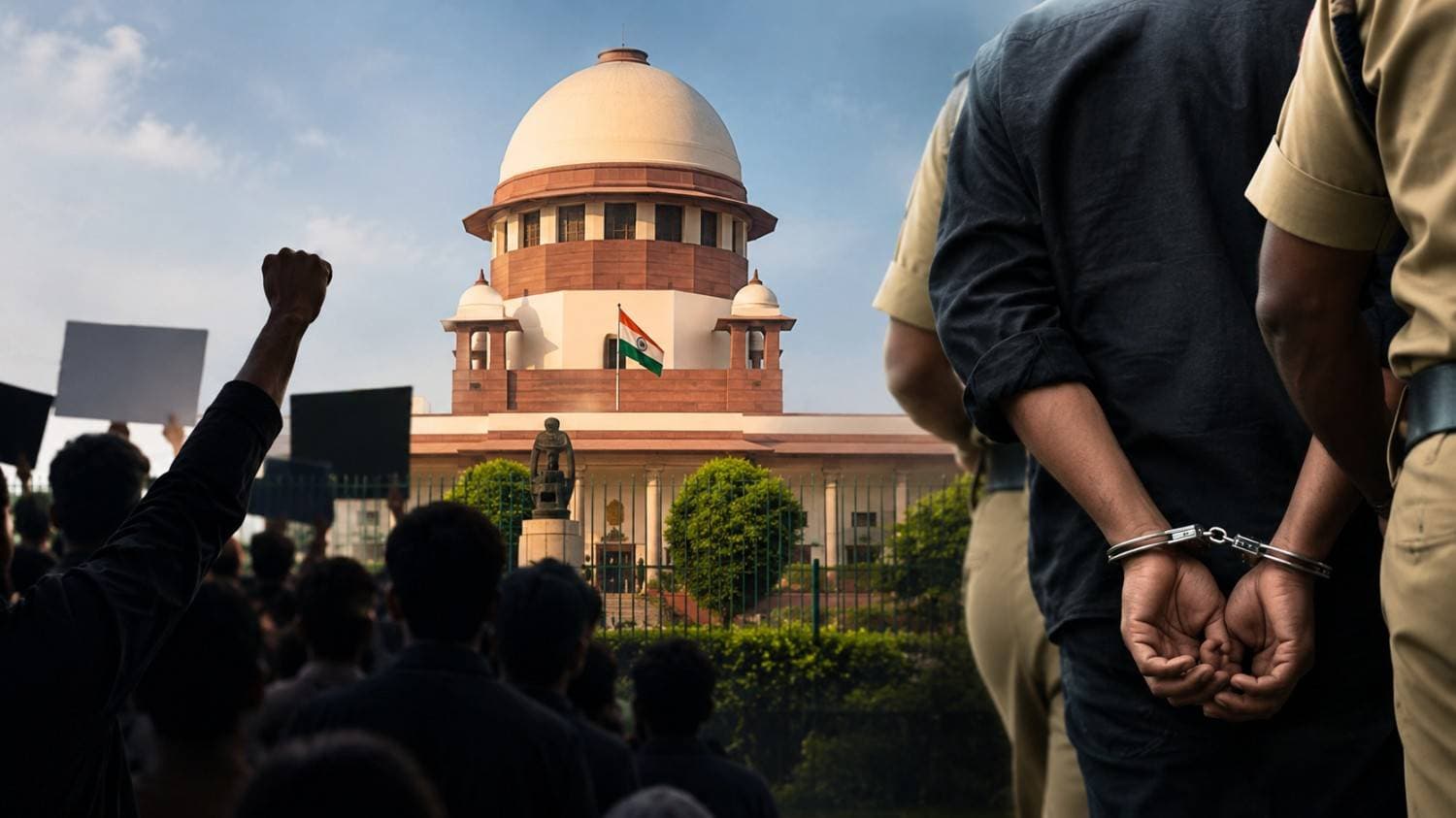
The Supreme Court of India convened a special hearing on Sunday to examine petitions challenging the preventive detention of thousands of individuals, including opposition leaders and four former Chief Ministers, who were taken into custody during a crackdown on protests organised by the Cockroach Janta Party (CJP). The protestors had gathered to demand the resignation of Chief Election Commissioner Gyanesh Kumar, citing concerns over the Special Intensive Revision (SIR) of electoral rolls, which they allege led to the removal of millions of names from voter lists. The Court was hearing arguments on whether the detentions and associated police actions violated constitutional protections.
Among the petitioners were Trinamool Congress Member of Parliament and Senior Advocate Menaka Guruswamy, who challenged the legality of the detentions and the manner in which protesters were picked up from public streets. Advocate Shailendra Mani Tripathi filed a separate contempt petition, asserting that authorities had disregarded an earlier order of the Court dated October 9, which had directed against a complete shutdown of public transport ahead of the planned demonstrations. Tripathi contended that Delhi Metro stations remained closed on Sunday despite that directive, thereby obstructing the movement of citizens and undermining judicial authority.
The Court was informed that the Delhi Metro services had been suspended to prevent protesters from reaching Jantar Mantar, a traditional site for public demonstrations in the national capital. Several senior political figures, including Arvind Kejriwal, Mamata Banerjee, Pinarayi Vijayan, and Manik Sarkar, were detained by police during the crackdown. Additionally, CJP leaders Abhijeet Dipke, Saurav Das, and Ashutosh Ranka were reportedly detained inside an aircraft upon its landing, highlighting the breadth of the enforcement action.
During the proceedings, the Bench focused on the scope of preventive detention laws, the necessity and proportionality of the restrictions imposed on public movement, and whether the closure of transport facilities amounted to an indirect restriction on the fundamental right to protest. The petitioners argued that the mass detentions, particularly of opposition leaders and elected officials, raised serious concerns about the use of executive power to suppress dissent, especially in the absence of individualised assessments of threat or likelihood of violence.
The Bench examined the timing and nature of the October 9 order, which had specifically addressed concerns about a blanket suspension of metro services. The Court sought clarification from the authorities on the basis for maintaining the closure on Sunday, and whether any alternative, less restrictive measures had been considered to maintain public order without infringing on civil liberties. The Solicitor General, representing the Union government, was expected to justify the actions taken under the prevailing security assessment.
The hearing underscored the tension between maintaining public order and safeguarding constitutional rights to freedom of speech, assembly, and movement. The Court’s inquiry into the compliance with its earlier order reflected its vigilance in ensuring that executive actions do not circumvent judicial directives through indirect means. The matter remains sub judice, with the Bench reserving its decision on the pleas pending further clarification from the state on the factual and legal basis for the detentions and transport restrictions.