Skip to content

    Supreme Court Simplifies Evidence: No Formal Proof Needed for Chargesheet Documents

    Supreme Court Judgement

    1. Home
    2. /Supreme Court Judgement

    Supreme Court Simplifies Evidence: No Formal Proof Needed for Chargesheet Documents

    An analysis of the Supreme Court's ruling on Section 294 CrPC, allowing the accused to use documents already in the chargesheet without formal proof of signature.

    Hydar Choudhury
    May 8, 2026·4 min read
    Supreme Court Simplifies Evidence: No Formal Proof Needed for Chargesheet Documents

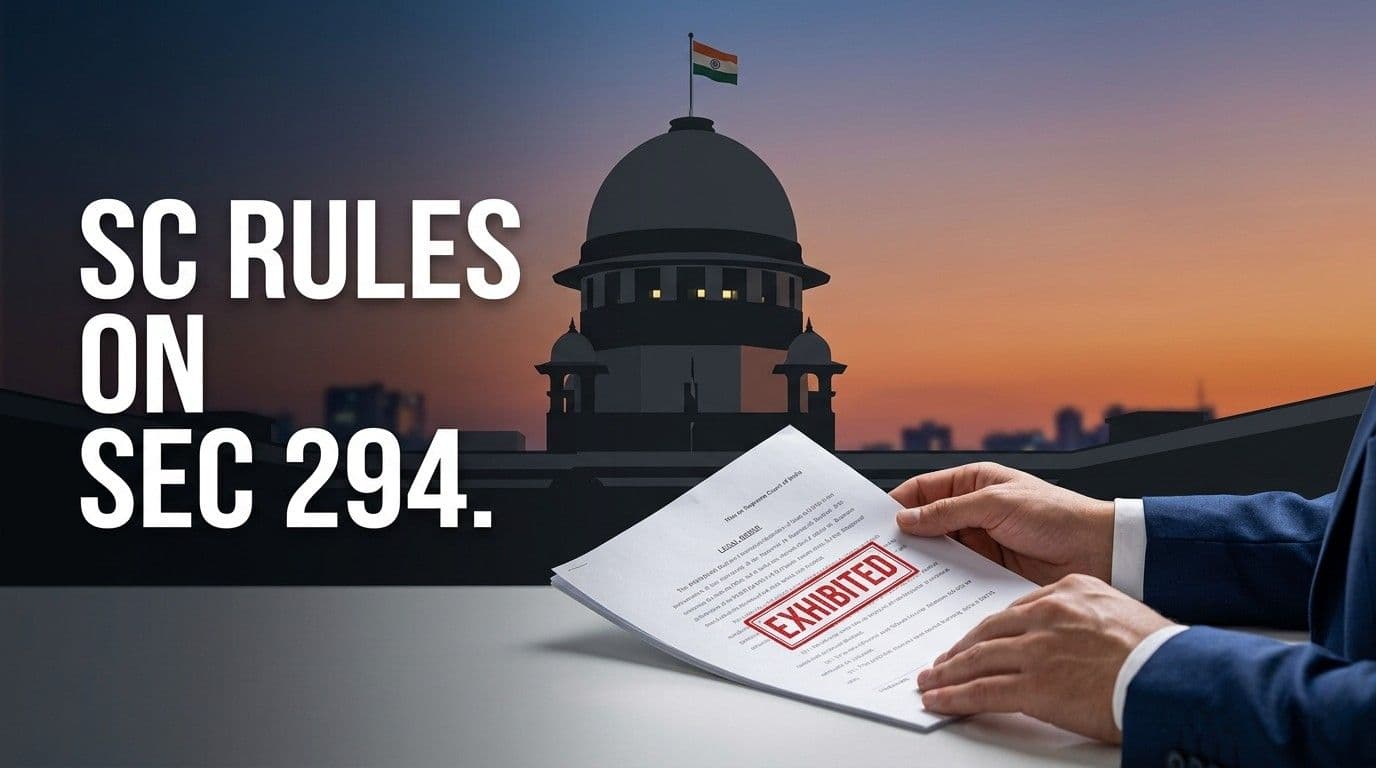
    ​In a significant move to streamline the often-lumbering pace of criminal trials, the Supreme Court has clarified the application of Section 294 of the Code of Criminal Procedure (CrPC). The Court ruled that once a document has been made part of the chargesheet by the prosecution, the accused can "exhibit" or rely upon these documents during the trial without the exhaustive requirement of formal proof, such as calling witnesses to verify signatures. This is not merely a technical adjustment; it is a profound shift toward judicial efficiency that recognizes the inherent reliability of documents that the State itself has collected and presented as part of its investigation.

    ​Section 294 was designed to bypass the "empty ritual" of proving documents whose authenticity is not in dispute. By allowing the accused to adopt these documents, the Court is dismantling a procedural hurdle that has historically delayed trials for years. In the theater of the courtroom, where every minute is a battle for liberty, the ability to present a document—such as a medical report or a forensic finding already in the file—without waiting for the author to appear in the witness box is a vital victory for the Right to a Speedy Trial under Article 21.

    ​The logic behind this ruling is grounded in common sense: if the prosecution has relied on a document to build its case, it cannot later challenge the "formal proof" of that same document when the accused seeks to use a portion of it for their defense. The Supreme Court emphasized that the purpose of criminal procedure is to discover the truth, not to trap the accused in a web of technicalities. By "exhibiting" these documents, the defense can now more effectively point out contradictions or favorable facts that were already hidden in plain sight within the prosecution's own evidence.

    ​From a strategic standpoint, this ruling empowers defense counsel to be more proactive during the early stages of a trial. It removes the "evidentiary blackmail" where a trial is stalled because a formal witness—like a clerk or a secondary officer—is unavailable to testify to a signature on a routine document. For the judiciary, this means fewer adjournments and a more focused examination of the substantive merits of the case. It reinforces the principle that the "record of the case" belongs to the court, not exclusively to the party that produced it.

    Advertisement

    Hydar Choudhury

    See more from Hydar →
    Jurisight logoJurisight logo

    Simplifying legal knowledge for professionals and citizens. Your daily source for Supreme Court, High Court, and Business Law updates.

    Platform

    HomeAll ArticlesTop NewsSC UpdatesHC Updates

    Categories

    Business LawConstitutionalCriminal LawCivil LawKnow Your Law

    Weekly Digest

    Join 15,000+ others and get the week's most important legal updates.

    © 2026 Jurisight. All rights reserved.
    Privacy PolicyCookie PolicyCookie ConsentLegal Disclaimer
    Advertisement

    ​Furthermore, the Court clarified that this rule applies specifically when the "genuineness" of the document is not disputed. If the accused admits the document’s existence as part of the record, the need for a witness to "prove" it is dispensed with. This creates a "fast-track" for documentary evidence, allowing the trial to proceed directly to the interpretation of the facts rather than getting bogged down in the mechanics of their presentation. It is a push toward a more "scientific" trial process where the focus shifts from the messenger to the message contained within the document.

    ​The broader implication for the Indian legal system is a move toward a more "adversarial balance." Often, the accused lacks the resources to summon a long list of witnesses to prove documents that are already sitting in the judge's file. By making the chargesheet a "common pool" of accessible evidence, the Supreme Court is leveling the playing field. It ensures that the defense can leverage the State’s own investigative findings to prove innocence, fulfilling the constitutional mandate of a "fair trial."

    ​In the final analysis, the SC's interpretation of Section 294 is a masterclass in pruning the "deadwood" of procedural law. It acknowledges that in a digital and document-heavy age, the law must evolve to be more lean and functional. As this ruling trickles down to trial courts across the country, it will act as a catalyst for faster disposals. To understand this judgment is to realize that justice is not just about the final verdict, but about the efficiency of the path taken to reach it. The chargesheet, once a one-sided weapon of the prosecution, has now been reaffirmed as a shared map for the pursuit of truth.

    Explore related legal coverage

    Continue with reporting and analysis connected to this article.

    Browse Supreme Court Judgement

    Related legal topics

    • Police Cannot Register Fir for Non Cognizable Offence by Masking HC

      Criminal Procedure India

    • Accused Has No Right to Decide the Agency of Investigation: Calcutta High Court Dismisses Impleadment Pleas in Probe Writ

      Criminal Procedure India

    • Section 138 NI Act Case Can Be Settled, Supreme Court Says

      Supreme Court Judgement

    • Delayed Chargesheet Can Quash Criminal Case, Supreme Court Says

      Supreme Court Judgement

    • S Rajaseekaran Case 2025: Road Safety Rights Explained

      Supreme Court Judgement

    • Last Seen Theory In Criminal Cases: Supreme Court Explains

      Supreme Court Judgement

    Advertisement