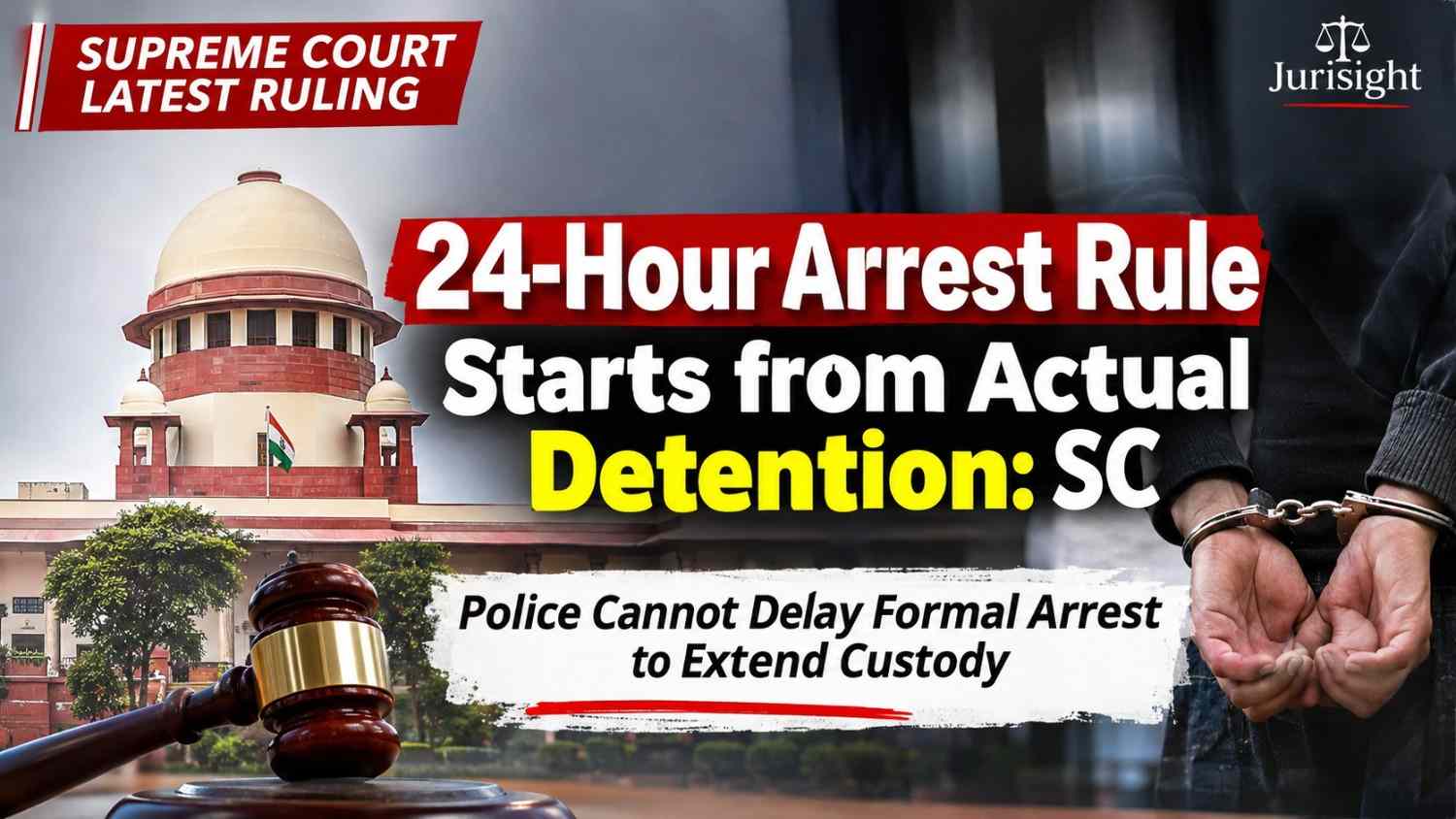
The Supreme Court of India has delivered an important judgment protecting the personal liberty of individuals, holding that the 24-hour period for producing an arrested person before a Magistrate begins from the time their liberty is actually restricted, and not from the time the police formally record the arrest.
In Sri Sujit Das and Others v. Union of India, 2026 INSC 1195, a Bench comprising Justice Ujjal Bhuyan and Justice Atul S. Chandurkar delivered the judgment on November 5, 2026.
The Court made it clear that the police cannot avoid the constitutional requirement of producing an arrested person before a Magistrate within 24 hours simply by delaying the formal arrest procedure.
The case involved three accused persons, Sujit Das, Suman Das and Rupak Sarkar, who were arrested in connection with a case under the Narcotic Drugs and Psychotropic Substances (NDPS) Act, 1985.
According to the case records, the three individuals were intercepted by Customs officials in Tripura on September 29, 2025, at around 2:00 PM during an investigation involving the alleged recovery of 60.79 kg of Yaba tablets.
However, their formal arrest was recorded only on September 30, 2025, at around 11:00 AM and 11:15 AM. They were subsequently produced before a Magistrate at approximately 4:45 PM on the same day.
The accused challenged their continued custody, arguing that the authorities had violated the 24-hour requirement under Article 22(2) of the Constitution.
The matter eventually reached the Supreme Court after the Tripura High Court rejected their bail applications.
The main question before the Supreme Court was whether the 24-hour period should be calculated from the time a person is actually detained or from the time the police officially record the arrest.
The Union of India argued that the time between interception and formal arrest was required for completing investigation-related procedures, including search and seizure formalities.
However, the Supreme Court did not accept the argument that the constitutional deadline could remain on hold until the formal arrest was recorded.
The Bench explained that the expressions "arrested" and "detained in custody" under Article 22(2) must be understood together. An artificial distinction between the two cannot be used to weaken the constitutional protection available to an individual.
The Court held that the 24-hour period starts when the investigating authority takes control of a person's liberty and effectively prevents them from moving freely.
In simple terms, the police cannot keep someone in custody and later change the starting time of the arrest by preparing the arrest documents.
Article 22(2) of the Indian Constitution provides that every person who is arrested and detained in custody must be produced before the nearest Magistrate within 24 hours of such arrest.
The time required for travelling from the place of arrest to the Magistrate's court is excluded from this calculation.
No person can be kept in custody beyond this period without the authority of a Magistrate.
The Supreme Court emphasised that this is a constitutional requirement and not merely a procedural formality.
The Court also referred to Section 58 of the Bharatiya Nagarik Suraksha Sanhita (BNSS), 2023, which requires that a person arrested without a warrant must not be detained for longer than is reasonable in the circumstances, and that detention cannot exceed 24 hours without a Magistrate's authority, subject to the statutory provisions.
The judgment also laid down important points for investigating authorities and Magistrates.
First, the 24-hour period must be calculated from the actual time of detention when the person's liberty is restricted, rather than the time mentioned in the formal arrest documents.
Second, only the time reasonably necessary for travelling from the place of arrest to the Magistrate's court can be excluded while calculating the 24-hour period.
Third, Magistrates must record the actual date and time when a person was detained and examine whether the constitutional deadline has been followed.
Fourth, even if a person is produced before a Magistrate within 24 hours, the Magistrate must examine whether the period of detention was reasonable in the circumstances.
If the detention exceeds the constitutional limit, the person must be released from custody. A Magistrate may also refuse remand if the detention has been unreasonably prolonged.
After examining the facts, the Supreme Court found that the three accused had been detained from 2:00 PM on September 29, 2025, but were produced before the Magistrate only at 4:45 PM on September 30, 2025.
This meant that the constitutional 24-hour limit had been exceeded.
The Court also found that the unexplained period of approximately 18 hours between the completion of the search and seizure operation and the formal recording of the arrests was unreasonable.
Consequently, the Supreme Court set aside the Tripura High Court's order and allowed the appeals.
It directed that the three accused be produced before the jurisdictional Special Court within a maximum period of seven days, after which they would be released on bail subject to the conditions imposed by that court.
The Supreme Court also directed that a copy of the judgment be circulated to the Directors General of Police of all States and Union Territories, Registrars General of High Courts and Directors of State Judicial Academies.
Case Details
Case: Sri Sujit Das and Others v. Union of India
Citation: 2026 INSC 1195
Court: Supreme Court of India
Decision Date: 5 November 2026
Bench: Justice Ujjal Bhuyan and Justice Atul S. Chandurkar