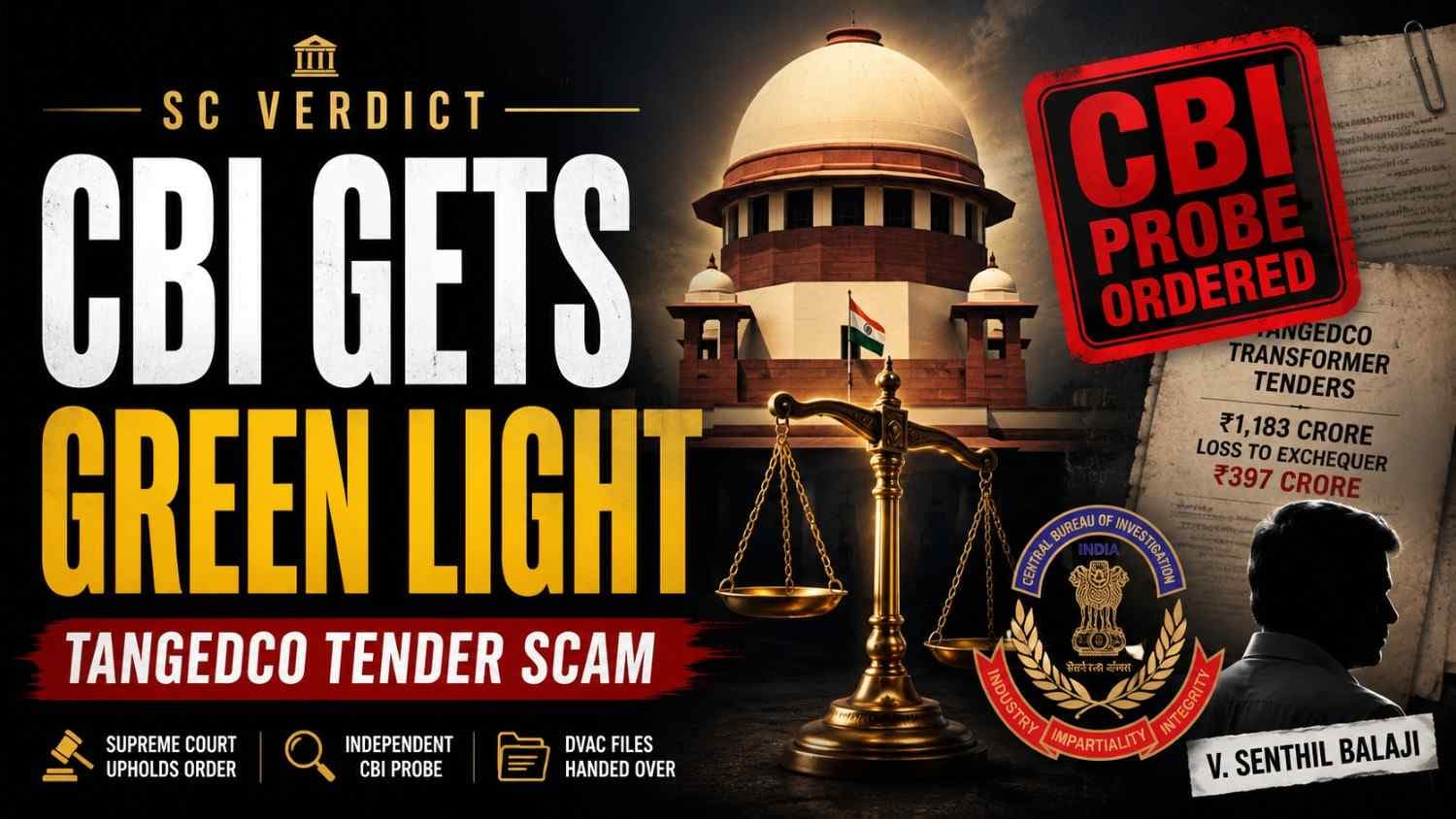
In a major legal blow to the stakeholders of the Tamil Nadu Generation and Distribution Corporation (TANGEDCO), the Supreme Court of India has refused to interfere with a court-ordered CBI probe into alleged tender irregularities. The case revolves around the procurement of transformers during the tenure of former Electricity Minister V. Senthil Balaji between 2021 and 2023. By dismissing the challenge, the apex court has ensured that the Central Bureau of Investigation will proceed with a de novo inquiry into one of the state's most high-profile corruption allegations.
The controversy stems from ten tenders issued for approximately 45,800 distribution transformers, valued at over ₹1,183 crore. An investigation by the NGO Arappor Iyakkam alleged that these tenders were systematically manipulated. The crux of the allegation involves "cartelization," where dozens of bidders reportedly quoted identical prices—a practice that critics argue bypassed the competitive spirit of the Tamil Nadu Transparency in Tenders Act and led to a loss of nearly ₹397 crore to the state exchequer.
The Madras High Court had initially ordered the CBI probe in April 2026, expressing concerns that the state’s own investigative wing, the Directorate of Vigilance and Anti-Corruption (DVAC), was being used to "shield" high-ranking officials. The High Court noted that the DVAC had conducted an unusually exhaustive preliminary inquiry without registering an FIR, suggesting a procedural attempt to suppress the truth rather than uncover it.
Appealing this order, the financial controller of TANGEDCO, Kasi, argued that the High Court’s direction was "politically motivated" and that no specific prayer for a CBI probe had been made by the original petitioners. However, a Supreme Court bench comprising Justice Vikram Nath and Justice Sandeep Mehta remained unmoved. The bench pointedly remarked that a court is fully empowered to direct an independent investigation if the circumstances of the case warrant such a step, regardless of specific prayers in the petition.
While the Supreme Court dismissed the appeal filed by the official, TANGEDCO itself chose to withdraw its separate petition against the probe. This move signals a significant shift in the legal strategy of the state-run corporation. However, the apex court did offer a small procedural safeguard: it directed the CBI to conduct its investigation independently, ensuring the agency is not influenced by the specific adverse observations made by the Madras High Court in its initial judgment.
This ruling marks another chapter in the legal struggles of V. Senthil Balaji, who has already faced significant jail time in connection with a separate "cash-for-jobs" scam. The transformer tender case adds a fresh layer of complexity to his political and legal standing. For the state government, the transition of the case files from the DVAC to the CBI represents a loss of control over a narrative that has dominated Tamil Nadu politics for months.
For the public, the Supreme Court’s stance reinforces the principle that large-scale public procurement must remain transparent and free from cartelization. As the CBI takes over the documents and case diaries, the focus will now shift to whether the identical bidding patterns were a result of market forces or a coordinated effort to siphon public funds. The outcome of this "de novo" investigation will be closely watched by legal and political analysts alike.
In summary, the Supreme Court has prioritized the need for an "independent and comprehensive" probe over procedural technicalities. With the CBI now at the helm, the investigation into the "transformer scam" enters a critical phase. For the petitioners and the public, the hope is that this centralized inquiry will finally bring clarity to whether the state’s electricity infrastructure was built on the back of a massive financial irregularity.