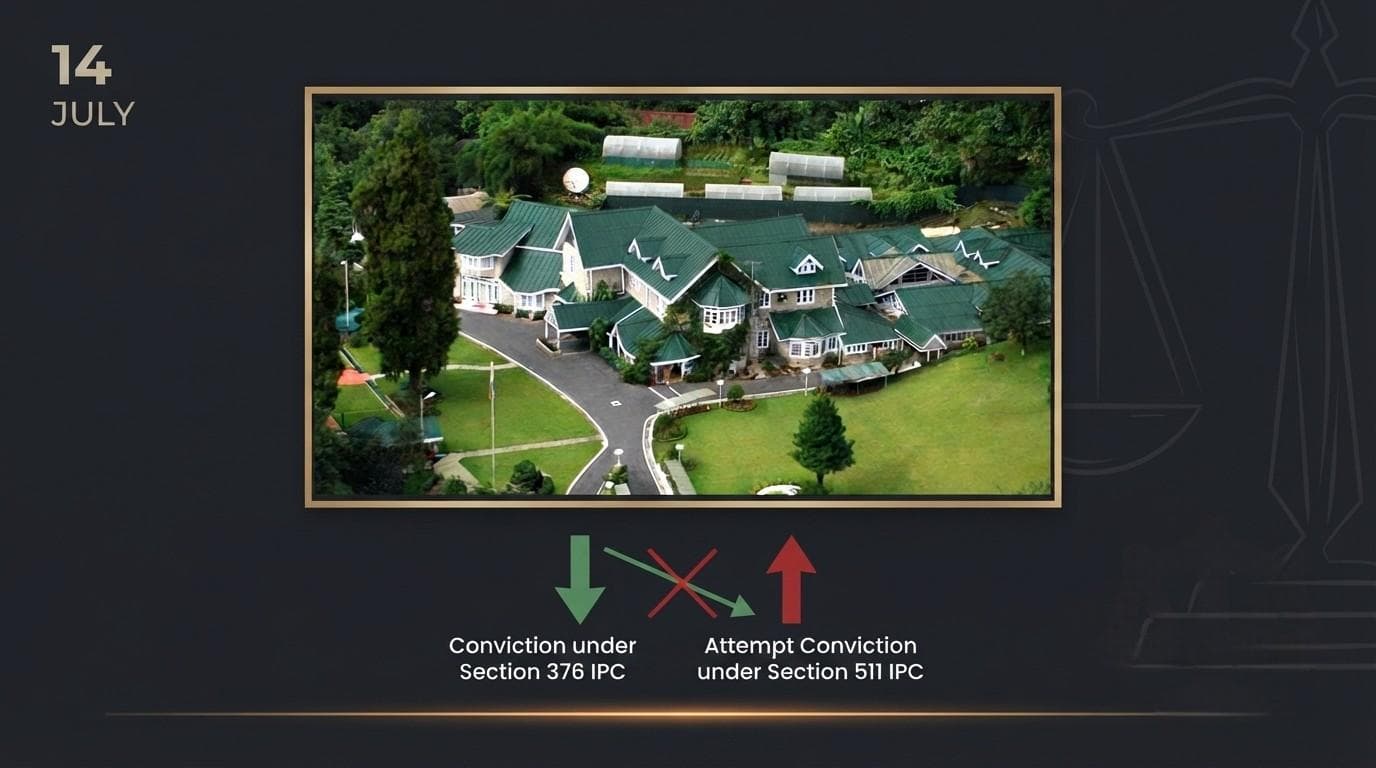
The Sikkim High Court, in the matter of Chenga Thsering Bhutia v State of Sikkim, has modified the conviction of the accused from rape under Section 376 IPC to attempted rape under Section 511 read with Section 376 IPC. The division bench comprising Chief Justice A Muhamed Mustaque and Justice Bhaskar Raj Pradhan delivered the order after reviewing the evidence presented by the prosecution.
The bench observed that, although forensic examination revealed the presence of the accused’s semen on the victim’s clothes, the record contained no proof of penetration. The court emphasised that the offence of rape defined in Section 375 IPC requires the establishment of penetration as an essential ingredient. Mere detection of seminal fluid on external clothing does not, by itself, satisfy that requirement.
In reaching its conclusion, the division bench considered the totality of the materials on record, including the medical report, the victim’s statement and any other corroborative evidence. It found that none of these documents established, beyond reasonable doubt, that penetration had occurred. Consequently, the bench held that the prosecution had failed to prove the offence of rape as charged.
The court further noted that, while the presence of semen may indicate sexual contact, the law distinguishes between completed rape and an attempt thereto. Where the actus reus of penetration is not proved, the appropriate legal characterisation is that of an attempt under Section 511 IPC, which punishes acts done towards the commission of an offence when the offence itself is not completed.
The bench accordingly set aside the conviction under Section 376 IPC and substituted it with a conviction for attempt to commit rape under Section 511 read with Section 376 IPC. The sentence was adjusted in accordance with the prescribed penalty for the offence of attempt, reflecting the reduced culpability.
This decision underscores the evidentiary burden placed on the prosecution in rape cases to demonstrate penetration. It reaffirms judicial adherence to the statutory definition of rape and cautions against reliance solely on incidental biological traces absent direct proof of the essential element of penetration.
The ruling also highlights the importance of a comprehensive medical examination and timely collection of forensic samples in sexual offence investigations. Where such evidence is lacking or inconclusive, courts may be inclined to treat the allegation as an attempt rather than a completed offence, as illustrated in the present judgment.
By altering the conviction, the Sikkim High Court has clarified the limits of circumstantial evidence in rape prosecutions and reinforced the principle that conviction must rest on proof of each ingredient of the offence beyond reasonable doubt.