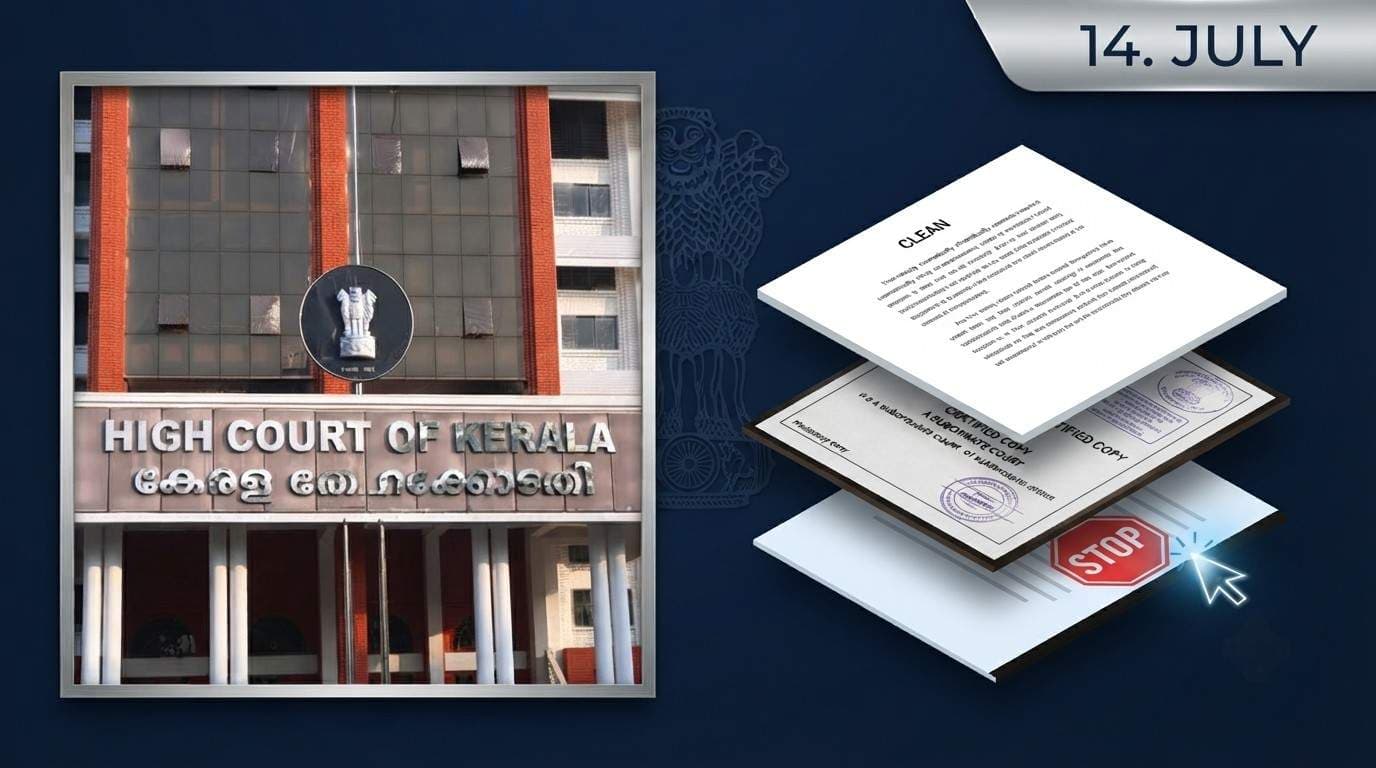
The Kerala High Court’s registry has identified a recurring defect in documents submitted for electronic filing: the presence of black lines, borders, shadows or dark edges appearing in exhibits and annexures. According to the registry, advocates are required to remove these markings before a case can be admitted for filing.
The directive applies to documents that are not generated by the advocate themselves. Such materials often consist of certified copies issued by subordinate courts, tribunal orders, government records, bank documents, revenue files, police papers, registered deeds or true copies supplied by the opposing party. These items arrive in the exact form in which they exist in the official record.
The registry observes that many of the markings deemed defective are not introduced by the advocate. A dark line along the edge of a page may be the natural result of photocopying an old record. A shadow may be part of the original scan obtained from a public office. A thick margin could have been created by repeated copying over decades. Lines may have been drawn by a presiding officer while marking exhibits. Underlining may have been made by a judicial officer during trial. Margins may bear initials, endorsements or official stamps. These features are characteristics of the original record rather than blemishes added by the advocate.
Nevertheless, the advocate is expected to perform digital cosmetic alterations on documents that are intended to faithfully reproduce the originals. The Electronic Filing Rules governing the Kerala High Court require that scanned documents be an accurate representation of the original, that they be complete and that they be readable. The rules emphasise fidelity, completeness and legibility rather than cosmetic perfection. A faithful reproduction of the original record is precisely what the rules contemplate.
The insistence on removing every harmless border, scanner shadow or photocopy edge appears to extend beyond the objective prescribed by the Electronic Filing Rules. This raises a question about how the legal system can simultaneously insist that filed documents must be true copies of the originals while requiring advocates to alter those copies by erasing portions of their contents. If a line drawn by a judge is removed, if a border appearing in a certified copy is digitally erased, if a tribunal’s markings or other official endorsements disappear during image processing, the document may no longer be an exact reproduction of the original.
The Kerala High Court itself regularly calls for original records from subordinate courts and tribunals. Those records inevitably contain dark margins, photocopy borders, judicial markings, endorsements, punched holes, folds and ageing marks accumulated over years of litigation. No one expects those original records to be cosmetically altered before they reach the high court. If the originals are acceptable in that condition, it is difficult to see why faithful digital reproductions should be rejected merely because they faithfully reproduce those very features.
Certified copies derive their evidentiary value from being faithful reproductions of the original judicial record. When advocates are required to erase portions of those reproductions merely to satisfy an aesthetic requirement, the system risks insisting that lawyers alter documents whose authenticity depends upon their fidelity. Cosmetic compliance should never come at the cost of documentary integrity.
The registry’s practice thus creates a tension between procedural neatness and the evidentiary principle that filed documents must be true and unaltered representations of the source material. The Electronic Filing Rules, by prioritising fidelity and readability, appear to support the view that the removal of such markings is unnecessary and potentially detrimental to the evidentiary value of the filings.
Advocates have expressed frustration that the requirement consumes disproportionate time without improving readability or reliability. The registry’s insistence on visual perfection contrasts with the stated purpose of electronic filing, which is to facilitate efficient access to judicial records, minimise delay, reduce costs and improve the administration of justice.
In summary, the Kerala High Court’s registry mandates the removal of lines, shades, borders and dark edges from court documents before filing, a practice that conflicts with the Electronic Filing Rules’ emphasis on faithful reproduction and raises concerns about the integrity of evidentiary material.