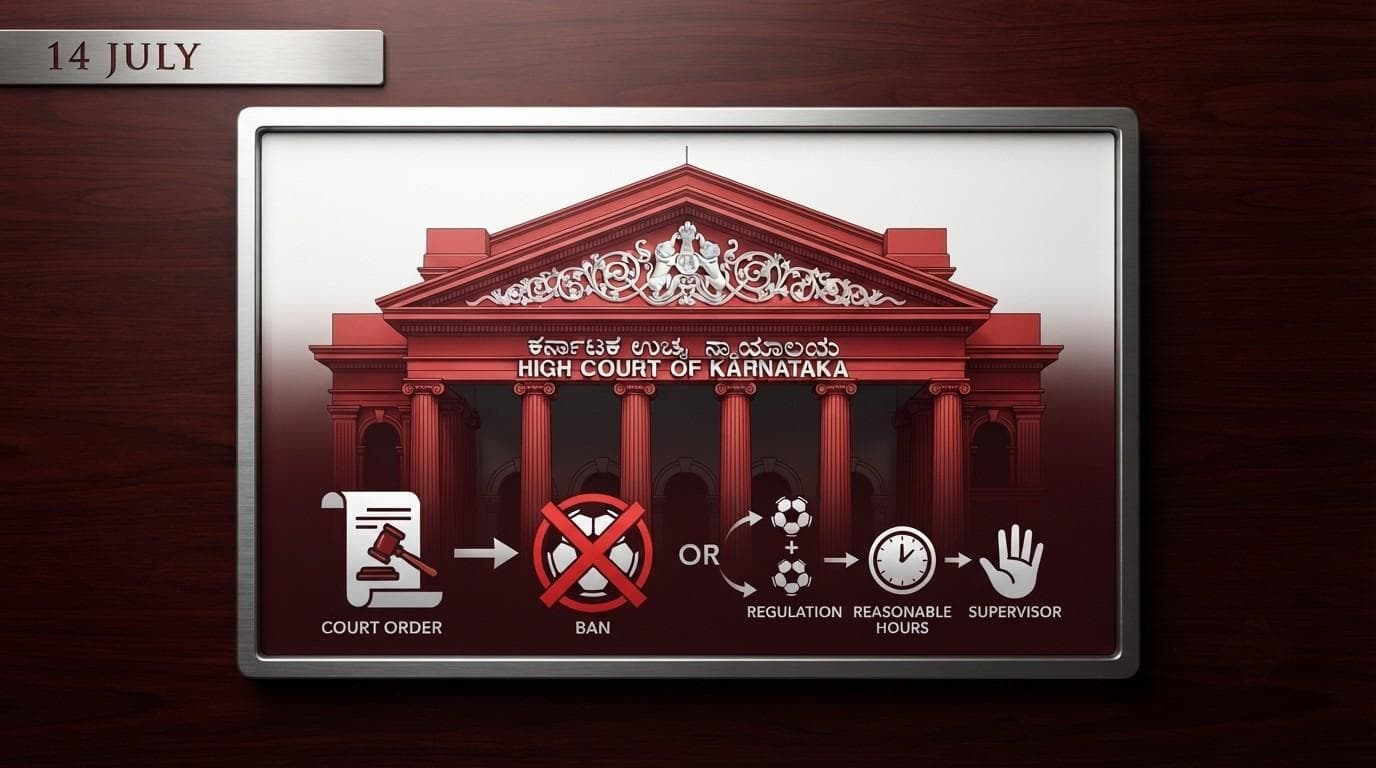
The Single Judge Bench of Justice Hanchate Sanjeevkumar, sitting in the Karnataka High Court, has allowed an appeal preferred by a couple who are residents of an apartment building in Bengaluru. The appeal challenged a resolution passed by the apartment owners' association that prohibited residents from playing football in the designated common play area. The court’s order, reported as [2026 LiveLaw (Kar) 246], sets aside the association’s ban and directs the association to reconsider the restriction in light of the competing rights involved.
In its reasoning, the Bench observed that apartment owners possess a legitimate right to maintain the safety and upkeep of common areas. At the same time, the Bench recognised that children residing in the complex hold a fundamental right to recreation and play. The court held that these two interests are not mutually exclusive and must be harmonised through reasonable regulation rather than an outright prohibition.
The Bench noted that the association’s resolution imposed a complete ban on football without considering alternative measures that could mitigate any perceived risks to safety, such as regulating the timing of play, designating specific hours for the activity, or requiring adult supervision. The court emphasized that a blanket restriction disproportionately infringes upon the children’s right to play, which is an integral component of the right to life and personal liberty under the Constitution.
While acknowledging the association’s concern for safety, the Bench held that the association must explore less restrictive means to achieve its objective. The court directed the association to convene a meeting with residents, including parents and children, to formulate a balanced policy that permits football under reasonable conditions safeguarding the common area’s integrity.
The Bench further clarified that the order does not compel the association to allow football unconditionally; rather, it mandates that any restriction imposed must be proportionate, non‑discriminatory, and based on an objective assessment of risk. The court indicated that the association may impose conditions such as the use of soft‑ball equipment, limitation of the number of players, or the appointment of a resident volunteer to oversee the activity.
The couple, who initiated the suit, argued that the ban deprived their children of a vital outlet for physical activity and social interaction, adversely affecting their health and development. They contended that the association’s resolution was passed without adequate consultation and failed to consider the developmental benefits of organised play. The Bench accepted these submissions, noting that the right to play is recognised in various international instruments and has been read into the fundamental right to life by Indian jurisprudence.
The decision carries broader implications for residential complexes across the State. It signals that housing societies cannot rely on sweeping bans to address safety concerns without first considering targeted, minimally invasive measures. The judgment reinforces the principle that the management of common areas must respect the constitutional rights of all residents, particularly children, whose developmental needs are entitled to protection under the law.
In disposing of the appeal, the Bench granted the couple’s request for relief and ordered the apartment owners' association to revise its policy within a stipulated period, failing which the court may pass further directions to ensure compliance. The judgment underscores the judiciary’s role in balancing competing rights within communal living arrangements and affirms that recreational activities for children constitute a protected facet of their fundamental rights.