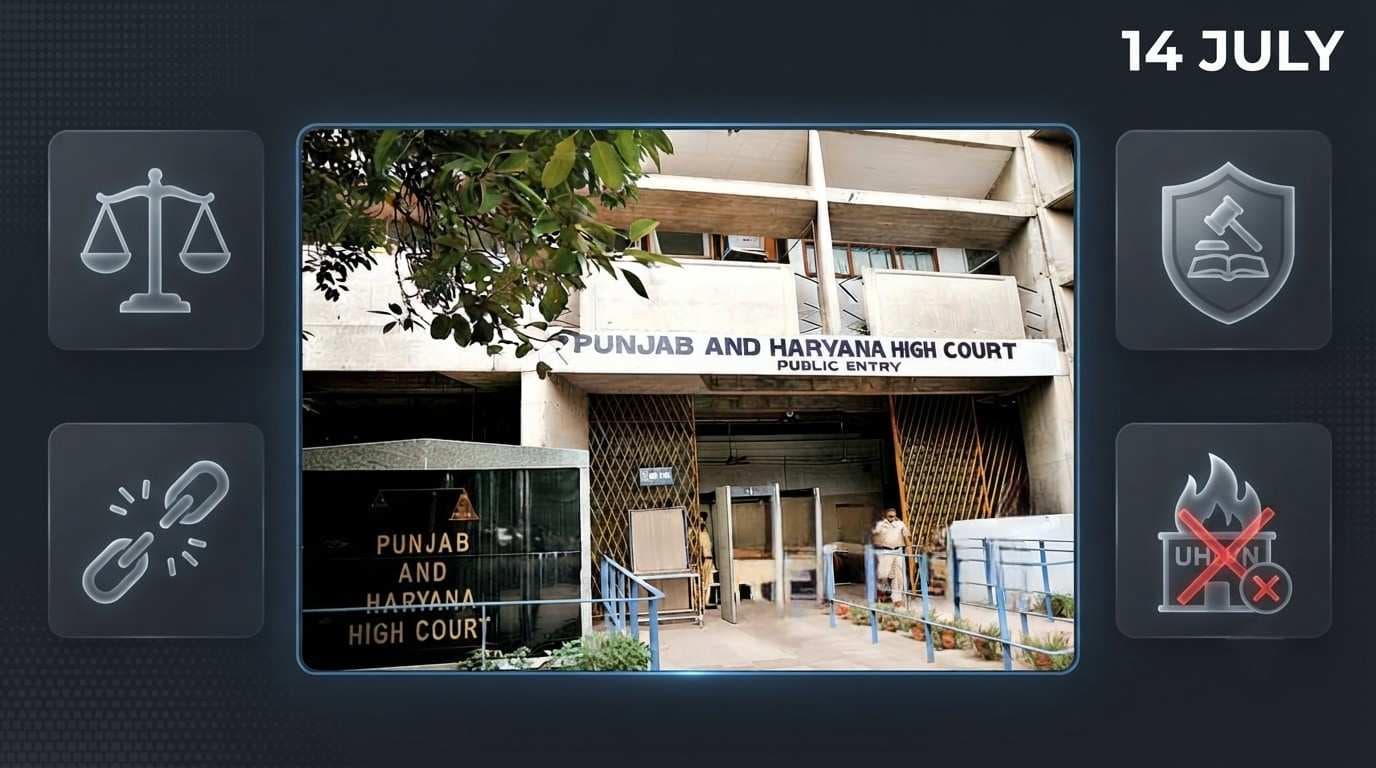
The Punjab and Haryana High Court, sitting as a Division Bench comprising Justice Vinod S. Bhardwaj and Justice Sukhvinder Kaur, has dismissed the appeal filed by the State of Haryana against the acquittal of four followers of Dera Sacha Sauda chief Gurmeet Ram Rahim Singh. The accused were charged with vandalising and setting ablaze the office of the Uttar Haryana Bijli Vitran Nigam Limited (UHBVN) at Kalayat in Kaithal district during the unrest that erupted after the Dera chief’s conviction in August 2017. The trial court had acquitted the four individuals, and the State sought to overturn that decision.
The Bench examined whether the prosecution had discharged its burden of proving the offences beyond reasonable doubt. The charges framed against the accused included allegations of sedition under Section 124A of the Indian Penal Code, arson under Sections 435 and 436, and mischief amounting to vandalism under Section 425. The Court observed that the prosecution failed to adduce sufficient evidence to establish the essential ingredients of any of these offences.
On the sedition charge, the Court noted that the prosecution did not establish that the accused had attempted to bring into hatred or contempt, or excite disaffection towards the Government established by law. The evidence presented did not show any overt act or speech that satisfied the ingredients of Section 124A, and the Bench held that mere presence at the scene of violence, without proof of incitement, was insufficient to sustain a sedition conviction.
Regarding arson, the Bench emphasised that the prosecution must prove that the accused intentionally caused damage by fire to property. The Court found that the evidence relied upon by the State consisted largely of circumstantial material and statements that were not corroborated by independent witnesses or forensic proof. The absence of direct evidence linking the accused to the act of setting fire led the Court to conclude that the prosecution had not satisfied the standard of proof required for arson.
On the mischief/vandalism charge, the Court reiterated that the offence under Section 425 requires proof of an act done with intent to cause wrongful loss or damage to property, or knowledge that such loss is likely to be caused. The Bench observed that the prosecution’s case rested on unverified assertions and did not demonstrate that the accused had the requisite mens rea or had committed the actus reus of vandalism. Consequently, the charge could not be sustained.
The Division Bench further highlighted the presumption of innocence that accrues to every accused person and stressed that the State must prove guilt beyond reasonable doubt. The Court noted that the trial court’s appreciation of evidence was sound and that no illegality or jurisdictional error was apparent in the acquittal order. Accordingly, the appeal was dismissed and the acquittal upheld.
The decision underscores the importance of a rigorous evidentiary standard in cases arising from mass violence, where emotions run high and the risk of over‑charging is pronounced. By insisting on proof of each ingredient of the alleged offences, the Court reaffirmed that prosecutorial enthusiasm cannot substitute for concrete evidence. The ruling also serves as a reminder to investigative agencies to gather reliable, corroborative material before proceeding with serious charges such as sedition and arson, particularly in situations involving large‑scale public disorder.
In practical terms, the judgment leaves the four accused free of criminal liability for the specific incidents at the UHBVN office in Kalayat. The State of Haryana may consider alternative legal remedies, but any further prosecution would require fresh evidence that meets the stringent burden of proof demanded by the High Court. The case thus contributes to the evolving jurisprudence on the limits of prosecutorial power in communal violence scenarios and reinforces the safeguards enshrined in criminal law to protect individuals from conviction on insufficient grounds.