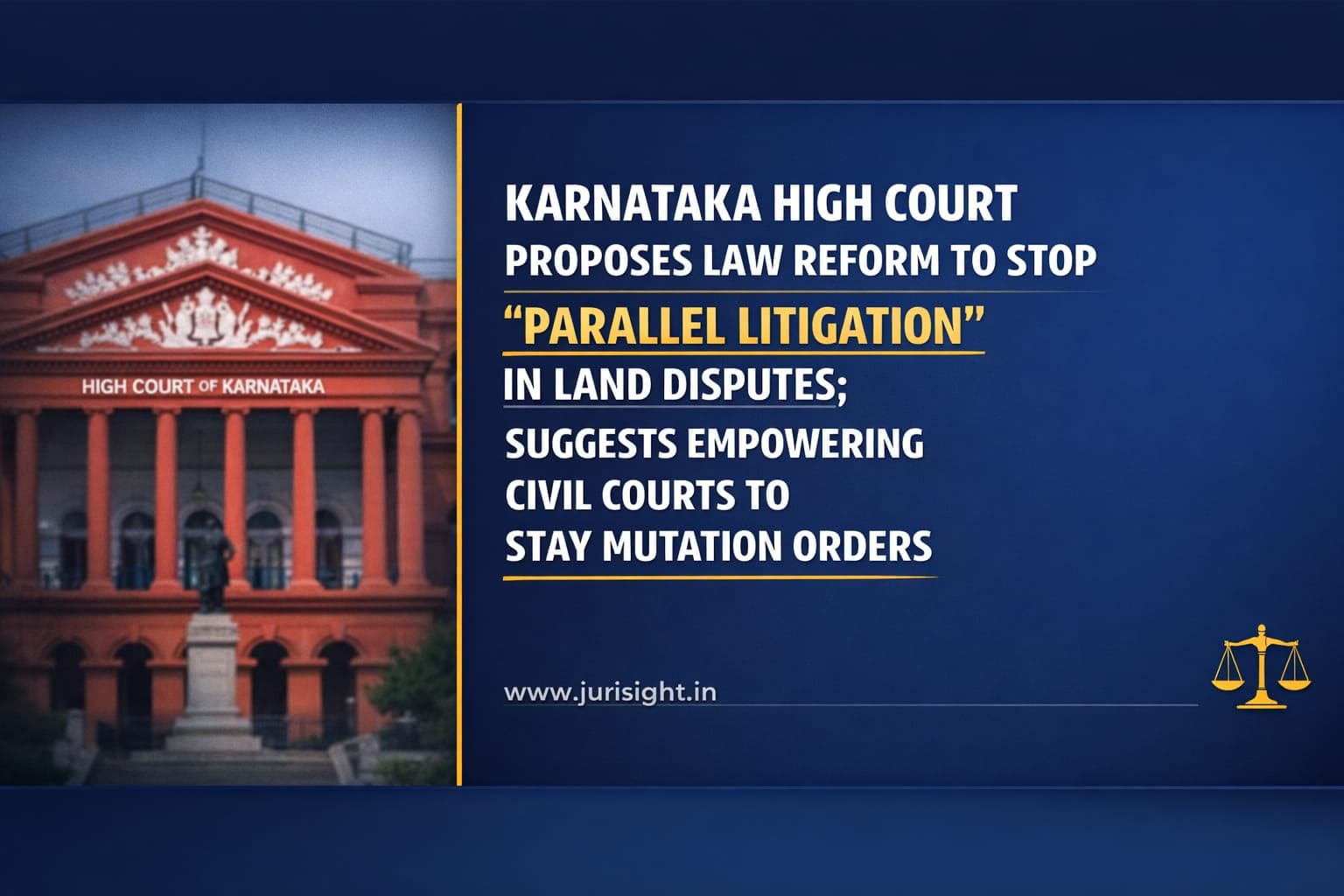
DHARWAD: In a significant move aimed at reducing the burden on both litigants and the judiciary, the Karnataka High Court has suggested a major overhaul of how land record (mutation) disputes are handled in the state. Justice Anant Ramanath Hegde, presiding over the Dharwad bench, pointed out a "lacuna" or gap in the current law that often forces people into a never-ending cycle of legal battles across different forums for the same piece of land.
The Court suggested that the State Legislature should consider empowering Civil Courts to stay mutation orders passed by revenue officials. This, the Court believes, would prevent unnecessary "parallel proceedings" where a person is fighting a case in a revenue office and a civil court at the same time for the same property.
The ruling came during the hearing of a petition (Writ Petition No. 100504 of 2021) filed by Shri Rukmanna. The case centered around a classic property dispute: a claim to land based on a "Will."
Initially, the Tahasildar (a local revenue officer) had changed the land records (mutation) in favor of the petitioner based on a Will. This decision was supported by the Assistant Commissioner. However, the Deputy Commissioner later stepped in and cancelled this mutation, ordering that the land records should instead show the names of the "natural heirs" (the immediate family members who would normally inherit the property).
The Deputy Commissioner’s reasoning was simple: revenue officers do not have the legal power to decide if a Will is genuine or not. Only a Civil Court has that authority.
The petitioner approached the High Court, asking it to set aside the Deputy Commissioner’s order and restore the mutation based on the Will. But there was a catch—the family members (respondents) revealed that a Civil Court had already looked into the matter and had already ruled that the Will in question was not proved.
Justice Hegde dismissed the petition, reinforcing a well-settled legal principle in India: Revenue Authorities (like Tahasildars or Commissioners) do not have the jurisdiction to decide claims based on a Will.
The Court explained that the job of revenue officers is primarily "fiscal"—they maintain records for tax and administrative purposes. When a person claims property through a Will, and others dispute it, the revenue officer cannot conduct a trial to check the Will's validity. That complex task is strictly reserved for a Civil Court, where evidence is recorded and witnesses are cross-examined.
“The Deputy Commissioner followed the well-settled position of law in this regard and has set aside the mutation based on the Will. There is no merit in the petition,” the Court noted.
While the specific case was straightforward, Justice Hegde used the opportunity to highlight a much larger problem affecting thousands of farmers and landowners in Karnataka. Under the Karnataka Land Revenue Act, 1964, specifically Chapter XI, there is a confusing overlap of powers.
Currently, if someone is unhappy with a land record entry, the process usually looks like this:
- Tahasildar passes an order.
- An Appeal is filed before the Assistant Commissioner.
- A Revision (a type of review) is filed before the Deputy Commissioner.
- Finally, a Writ Petition is filed in the High Court.
The problem? None of these four stages can actually "finalize" who owns the land if there is a title dispute. Even after going all the way to the High Court, the parties are often told: "Go to a Civil Court to prove your ownership."
Justice Hegde observed that Section 135 of the Act technically bars suits against the government regarding land entries, but its "proviso" allows people to file a civil suit for a "declaration of right."
The Court noted that because the Land Revenue Act doesn't clearly give Civil Courts the power to "stay" or "pause" a mutation order passed by a Tahasildar, people feel forced to keep fighting in the revenue department just to keep the records from changing.
This creates a "parallel" system where:
- Forum A (Revenue Department): The parties fight over whose name should be on the paper.
- Forum B (Civil Court): The parties fight over who actually owns the land.
The Court remarked, "It is high time to revisit the law which encourages parallel proceedings before various forums... the law in the present form is encouraging multiple proceedings in different forums over one lis (dispute)."
Justice Hegde offered several specific suggestions to the Law Commission and the State Legislature to streamline justice:
1. Empower Civil Courts to Grant Stays on Mutations The Court suggested that if a person files a comprehensive civil suit regarding property title or possession, the Civil Court should have the explicit power to stay the operation of any mutation orders passed by revenue authorities. If the Civil Court can pause the revenue order, the parties won't feel the need to rush to the Assistant Commissioner, Deputy Commissioner, or High Court for temporary relief.
2. Make the Deputy Commissioner’s Revision Optional or Unnecessary The Court noted that most disputes travel from the Tahasildar all the way to the High Court, yet the High Court ultimately says the result depends on the Civil Court. Justice Hegde suggested that a "Revision" before the Deputy Commissioner might be an "unnecessary exercise" in cases where a title dispute is already destined for a Civil Court.
3. Direct Route to Civil Court Referencing a Full Bench decision in the case of Jayamma vs. State of Karnataka, the Court reminded litigants that they don't have to finish all revenue appeals before going to a Civil Court. If there is a title or possession dispute, one can go straight to the Civil Court.
The Court emphasized that the current "sequential" litigation (moving from one officer to the next) results in "avoidable delay." For a common citizen, this means spending years and significant money on lawyers in different offices, only to be told at the end of ten years that they need to start a fresh case in a Civil Court.
"The exercise before the Revenue Authority where there cannot be any conclusive decision relating to title and possession... is unnecessary. Such a situation has to be avoided in the interest of a litigant seeking justice," the Court said.
By dismissing the petition, the High Court upheld the rule of law regarding Wills and land records. However, the lasting impact of this judgment lies in its call for reform.
To ensure these suggestions reach the right ears, the Registry of the High Court has been directed to send copies of this order to:
- The Chairman of the Karnataka State Law Commission.
- The Principal Secretary of the Department of Parliamentary Affairs and Legislation.
- The Principal Secretary of the Department of Revenue.
This judgment serves as a roadmap for the Karnataka government to simplify land laws, reduce the massive backlog of "Writ Petitions" in the High Court, and most importantly, save the common man from the exhausting maze of parallel legal battles.
Case Details:
- Case Title: Shri Rukmanna v. The Deputy Commissioner & Others
- Case Number: Writ Petition No. 100504 of 2021
- Court: High Court of Karnataka (Dharwad Bench)
- Judge: Hon'ble Justice Anant Ramanath Hegde