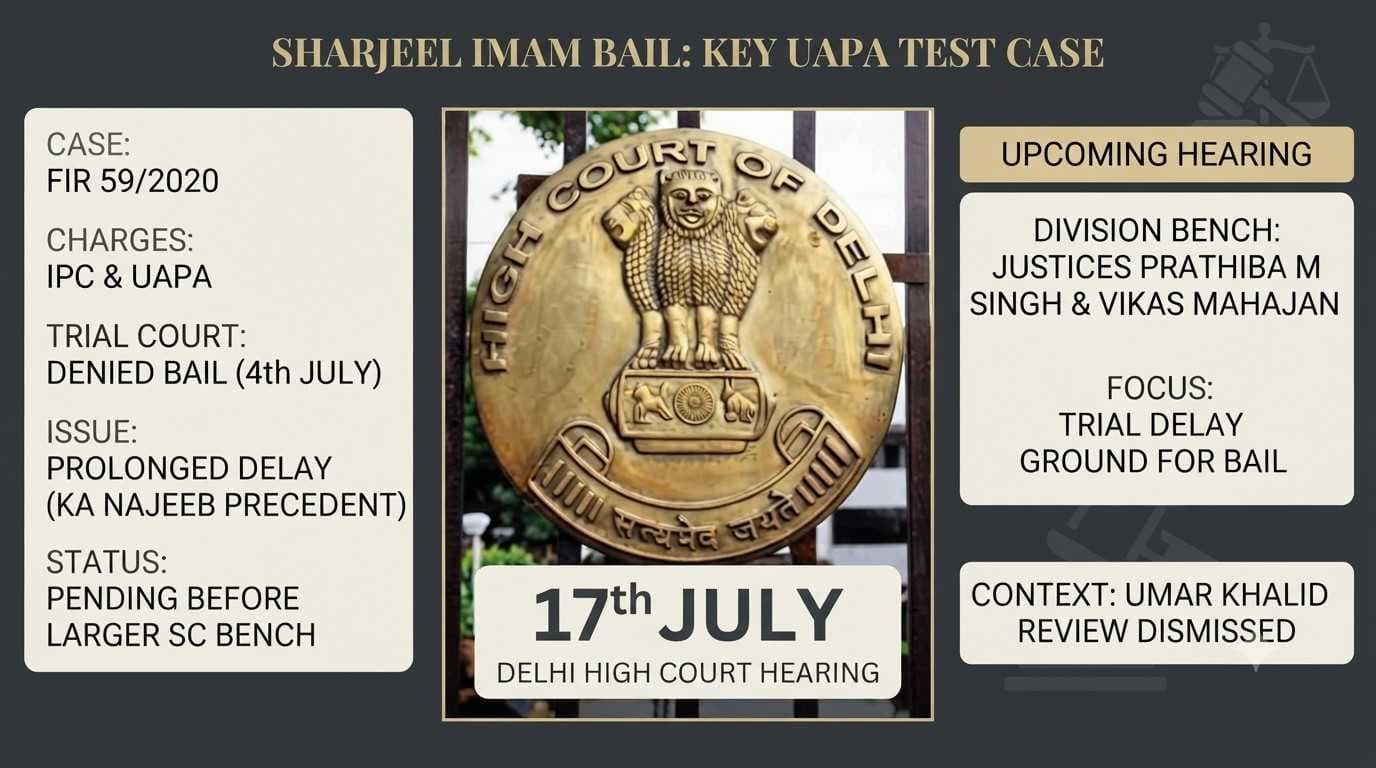
Sharjeel Imam has filed an application in the Delhi High Court seeking bail in the case registered as FIR 59 of 2020, which alleges a larger conspiracy in the commission of the 2020 North East Delhi riots. The case is being investigated by the Special Cell of Delhi Police and includes charges under the Indian Penal Code, 1860 and the Unlawful Activities (Prevention) Act, 1967. The application challenges the order passed by the trial court on July 04, 2024, which denied Imam bail.
The trial court, in its order, observed that the judgment in the matters of Gulfisha Fatima and Syed Iftikhar Andrabi had already been referred to a larger bench by the Supreme Court. Consequently, unless the issue is settled by that bench, the trial court felt constrained from considering Imam’s bail application on any ground. The trial judge further stated that he had no option but to follow the Supreme Court’s judgment that had denied bail to Imam.
The Supreme Court, on January 05, 2024, passed an order granting bail to Gulfisha Fatima, Meera Haider, Shifa Ur Rehman, Mohd. Saleem Khan and Shadab Ahmed, while denying bail to Umar Khalid and Sharjeel Imam. Following that order, Imam filed regular bail pleas after a coordinate division bench of the Supreme Court, led by Justice BV Nagarathana, expressed reservations about the Gulfisha Fatima judgment. That bench noted that the judgment did not adequately follow the principle laid down in the three‑judge bench decision in Union of India v KA Najeeb (2021), which had recognised prolonged delay in trial as a permissible ground for granting bail in cases under the UAPA.
In May 2024, a division bench headed by Justice Aravind Kumar, which had previously rejected the bail pleas of both Khalid and Imam, observed that there was a perceived conflict among different benches regarding the interpretation of the Union of India v KA Najeeb judgment. The bench therefore referred the question of whether long delay in trial can be treated as a ground for bail in UAPA cases to a larger bench for authoritative clarification.
The Supreme Court, in its January 05 order, also indicated that Imam would be at liberty to renew his bail prayer only after either the completion of the examination of the protected witnesses in the case or the expiry of one year from the date of the said order, whichever occurs earlier. This condition was reiterated by the trial court when it refused bail.
For context, Umar Khalid had earlier filed a review petition challenging the Supreme Court’s January 05 order denying him bail; that petition was dismissed by the Court. Imam’s current application before the Delhi High Court is therefore premised on the argument that the issue of bail eligibility under the UAPA, particularly concerning trial delay, remains pending before a larger bench and that the trial court’s reliance on the Supreme Court’s judgment is premature.
The Delhi High Court will hear the matter tomorrow. The division bench comprising Justice Prathiba M Singh and Justice Vikas Mahajan will consider the submissions of the parties, the trial court’s order, and the prevailing judicial discourse on the interplay between trial delay and bail provisions under the UAPA. The outcome of the hearing may influence the procedural trajectory of the larger conspiracy case and the broader jurisprudence on bail in UAPA proceedings.