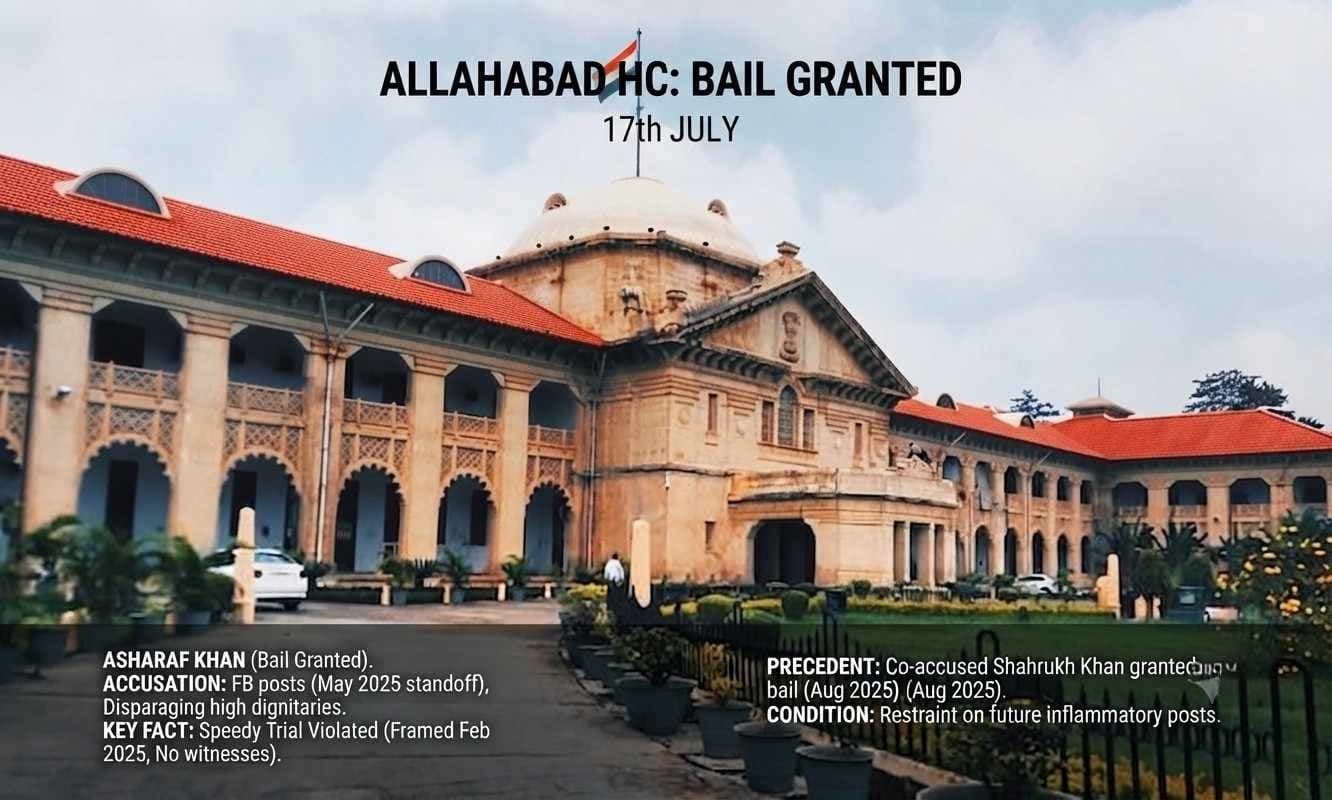
The accused, Asharaf Khan alias Nisrat, was taken into custody in May 2025 following allegations that he uploaded edited videos on his Facebook account during the 2025 India‑Pakistan military standoff. The prosecution contended that the videos depicted the Prime Minister of India in a disparaging manner, showed an Indian Air Force officer in the company of Pakistan’s Army Chief, and contained statements such as “Pakistan Air Force Zindabad” alongside imagery of an Indian aircraft being destroyed. Additional posts were said to target the Defence Minister and the Prime Minister. The charges were framed under Sections 152 and 197 of the Bharatiya Nyaya Sanhita, and the trial court recorded the framing of charges in February 2025.
In July 2025 the same bench considered the accused’s first bail application and refused it. The court observed that the constitutional guarantee of freedom of speech does not extend to acts that show disrespect to high dignitaries or that create disharmony among citizens. It further remarked that a tendency had emerged among certain groups to misuse social media under the pretext of free expression by levelling unfounded allegations against public officials and spreading content that fosters hatred.
When the second bail plea was heard, Justice Arun Kumar Singh Deshwal emphasized that a speedy trial is a fundamental right of the accused. The bench pointed out that, despite the charges having been framed in February 2025, the trial court had not examined a single witness up to the date of the hearing. This prolonged inaction, the court noted, violated the accused’s right to a timely trial and weighed in favour of granting bail.
The bench also took into account the position of a co‑accused, Shahrukh Khan, who had been alleged to be the primary person responsible for making the objectionable video viral. Shahrukh Khan had already been enlarged on bail by a coordinate bench in August 2025. The court noted that the principal allegation against the present accused was therefore less direct, which influenced its assessment of the need for continued custody.
Accordingly, the Allahabad High Court granted bail to Asharaf Khan alias Nisrat. The order imposed a condition that the accused shall not upload any content on social media that could encourage separatist sentiments or be prejudicial in respect of any particular community. The bench further restrained him from posting material that might be construed as disrespectful to high dignitaries or that could foment disharmony among citizens.
The decision underscores the judiciary’s insistence on protecting the right to a speedy trial while simultaneously upholding the permissible limits of free expression under the Constitution. By conditioning the release on restraint from posting objectionable material, the court sought to balance the accused’s liberty interests with the need to preserve public order and respect for constitutional authorities. The order also signals that allegations of viral dissemination will be scrutinised for their attribution to specific individuals, as demonstrated by the differing treatment of the co‑accused who had already secured bail.