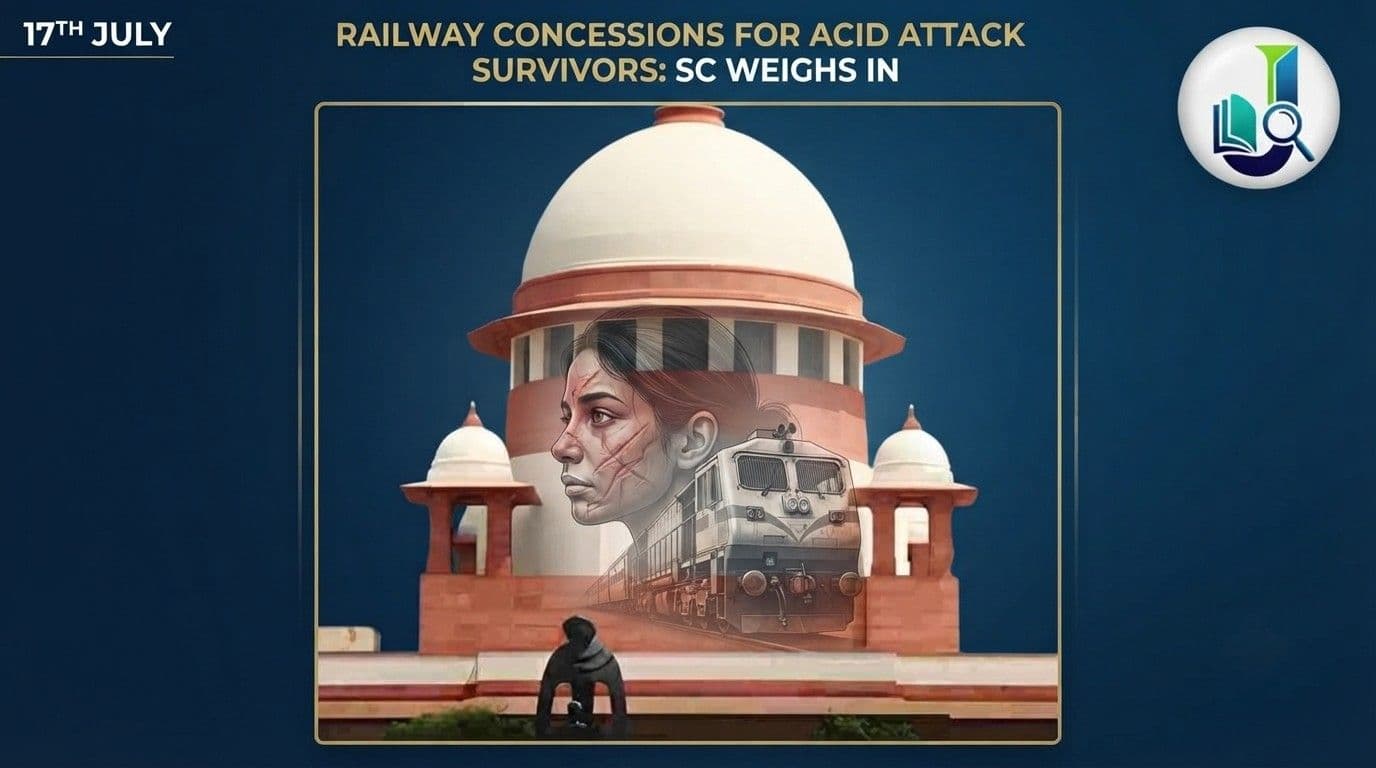
The Supreme Court bench comprising Chief Justice Surya Kant, Justice Joymalya Bagchi and Justice V Mohana heard a public interest litigation filed by Atijeevan Society seeking concessional fares and an emergency reservation quota in Indian Railways for acid‑attack survivors. During the proceedings, Additional Solicitor General Archana Pathak Dave informed the court that the Union government is presently deliberating on extending emergency quotas to all persons with disabilities, a category that would subsume acid‑attack survivors if the proposal is adopted.
She outlined the present concession framework, stating that out of the twenty‑one recognised disability categories, railway concessions and emergency quotas are currently limited to four groups: orthopaedically handicapped or paraplegic persons, persons with intellectual disabilities, visually impaired individuals (whether travelling alone or with an escort), and persons with complete speech and hearing impairment. The ASG noted that these beneficiaries typically require full‑time escorts during travel.
Counsel for the petitioner, Anandh Venkataramani, countered that the Railways in fact extend reservation benefits to nine disability categories, enumerating thalassaemia, haemophilia, sickle cell disease and persons who are deaf and dumb among them. He traced the origin of the coaching tariff that underpins the concession scheme, noting that it was first introduced in 1902 and subsequently revised in 1999 and 2015, i.e., prior to the enactment of the Rights of Persons with Disabilities Act, 2016 (RPwD Act). Venkataramani argued that the concessions historically granted by the Railways were purely benevolent measures and lacked statutory foundation until Section 41(2) of the RPwD Act came into force in 2016, which now obliges the Railways to provide such facilities.
He further submitted that acid‑attack survivors are predominantly women who sustain facial injuries necessitating prolonged medical treatment, including skin grafts, ocular surgery and periodic check‑ups. Because specialised care is often available only in multi‑specialty hospitals located in major cities, survivors frequently undertake long‑distance travel for therapy. The bench, responding to these submissions, asked the ASG to explain why acid‑attack survivors cannot be placed on par with cancer patients or persons suffering from other chronic ailments for the purpose of availing concessional railway fares and emergency quota.