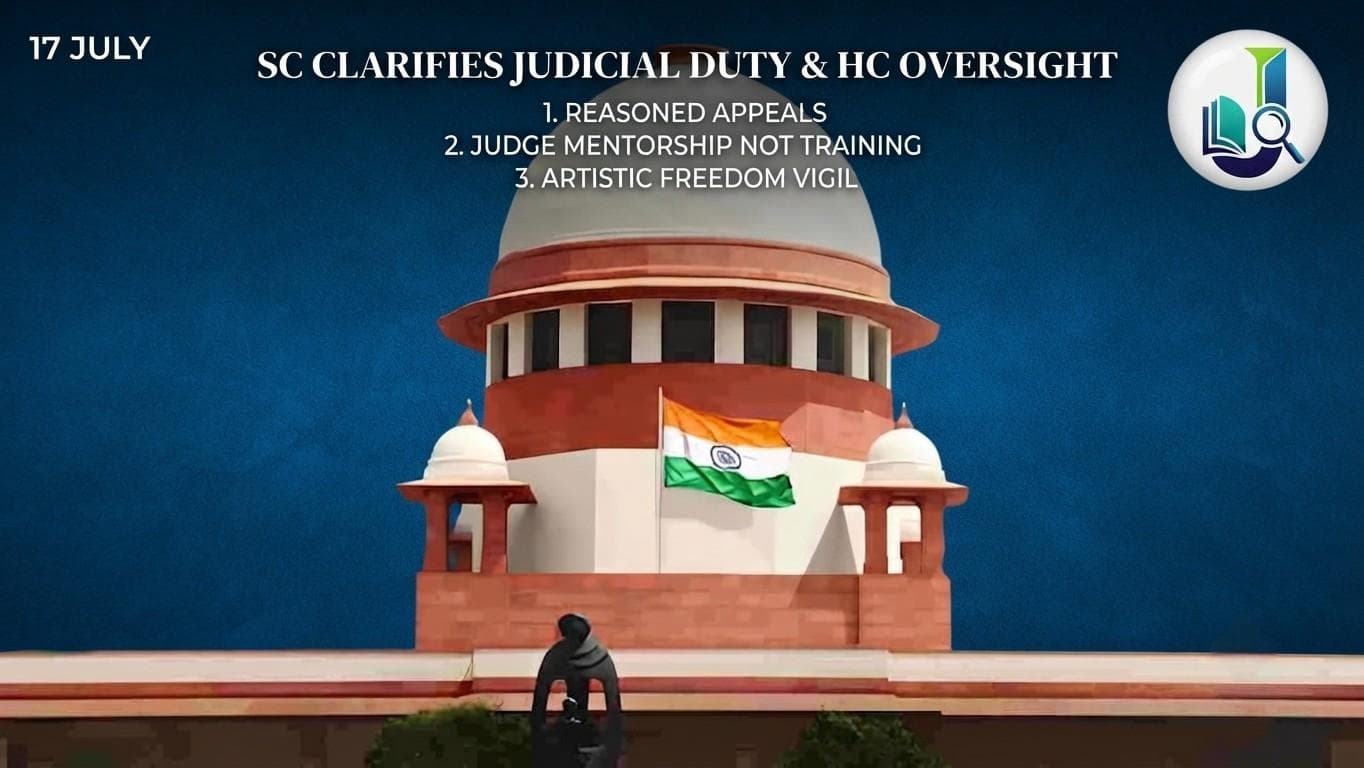
The Supreme Court of India, sitting on July 16, 2026, delivered a series of observations that clarify the appellate jurisdiction, the supervisory role of higher courts over subordinate judiciary, and the procedural recourse available to parties aggrieved by high court orders. The remarks were made in the course of routine proceedings and were recorded in the Supreme Court Daily Round‑Up for that date.
Appellate Courts Must Provide Independent Reasons
The Court held that an appellate court cannot simply overturn a trial court’s verdict by labelling it erroneous. It emphasized that the appellate authority must apply its own mind and record independent reasons for any reversal or modification. The Bench explained that the duty of an appellate court is to re‑evaluate the evidence and legal conclusions, not to adopt the trial court’s findings wholesale or to reject them without a reasoned analysis. The Court warned that a mechanical approach undermines the purpose of appellate review and risks violating the principle of reasoned adjudication.
Further, the Court noted that the requirement to give independent reasons serves to enhance transparency and allows the parties to understand the basis of the appellate decision. It observed that when an appellate court merely echoes the trial court’s reasoning or dismisses it without explanation, the aggrieved party is deprived of a meaningful opportunity to challenge the decision on merit. The Bench therefore directed that all appellate judgments must contain a distinct discussion of the facts, the applicable law, and the reasoning that leads to the final order.
Appellate Courts to Act as Friend, Philosopher and Guide
In a separate observation, the Supreme Court expressed disapproval of a high court direction that had ordered a subordinate judge to undergo training. The Court stated that such a directive exceeds the appropriate scope of appellate supervision. It reminded the high courts that their role vis‑à‑vis subordinate judicial officers is that of a friend, philosopher and guide, not that of a disciplinary authority imposing punitive measures.
The Bench explained that the friend‑philosopher‑guide model entails offering guidance, sharing judicial wisdom, and assisting subordinate judges in improving their performance through mentorship and constructive feedback. It cautioned against issuing orders that compel training or other corrective actions without first providing an opportunity for the concerned judge to explain his or her conduct. The Court held that any corrective measure must be proportionate, preceded by a show‑cause notice, and grounded in the principles of natural justice.
The Court added that the high court’s direction, in the present instance, failed to meet these safeguards and therefore was set aside. It reiterated that the supervisory jurisdiction of high courts must be exercised with restraint and with the objective of strengthening judicial independence rather than undermining it.
Film Makers Seek Relief Against Orissa High Court Ban
The third item recorded in the round‑up noted that the producers of the film titled “Mahaprabhu Jagannath” have approached the Supreme Court challenging a ban imposed by the Orissa High Court. The Court did not elaborate on the merits of the ban or the relief sought in the excerpt, but it acknowledged the filing of a special leave petition or equivalent remedy by the film makers.
The Bench indicated that it would examine whether the high court’s order restricting the exhibition or distribution of the film complied with the constitutional guarantees of freedom of speech and expression, and whether any procedural lapses attended the passing of the ban. The Court emphasized that any restriction on artistic expression must be justified under the permissible grounds laid down in Article 19(2) of the Constitution and must be proportionate to the objective sought.
The Court further observed that the entertainment industry frequently invokes judicial scrutiny when state actions impinge on creative liberty, and it affirmed its willingness to consider such petitions on an expedited basis where a prima facie case of illegality is made out.
In sum, the Supreme Court’s pronouncements on July 16, 2026 reinforce the appellate duty to reason independently, delineate the proper supervisory posture of high courts over subordinate judges, and signal a vigilant stance towards safeguarding freedom of expression in the realm of cinematic works. The observations collectively aim to promote reasoned adjudication, judicial collegiality, and constitutional protection of artistic liberty.