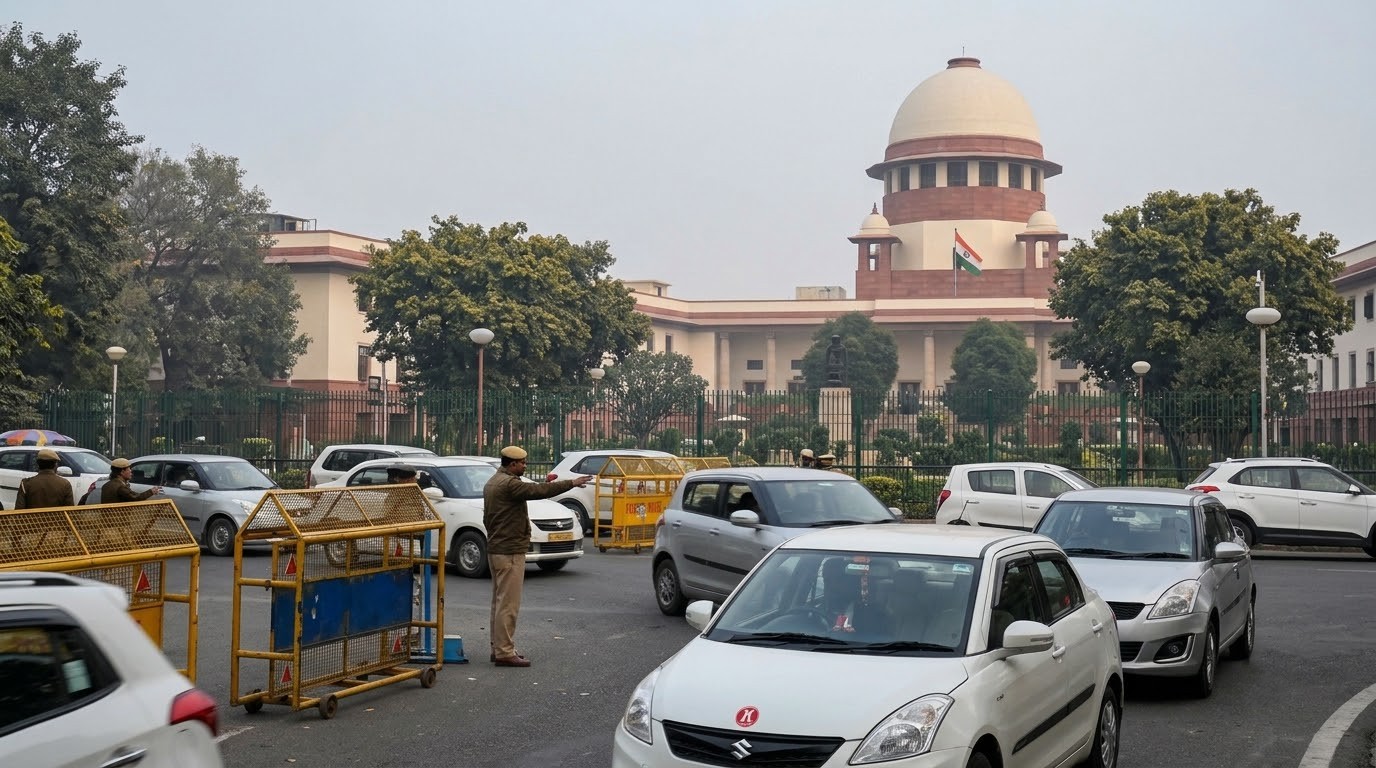
The Supreme Court Bar Association (SCBA) has formally requested the Supreme Court administration to intervene with the Delhi Government for an exemption allowing advocates to enter the capital in vehicles that do not meet Bharat Stage VI (BS-VI) emission standards. The restriction, part of the Delhi Government’s winter pollution control measures, takes effect on November 1, 2026, and remains in force until January 31, 2027.
In a letter dated October 31, 2026, addressed to the Secretary General of the Supreme Court, SCBA Honorary Secretary Pragya Baghel highlighted that a large number of advocates practising before the Supreme Court commute daily from neighbouring National Capital Region (NCR) towns such as Noida, Ghaziabad, Faridabad, and Gurugram. The letter emphasised that junior advocates, in particular, often rely on personal vehicles to attend court proceedings.
The association argued that the entry ban on non-BS-VI compliant vehicles registered outside Delhi would impose considerable hardship on members of the Bar and could disrupt the smooth administration of justice. The letter stated that advocates constitute an integral and indispensable part of the justice delivery system, and any restriction affecting their daily commute would have a direct bearing on the effective discharge of their professional obligations.
The SCBA also drew the Registry’s attention to previous Supreme Court orders that had permitted vehicles conforming to older emission standards to operate subject to prescribed conditions. The request urges the Registry to take up the matter with the Delhi Government and concerned authorities to work out suitable exemptions or relaxations for advocates travelling to the Supreme Court.
Is the SCBA letter a judicial petition challenging the BS-VI norms?
No. The communication is an administrative representation addressed to the Supreme Court Registry, not a petition filed on the judicial side. The SCBA has not challenged the pollution control measure itself but has sought a carve-out for advocates to ensure access to justice. No judicial order has been passed on the letter so far.
Scope of the Delhi BS-VI Restriction
Parameter | Details |
|---|---|
Restriction Period | November 1, 2026 to January 31, 2027 |
Applicability | Vehicles registered outside Delhi not complying with BS-VI norms |
Key Exemptions Notified | CNG vehicles, electric vehicles, emergency service vehicles |
Target Group for Exemption Request | Advocates commuting from NCR (Noida, Ghaziabad, Faridabad, Gurugram) |
The SCBA letter follows a similar representation made a day earlier by the Delhi High Court Bar Association (DHCBA). In a letter dated October 30, 2026, addressed to the Lieutenant Governor of Delhi, DHCBA President Senior Advocate N Hariharan sought an exemption from the BS-VI restriction for judges, lawyers, and court staff.
Both bar bodies have framed their requests around the necessity of physical access to courts rather than contesting the environmental rationale underlying the curbs. The Delhi Government’s response to these administrative representations will determine whether advocates commuting from the NCR receive relaxation from the entry ban during the winter months. The outcome remains contingent on executive action, as the Supreme Court Registry has not yet conveyed a decision on forwarding the request.
The development underscores the recurring tension between stringent air quality regulations in the capital and the operational requirements of the judicial system, particularly for legal practitioners residing outside Delhi’s territorial jurisdiction.