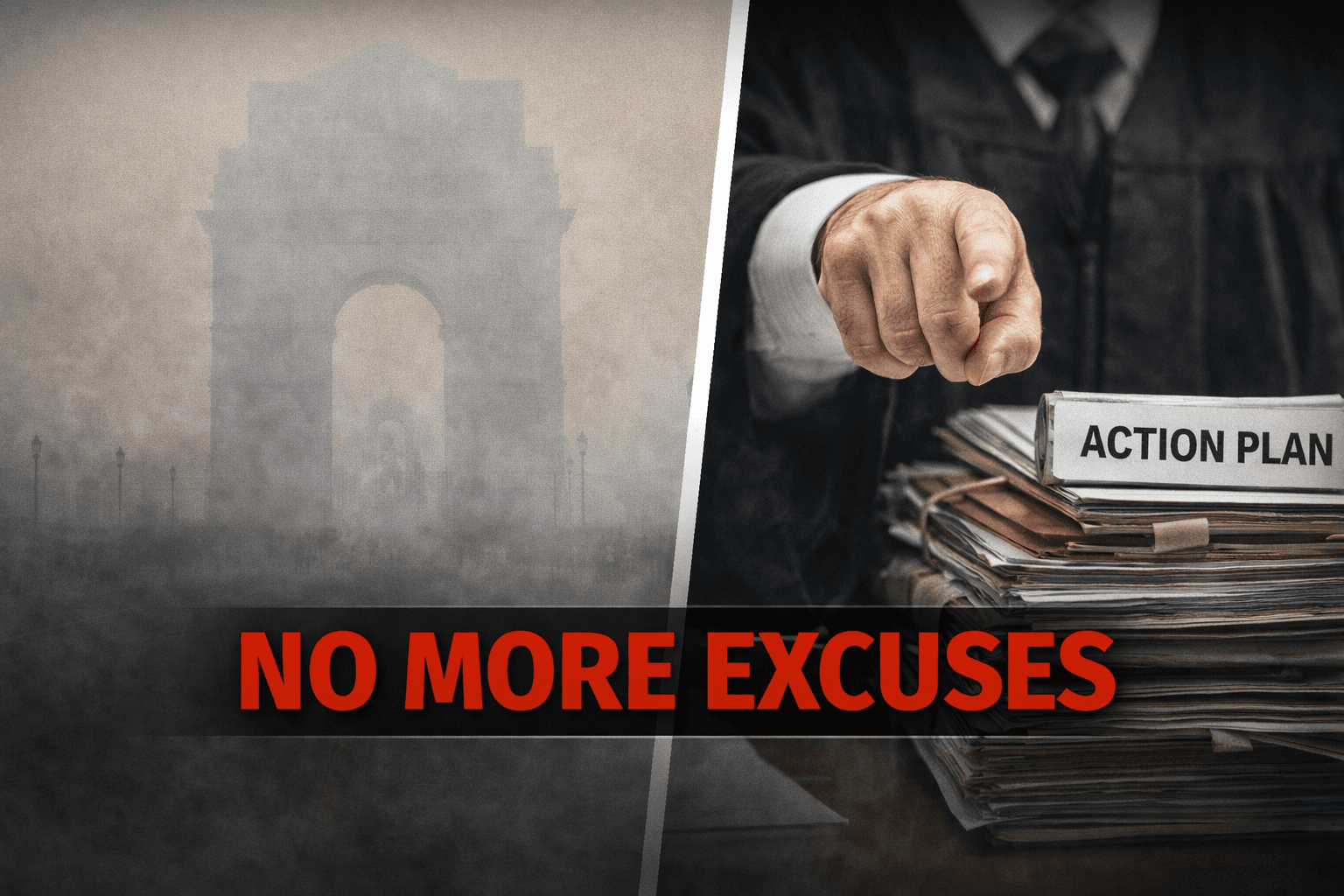
New Delhi: In a stern directive aimed at ending the bureaucratic blame game over Delhi's toxic air, the Supreme Court on Wednesday told the Centre, the Commission for Air Quality Management (CAQM), and state agencies to "stop raising objections" and start implementing long-term solutions.
The Bench, led by Chief Justice of India Surya Kant along with Justices Joymalya Bagchi and Vipul M. Pancholi, emphasized that the time for debating the causes of pollution is over. The Court accepted the comprehensive report filed by the CAQM, which outlines structural measures to tackle the crisis, and ordered all stakeholders to execute it without delay.
For years, the response to Delhi's pollution has been reactive—shutting schools or banning trucks only when the AQI hits 'Severe'. The Supreme Court has now signaled a shift away from these ad-hoc measures.
During the hearing, the Bench remarked that agencies often waste time shifting responsibility—blaming farmers for stubble burning or pointing fingers at vehicular emissions.
"The CAQM has recommended long-term measures... the Commission has also identified the concerned agencies who are competent to give effect to these. We direct all stakeholders to stop objecting and start implementing the plan."
The Court-mandated action plan targets "predictable" pollution sources that plague the NCR year-round, not just in winter:
- Vehicular Emissions: Strict phasing out of older vehicles and managing toll plaza congestion to reduce idling time.
- Stubble Burning: Moving beyond penalties to providing farmers with genuine machinery and incentives.
- Industrial Compliance: Ensuring power plants and industries adhere to emission standards without seeking repeated deadline extensions.
This order follows a sharp rebuke earlier this month where the Court observed that the CAQM appeared to be "in no hurry" to identify the causes of worsening AQI. The Bench had criticized the statutory body for seeking adjournments instead of acting. By accepting the new report and ordering immediate implementation, the Supreme Court has effectively placed the CAQM and state governments on a ticking clock.
This ruling attempts to break the cycle of "paralysis by analysis." By legally binding the agencies to a specific long-term roadmap, the Court is removing the excuse of "lack of consensus." For the residents of Delhi-NCR, this offers a glimmer of hope that future winters might be managed with structural policy changes rather than emergency lockdowns.