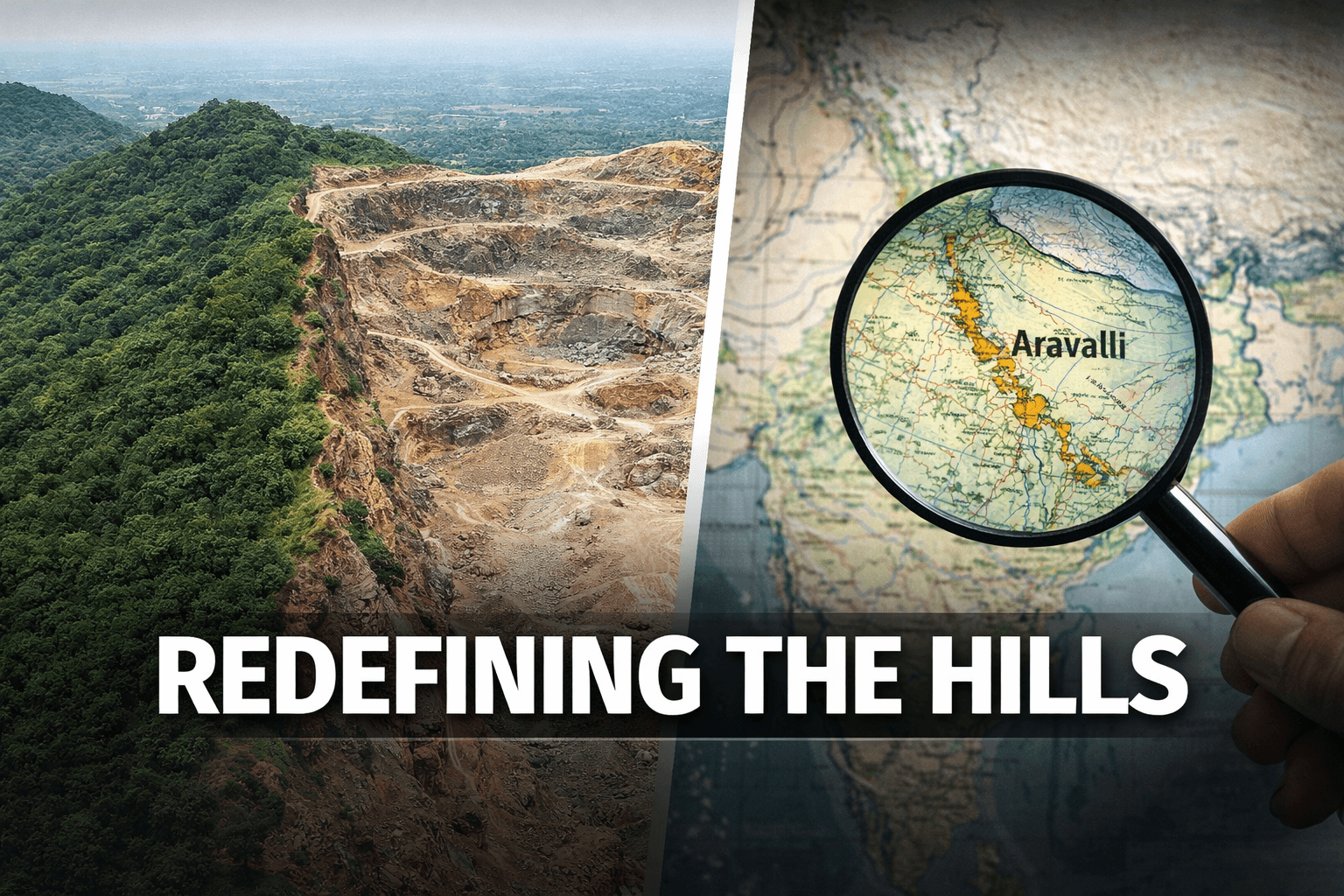
New Delhi: In a decisive move to protect one of the world’s oldest mountain ranges from irreversible degradation, the Supreme Court on Wednesday directed the constitution of a court-monitored expert committee to scientifically define the "Aravalli Hills." The Bench, led by Chief Justice of India Surya Kant, along with Justices Joymalya Bagchi and Vipul M. Pancholi, has sought names of eminent environmentalists, scientists, and forest experts to staff this panel.
This direction effectively extends the stay on the Court's own previous order (dated November 20, 2025), which had accepted a restrictive definition of the Aravallis, triggering widespread outcry among conservationists
The core of the dispute lies in a definition previously accepted by a Bench led by former CJI B.R. Gavai. That order defined "Aravalli Hills" only as landforms rising 100 meters or more above the local relief.
Critics and environmentalists argued that this definition was scientifically flawed. The Aravallis are an ancient, eroded fold mountain range; vast stretches of it—especially in Haryana and Delhi—are low-lying ridges, scrublands, and essential water recharge zones that do not meet the arbitrary "100-meter" height threshold. By applying this rule, nearly 90% of the Aravalli range would have lost its "forest" status, opening the floodgates for mining and real estate development.
Acknowledging these fears, the current Bench observed that illegal mining in these vulnerable areas could cause "irreversible damage" to the ecosystem. The Court noted that the previous committee, whose report was accepted in November, was largely bureaucratic. The new committee, in contrast, will be dominated by subject-matter experts.
The Court directed Amicus Curiae K. Parameshwar and Additional Solicitor General Aishwarya Bhati to submit a list of potential members within four weeks.
"The committee will work under the direction and supervision of this court... Illegal mining can lead to irreversible damage."
This is a rare instance of the Supreme Court "correcting course" on its own judgment within months due to public interest. The Aravallis act as a natural green wall checking the spread of the Thar Desert into the National Capital Region (NCR). If the "100-meter rule" had prevailed, the legal shield protecting these hills would have vanished, exacerbating the water crisis and air pollution in North India. The formation of this new committee signals that ecological integrity, not just physical height, will now determine what counts as a "hill."