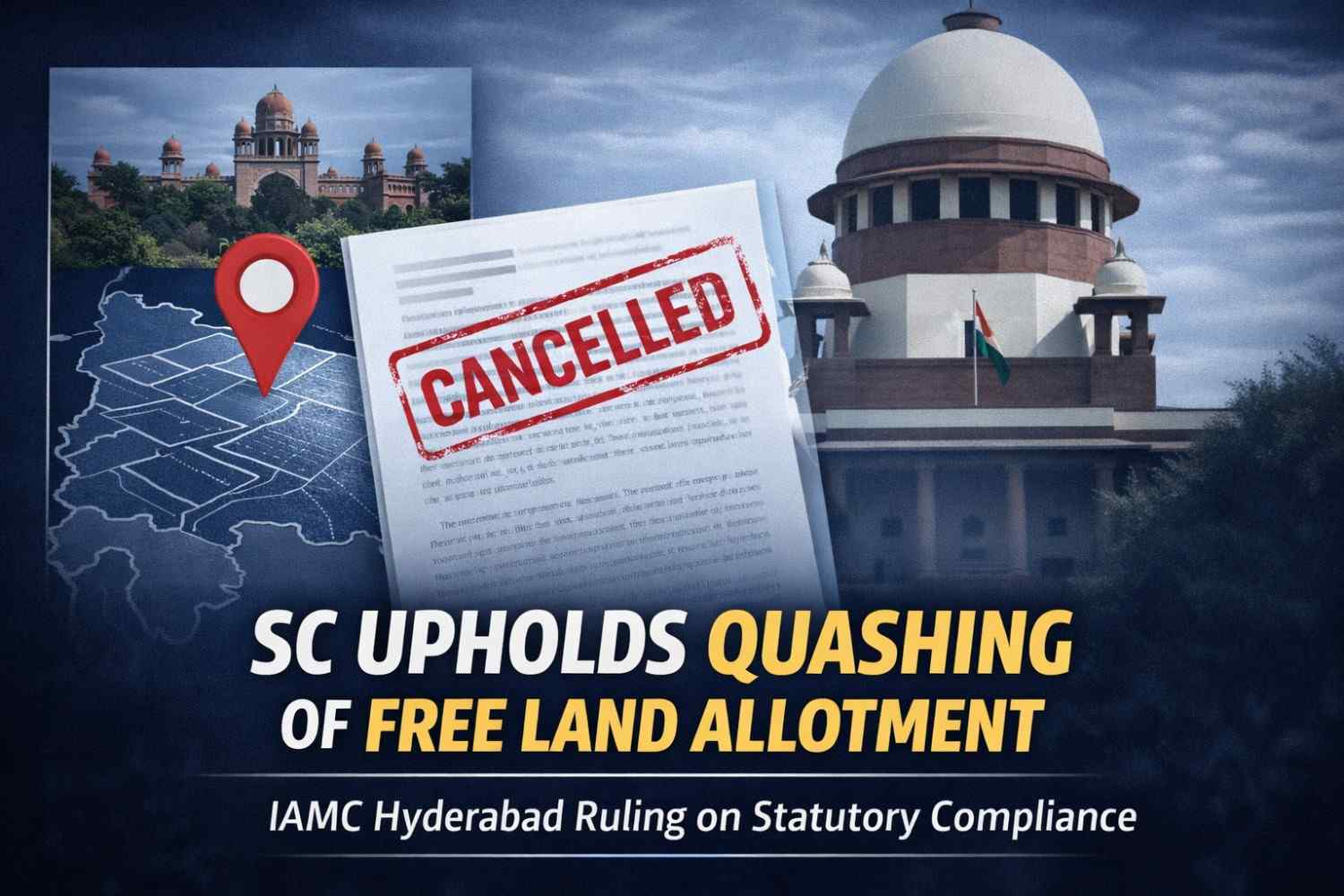
In a significant affirmation of judicial scrutiny over executive action, the Supreme Court of India on Thursday upheld the Telangana High Court’s judgment that set aside the State government’s decision to allot prime government land free of cost to the International Arbitration and Mediation Centre (IAMC), Hyderabad. A Bench comprising Justice Dipankar Datta and Justice S.V.N. Bhatti declined to interfere with the High Court’s reasoning, reinforcing that state largesse must comply with mandatory statutory procedure.
The controversy originated from a string of Government Orders issued by the State of Telangana in 2021–22, including the allotment of 3.70 acres of government land in Raidurg village, Hyderabad, to IAMC without charging market value, along with a ₹3 crore financial grant and a policy directing state departments to refer high-value disputes to IAMC for arbitration.
Two public interest litigations (PILs) challenged these orders on the ground that they constituted arbitrary distribution of state resources, flouted the statutory land-alienation framework under the Andhra Pradesh (Telangana Area) Alienation of State Lands and Land Revenue Rules, 1975, and caused loss to the public exchequer.
The High Court Division Bench of Justice K. Lakshman and Justice K. Sujana held that while promoting arbitration and mediation is a legitimate public objective, the State cannot pursue such objectives by bypassing mandatory statutory safeguards. It observed that government land could be alienated to private entities only after assessing and collecting the appropriate market value—a requirement ignored in this case.
Importantly, the High Court noted that IAMC was not registered as a company at the time of the allotment — a condition precedent for private institutional access to concessionary land — and that there was no material to show compliance with the applicable land-alienation rules. Accordingly, the land allotment was quashed as ultra vires executive power.
However, the High Court did not interfere with the Government Orders granting financial aid or the referral policy, treating them as policy decisions within the State’s discretion, absent any statutory infirmity. It also directed the government to institute periodic reviews of IAMC’s performance and utilisation of public funds.
Challenged before the Supreme Court, IAMC’s Special Leave Petitions to overturn the High Court’s order were dismissed. The Supreme Court Bench expressed that it was “not inclined to interfere” with the High Court’s judgment, effectively endorsing the High Court’s statutory and procedural analysis.
This judgment reinforces a critical constitutional and administrative law principle: state resources, especially land of high commercial value, cannot be dispensed at will without satisfying clear statutory conditions. Even when guided by noble policy objectives — such as bolstering institutional arbitration — the state must adhere to procedural safeguards designed to protect public interest and ensure transparency. The Supreme Court’s refusal to disturb the High Court’s order signals judicial resolve to hold the executive accountable for compliance with mandatory statutory norms in the realm of public resource governance.
Beyond the immediate dispute, the decision may influence how future government initiatives — especially those involving public property or discretion in resource allocation — are legally structured, reviewed, and justified before courts.In a significant affirmation of judicial scrutiny over executive action, the Supreme Court of India on Thursday upheld the Telangana High Court’s judgment that set aside the State government’s decision to allot prime government land free of cost to the International Arbitration and Mediation Centre (IAMC), Hyderabad. A Bench comprising Justice Dipankar Datta and Justice S.V.N. Bhatti declined to interfere with the High Court’s reasoning, reinforcing that state largesse must comply with mandatory statutory procedure.
The controversy originated from a string of Government Orders issued by the State of Telangana in 2021–22, including the allotment of 3.70 acres of government land in Raidurg village, Hyderabad, to IAMC without charging market value, along with a ₹3 crore financial grant and a policy directing state departments to refer high-value disputes to IAMC for arbitration.
Two public interest litigations (PILs) challenged these orders on the ground that they constituted arbitrary distribution of state resources, flouted the statutory land-alienation framework under the Andhra Pradesh (Telangana Area) Alienation of State Lands and Land Revenue Rules, 1975, and caused loss to the public exchequer.
The High Court Division Bench of Justice K. Lakshman and Justice K. Sujana held that while promoting arbitration and mediation is a legitimate public objective, the State cannot pursue such objectives by bypassing mandatory statutory safeguards. It observed that government land could be alienated to private entities only after assessing and collecting the appropriate market value—a requirement ignored in this case.
Importantly, the High Court noted that IAMC was not registered as a company at the time of the allotment — a condition precedent for private institutional access to concessionary land — and that there was no material to show compliance with the applicable land-alienation rules. Accordingly, the land allotment was quashed as ultra vires executive power.
However, the High Court did not interfere with the Government Orders granting financial aid or the referral policy, treating them as policy decisions within the State’s discretion, absent any statutory infirmity. It also directed the government to institute periodic reviews of IAMC’s performance and utilisation of public funds.
Challenged before the Supreme Court, IAMC’s Special Leave Petitions to overturn the High Court’s order were dismissed. The Supreme Court Bench expressed that it was “not inclined to interfere” with the High Court’s judgment, effectively endorsing the High Court’s statutory and procedural analysis.
This judgment reinforces a critical constitutional and administrative law principle: state resources, especially land of high commercial value, cannot be dispensed at will without satisfying clear statutory conditions. Even when guided by noble policy objectives — such as bolstering institutional arbitration — the state must adhere to procedural safeguards designed to protect public interest and ensure transparency. The Supreme Court’s refusal to disturb the High Court’s order signals judicial resolve to hold the executive accountable for compliance with mandatory statutory norms in the realm of public resource governance.
Beyond the immediate dispute, the decision may influence how future government initiatives — especially those involving public property or discretion in resource allocation — are legally structured, reviewed, and justified before courts.