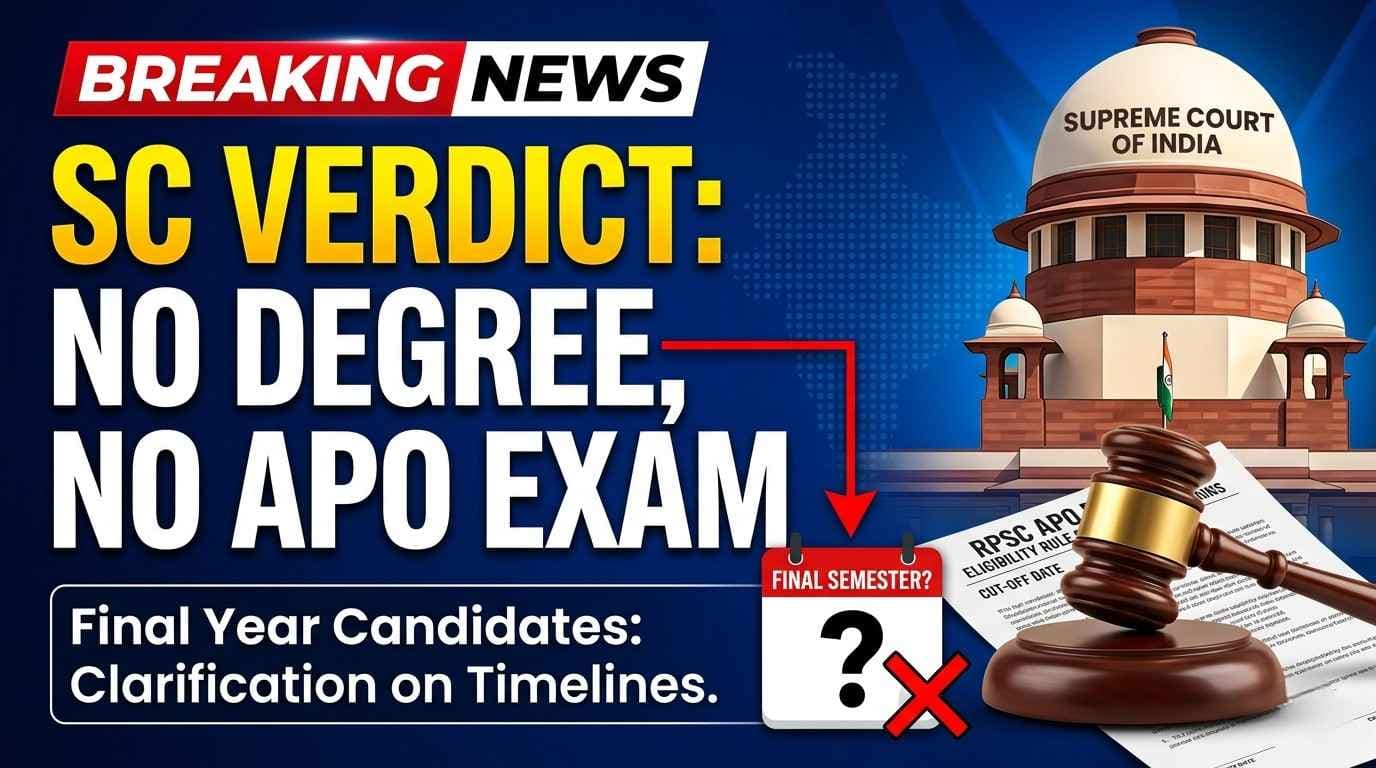
The Supreme Court of India has provided much-needed clarity on the eligibility timelines for civil service recruitments, specifically addressing the Rajasthan Assistant Prosecution Officer (APO) Examination. A bench comprising Justice Surya Kant and Justice Joymalya Bagchi ruled that candidates must possess a valid degree in law on or before the date the recruitment advertisement is issued. This judgment underscores the principle of administrative certainty and prevents the "shifting of goalposts" during the competitive examination process.
The legal dispute arose when several candidates, who were in the final semester of their LL.B. program at the time of the advertisement, sought permission to appear for the exam. They argued that since the results of their degree would be declared before the final stage of selection (the interview or the main examination), they should be considered eligible. However, the Rajasthan Public Service Commission (RPSC) and the State Government maintained that the "cut-off date" for possessing the requisite qualification is the date of the advertisement itself.
In its detailed observation, the Supreme Court referred to the Rajasthan Prosecution Subordinate Service Rules. The Court noted that unless the specific recruitment rules or the advertisement itself provides an exception—such as allowing final-year students to apply subject to producing the degree at the time of the interview—the general rule of "qualification on the date of application" must prevail. The bench emphasized that allowing candidates to acquire qualifications after the advertisement date would lead to "endless litigations and uncertainty" in public employment.
The Court highlighted that the purpose of a cut-off date is to provide a uniform standard for all applicants. If candidates without degrees were allowed to compete, it could potentially disadvantage those who refrained from applying because they strictly followed the eligibility criteria mentioned in the notification. Justice Surya Kant remarked that "sanctity of the recruitment process" relies on the strict adherence to the timelines and qualifications stipulated at the very beginning of the exercise.
This ruling has significant implications for law students and competitive exam aspirants across the country. It reinforces the standard that "eligibility is not a rolling window" but a fixed point in time. For the RPSC, this judgment allows the APO recruitment process to proceed without the risk of being stalled by late-eligible candidates seeking entry into the merit list.
Furthermore, the judgment touches upon the broader administrative law principle that the "rules of the game cannot be changed once the game has started." While the Court expressed sympathy for bright students nearing the completion of their courses, it maintained that judicial compassion cannot override statutory rules governing public appointments. The bench clarified that the state has the prerogative to set the bar for entry into the prosecution service, which is a vital arm of the criminal justice system.
As a result of this decision, the RPSC will now strictly filter the applications for the Assistant Prosecutor post based on the date of the initial notification. Candidates are advised to ensure they have their provisional or original degrees in hand before applying for future vacancies, as the "final year appearing" status will only be valid if explicitly mentioned in the official advertisement.
In conclusion, the Supreme Court’s decision brings a definitive end to the ambiguity surrounding the Rajasthan APO eligibility. By prioritizing the "date of advertisement" as the definitive marker for qualifications, the Court has ensured a transparent, predictable, and fair recruitment process for all law graduates. This judgment serves as a vital precedent for various state commissions navigating similar challenges in public service examinations.