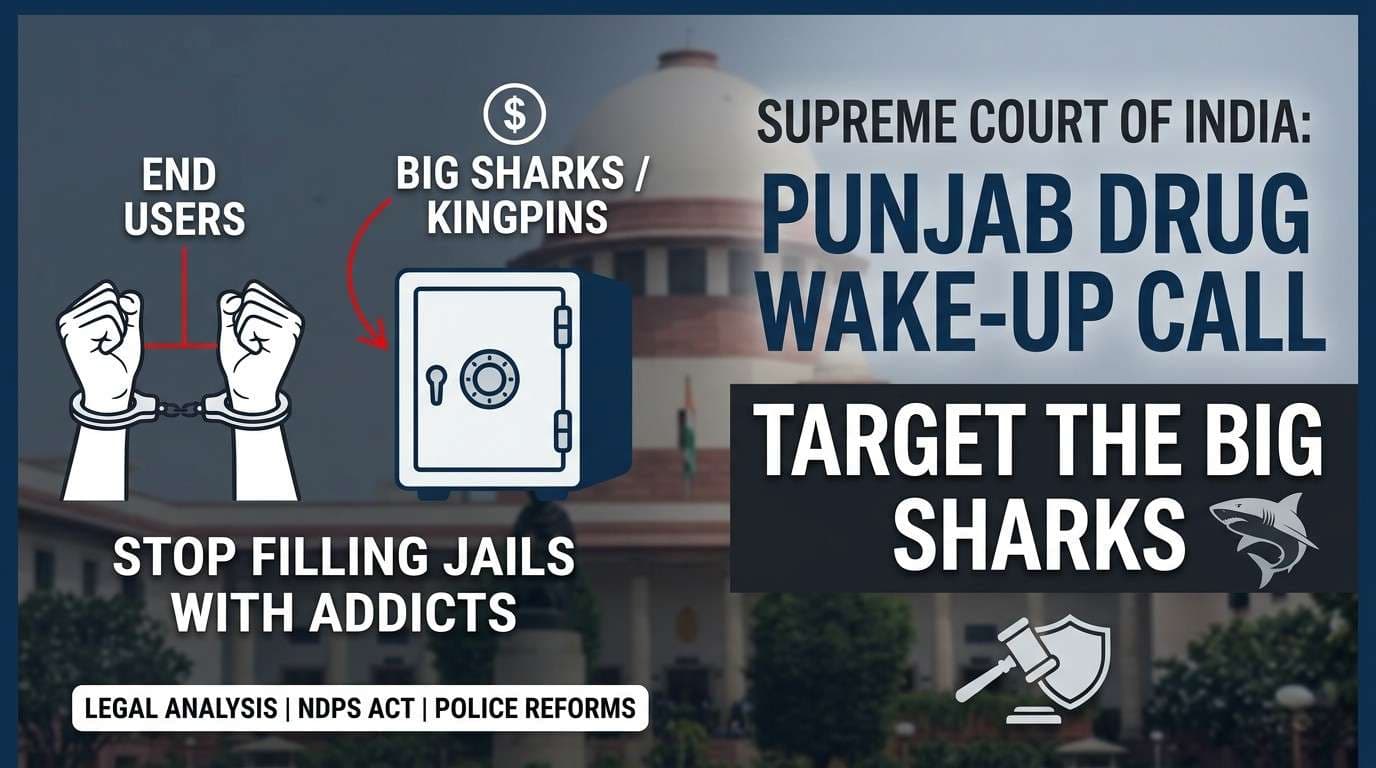
The Supreme Court of India has issued a stern wake-up call to the Punjab administration, expressing deep concern over the persistent drug epidemic that continues to hollow out the state’s youth. In a recent hearing, the bench—led by Justice Surya Kant—raised a "red alert," observing that the current law enforcement strategy appears to be disproportionately focused on "small players" and addicts, while the "big sharks" or kingpins of the narcotics trade remain largely untouched. This judicial intervention marks a pivotal shift, demanding a transition from performative arrests to a strategic, intelligence-led dismantling of the multi-layered trafficking networks.
The Court’s critique touches upon a long-standing grievance in the implementation of the Narcotics Drugs and Psychotropic Substances (NDPS) Act. While police records often show a high volume of FIRs and arrests, a closer look reveals that many of those detained are "end-users" or low-level couriers carrying minimal quantities. The Supreme Court pointed out that merely filling jails with the victims of addiction does nothing to stem the flow of drugs into the state. By urging the police to "target the big sharks," the judiciary is mandating a focus on the financial and logistical masterminds who operate the supply chains from behind the scenes.
From a legal perspective, the Court is emphasizing the need for Section 67 NDPS (power to call for information) and financial investigation to be used more robustly. The bench noted that the "money trail" is often the most overlooked aspect of narcotics cases in Punjab. To truly break a syndicate, the police must look beyond the physical seizure of contraband and move toward the "attachment of properties" and the freezing of assets belonging to major traffickers. This "hitting them where it hurts" approach is essential to making the drug trade economically unviable.
The sociological implications of the Court’s "alarm" are profound. Punjab’s proximity to the "Golden Crescent" (the illicit opium-producing region of Iran, Afghanistan, and Pakistan) makes it a frontline state in the global drug trade. The judiciary’s observation that the "generation is being destroyed" reflects an institutional realization that the drug crisis is no longer just a criminal issue, but an existential threat to the state’s social fabric. The Court’s demand for a "comprehensive action plan" suggests that it will no longer accept a "business as usual" approach from the state’s narcotics bureau.