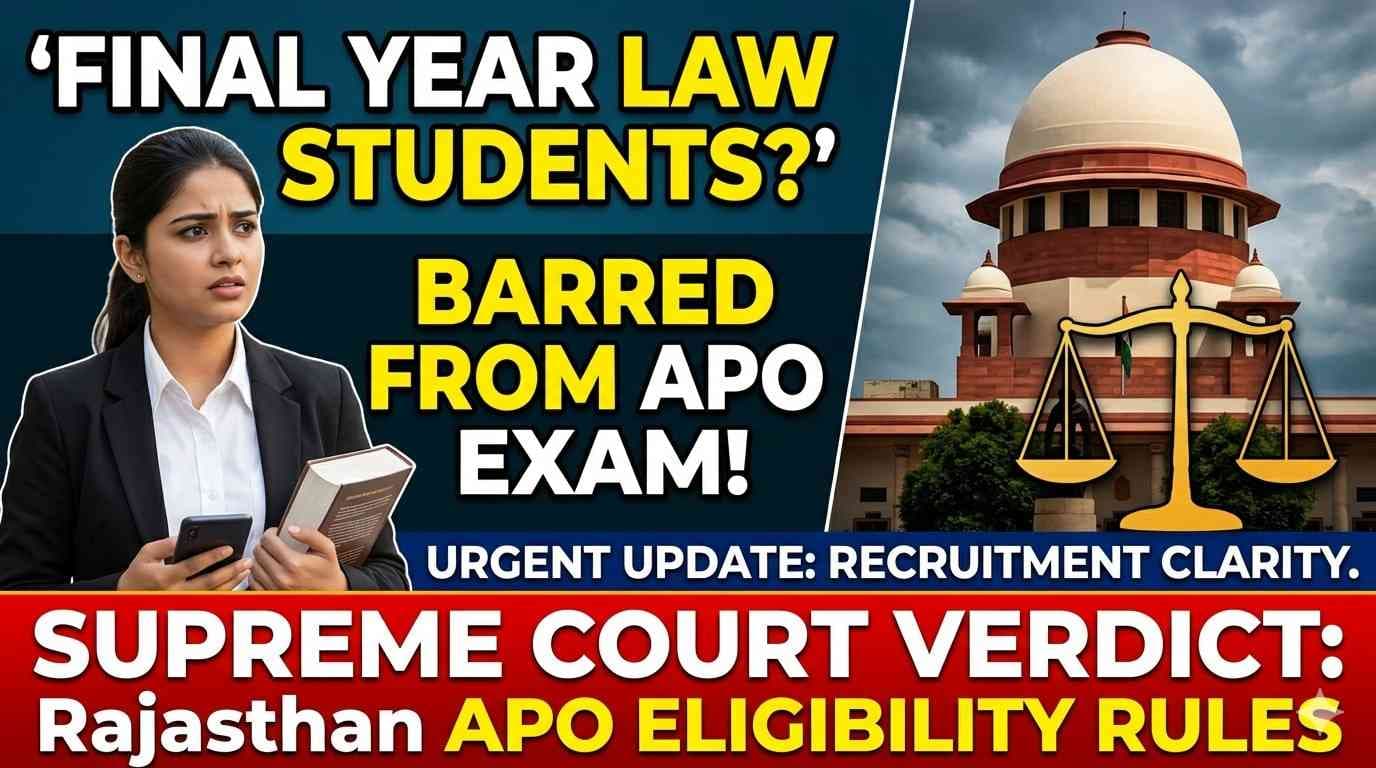
The Supreme Court of India has provided crucial clarity on the eligibility timelines for civil service recruitments, specifically concerning the role of Assistant Prosecution Officers (APO) in Rajasthan. In a significant judgment, the Court ruled that candidates must possess a valid law degree as of the date the recruitment advertisement is issued. This decision effectively bars final-year law students or those awaiting results at the time of the notification from participating in the examination process for these specific posts.
The ruling came in response to a batch of petitions challenging the Rajasthan Public Service Commission's (RPSC) strict adherence to the "date of advertisement" rule. The petitioners argued that since the recruitment process often takes months or years to conclude, candidates who obtain their degrees before the final stage or interview should be considered eligible. However, the apex court bench emphasized that the "rules of the game" cannot be changed once the process has started and that eligibility must be determined by a fixed, non-arbitrary date.
At the center of the dispute was the interpretation of the Rajasthan Subordinate Reforms and Subordinate Services (Recruitment and other Service Conditions) Rules. The Court observed that the qualification prescribed in the advertisement is the bedrock of the selection process. Allowing candidates to qualify mid-process would not only lead to administrative chaos but also unfairly disadvantage those who did not apply because they strictly followed the eligibility criteria mentioned in the initial notification.
The Supreme Court highlighted that the post of an Assistant Prosecution Officer is a critical role within the criminal justice system, requiring a high degree of legal proficiency. The bench noted that a "law degree" is not just a formality but a statutory requirement that must be met at the threshold of the application. By insisting on the degree at the time of advertisement, the Court aimed to ensure that only fully qualified professionals enter the competitive pool, thereby maintaining the standards of the prosecution service.
This judgment reinforces a long-standing principle in service jurisprudence: the cut-off date for eligibility, unless otherwise specified in the rules, is the last date for the submission of applications as per the advertisement. The Court cautioned against judicial overreach in modifying these dates, stating that such interventions interfere with the executive's prerogative to manage public recruitment. This serves as a significant precedent for various Public Service Commissions across India that face similar litigation during large-scale hiring cycles.
For law students and aspiring prosecutors, this ruling underscores the importance of timing in career planning. It clarifies that "appearing" in the final semester is not equivalent to "holding" a degree for the purposes of these state-level examinations. The decision is expected to streamline the RPSC’s recruitment process, which had been slowed down by multiple interim orders and challenges regarding candidate eligibility.
The Court also addressed the argument regarding the "shortage of officers," noting that while the need to fill vacancies is urgent, it cannot be a ground for compromising the procedural integrity of the recruitment rules. The bench suggested that the state could issue fresh advertisements more frequently to accommodate new graduates rather than relaxing existing rules for an ongoing cycle.
In conclusion, the Supreme Court’s verdict brings finality to the eligibility controversy surrounding the Rajasthan APO exam. By upholding the requirement of a law degree on the date of advertisement, the Court has prioritized legal certainty and administrative discipline. This ruling serves as a vital reminder to all candidates to meticulously verify their eligibility status against the specific cut-off dates mentioned in official recruitment notifications.