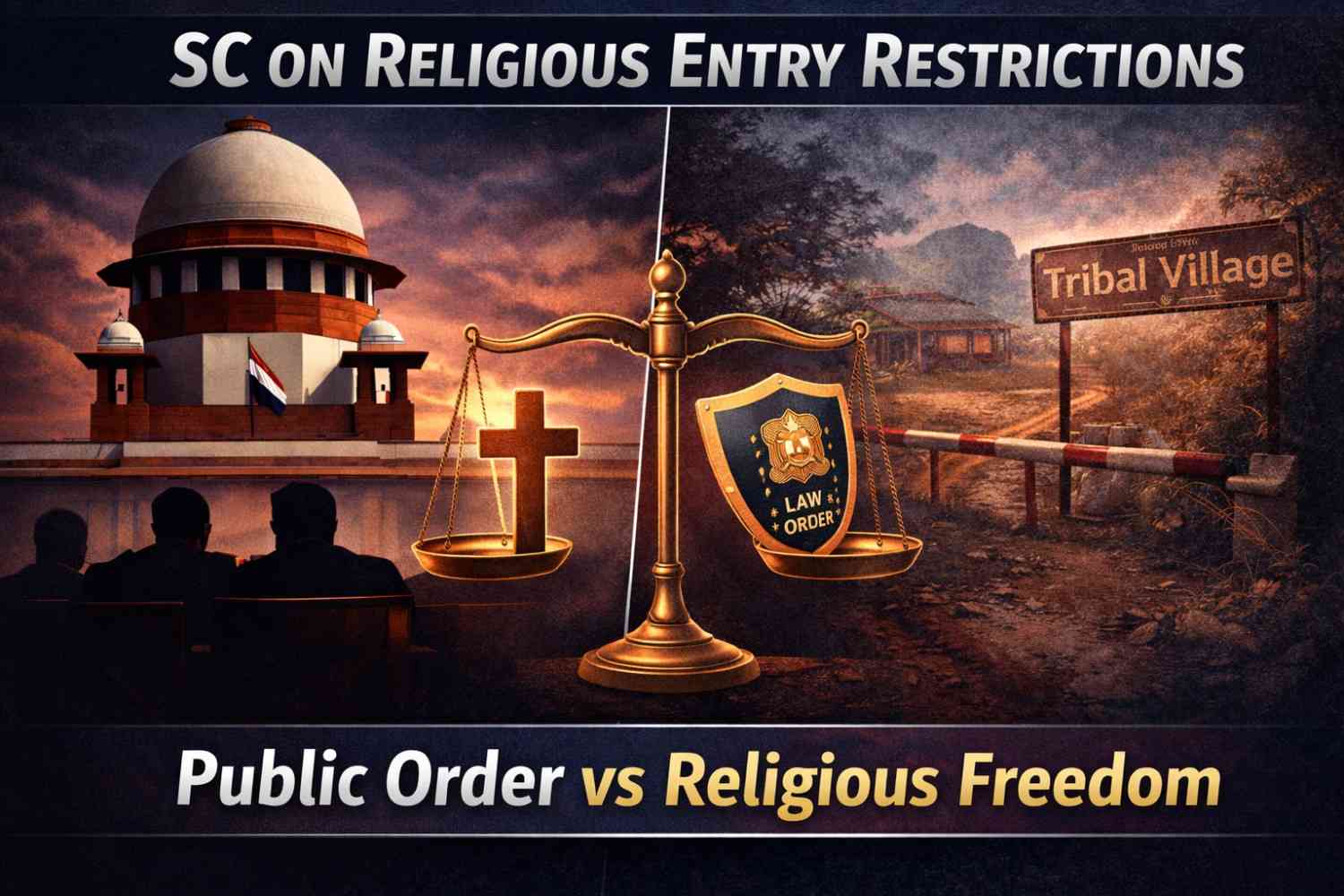
The Supreme Court of India has declined to interfere with restrictions imposed on entry of Christian missionaries into certain tribal villages in Chhattisgarh, observing that local authorities are empowered to regulate access in order to maintain peace and public order.
A Bench comprising Chief Justice of India Surya Kant, Justice B.V. Nagarathna and Justice Joymalya Bagchi was hearing a petition challenging administrative action preventing religious workers from entering notified tribal areas.
The petitioner contended that preventing missionaries from entering villages violated the fundamental right to practice and propagate religion under Article 25 of the Constitution.
It was argued that the restrictions effectively curtailed religious outreach and discriminated against a particular faith.
However, the State submitted that the measures were preventive — aimed at avoiding tension and preserving communal harmony in vulnerable tribal belts.
The Bench noted that Article 25 is not absolute and is subject to public order, morality and health.
“Rights under Article 25 are subject to reasonable restrictions.”
The Court observed that when authorities anticipate conflict or disturbance, they are entitled to regulate entry into sensitive areas to prevent escalation.
The judges also took note that the action was not a nationwide prohibition on religious practice but a localized administrative measure based on ground realities.
“Administration must act if there is apprehension of disturbance.”
The Court indicated that such decisions fall within executive domain unless manifestly arbitrary or discriminatory — which was not established in the present case.
Finding no constitutional infirmity at the threshold stage, the Supreme Court declined to entertain the plea.
The Bench clarified that affected individuals may approach appropriate forums if specific illegal actions occur, but broad judicial intervention was not warranted.
The decision reiterates a key constitutional principle: freedom of religion coexists with maintenance of public order.
Its implications are significant:
- Article 25 protections are subject to preventive administrative regulation.
- Courts will defer to local authorities in sensitive law-and-order situations.
- Religious propagation cannot override community peace considerations.
The ruling highlights a delicate balance — safeguarding religious freedom while enabling the State to prevent social conflict. In doing so, the Court reaffirmed that constitutional rights operate within a framework of societal stability, not in isolation from it.