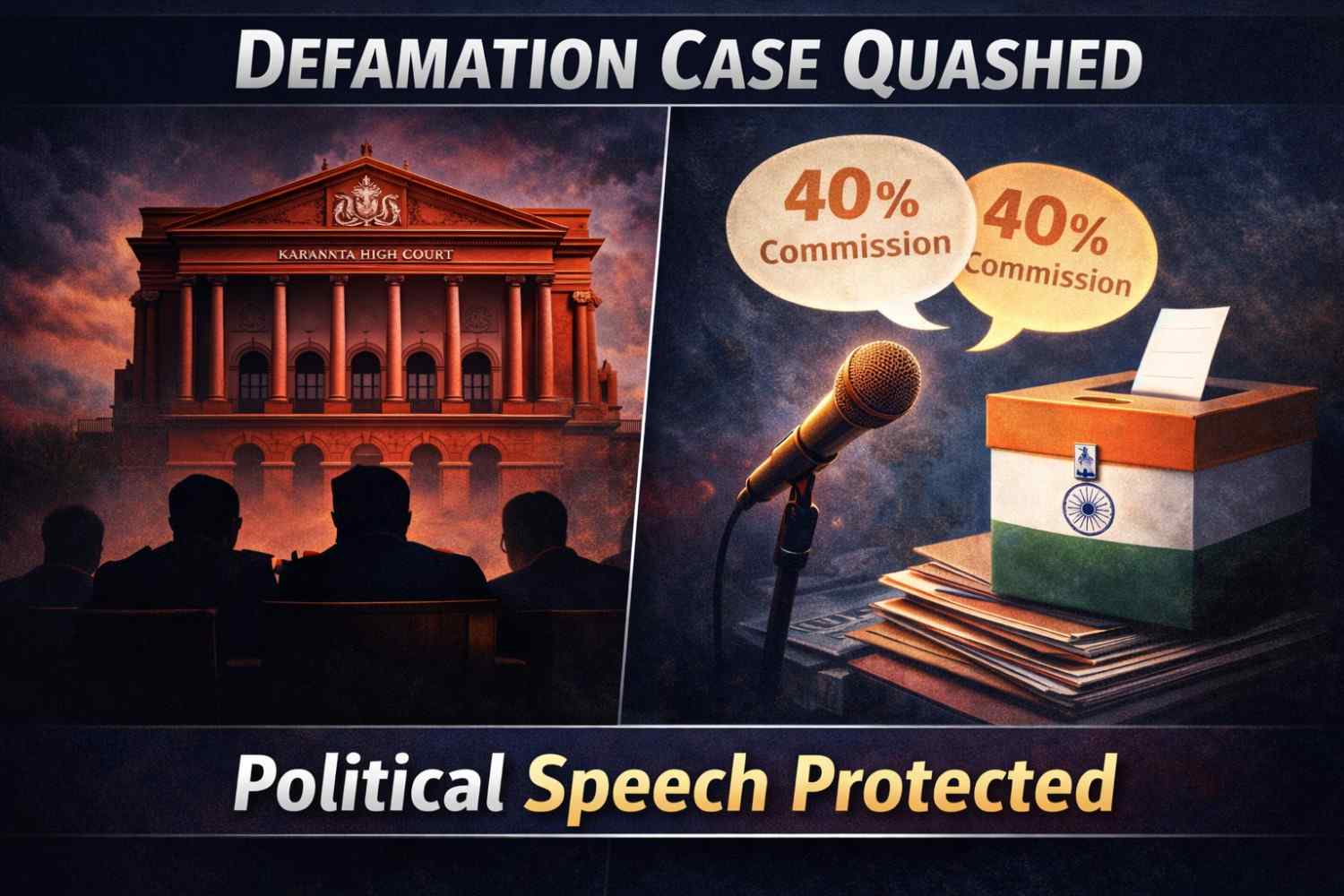
In a significant ruling on political speech and criminal defamation, the Karnataka High Court has quashed criminal defamation proceedings initiated against Congress leader Rahul Gandhi over election campaign advertisements referring to the then State government as a “40% commission government”.
The Court held that campaign rhetoric made in the course of democratic contestation cannot ordinarily attract criminal prosecution unless it clearly crosses the threshold of defamation under law.
The case arose from advertisements issued during the Karnataka Assembly elections in which the ruling party government was described as a “40% commission” administration — a phrase used by opposition leaders to allege corruption in public works contracts.
A complaint was filed alleging offences under Sections 499 and 500 of the Indian Penal Code (criminal defamation), claiming the statements harmed the reputation of members of the government.
The High Court examined whether criticism of a government, even if harsh, amounts to defamation of individuals.
The Court observed that democratic politics inherently involves criticism of those in power and cannot be equated with imputations against specific identifiable persons unless direct allegations are made.
“Criticism of governance or administration does not automatically translate into defamation of individual office-holders.”
The Bench stressed that criminal defamation requires a clear and specific imputation harming the reputation of a determinate person or group capable of being identified.
The Court further noted that election campaigns represent a heightened sphere of political debate where voters evaluate competing narratives.
“Political expression during elections must receive broad protection in a democracy.”
The judges held that generalised allegations about governance performance, corruption perception, or administrative functioning fall within protected political speech unless accompanied by specific false factual assertions against identifiable individuals.
A crucial factor was absence of a definite complainant who could demonstrate personal reputational harm.
The Court ruled that the advertisement targeted a government as a political institution rather than particular persons — therefore failing the legal requirement under Section 499 IPC.
Accordingly, criminal proceedings were quashed.
The ruling reinforces a foundational constitutional principle: democracy tolerates strong criticism of government.
Key implications:
- Criminal defamation cannot be used as a political tool to silence electoral criticism.
- Governments, as institutions, cannot claim personal reputation like individuals.
- Election speech receives wider protection under free speech jurisprudence.
The judgment strengthens the boundary between political accountability and criminal liability — ensuring courts do not become arenas for settling political debates.