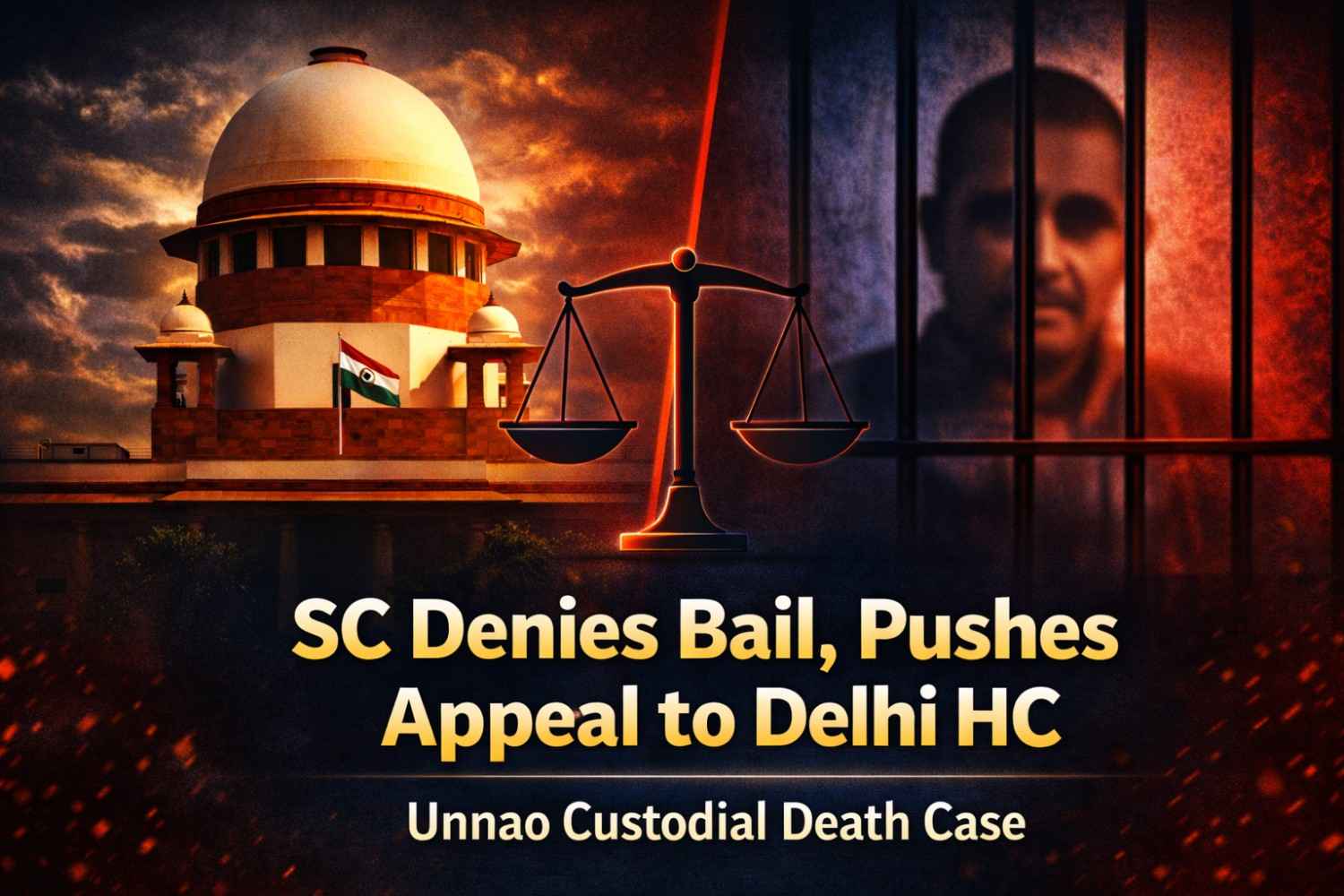
In a landmark order today, the Supreme Court of India declined to grant immediate bail or suspend the 10-year custodial sentence of former MLA Kuldeep Singh Sengar, convicted in the custodial death of the father of the Unnao rape survivor, and directed the Delhi High Court to accord an out-of-turn hearing to his appeal. The Bench underlined the gravity of the charges and emphasized prompt disposal of both the convict’s and victim’s appeals.
Bench’s Decision: Prioritising Final Hearing Over Interim Relief
A three-judge Bench comprising Chief Justice of India Surya Kant, Justice Joymalya Bagchi and Justice N.V. Anjaria heard Sengar’s special leave petition after the Delhi High Court on January 19 refused to suspend his 10-year sentence in the custodial death case. The Supreme Court refused to entertain his bail plea or grant suspension of sentence at this stage, noting the seriousness of the offence involving moral turpitude.
Instead of immediate relief, the Supreme Court directed the Delhi High Court to take up Sengar’s appeal on an “out-of-turn” or urgent basis, and to decide it within three months, ensuring that justice is not delayed.
“Let the Delhi High Court take up the appeals out of turn and decide them within three months.”
— Supreme Court.
Importantly, the Supreme Court ordered that the victim’s appeal seeking enhancement of sentence — which challenges the classification of the offence and seeks greater punishment — must be heard along with Sengar’s appeal. The Bench also asked that appeals by co-accused be considered together.
Context: The Custodial Death Case and Sengar’s Sentence
Sengar was sentenced to 10 years’ rigorous imprisonment by a trial court for the custodial death of the rape survivor’s father, who died in April 2018 while in custody after being arrested on questionable charges shortly after his daughter was raped. The trial court convicted Sengar for the offence of culpable homicide not amounting to murder under Section 304 of the Indian Penal Code and imposed a fine.
Sengar contended that he has spent over seven years of the sentence and sought suspension under Section 389 of the Code of Criminal Procedure. The Delhi High Court, in January, refused the suspension, observing that the delay cannot be solely attributed to the court and that no exceptional circumstances justified interim relief.
Sengar’s ongoing appeals include both this custodial death conviction and his conviction and life sentence in the rape case involving the same victim. Notably, the High Court had earlier suspended his life sentence in the rape case, but the Supreme Court stayed that order.
Why This Matters:
This is a significant judicial moment with three key legal implications:
- Striking a balance between interim relief and final adjudication: The Supreme Court refused ad-hoc or interim relief in a case involving serious allegations and custodial death, emphasizing that merits should be examined expeditiously rather than bypassed with provisional bail.
- Urgency and judicial oversight: By directing the High Court to decide the appeals within a fixed timeframe, the top court underscored that justice delayed can be justice denied, especially in high-profile criminal matters where public interest and victims’ rights are at stake.
- Unified hearing of appeals: Ordering the victim’s sentence enhancement plea to be heard along with Sengar’s appeal reinforces comprehensive adjudication, reducing fragmentation in how related appeals are heard.
The Supreme Court’s intervention reflects a measured judicial approach — ensuring that relief is not granted prematurely in heinous cases while also mandating procedural efficiency in the appellate process. This decision will set a precedent for handling similar interlocutory challenges in high-stakes criminal cases in future.