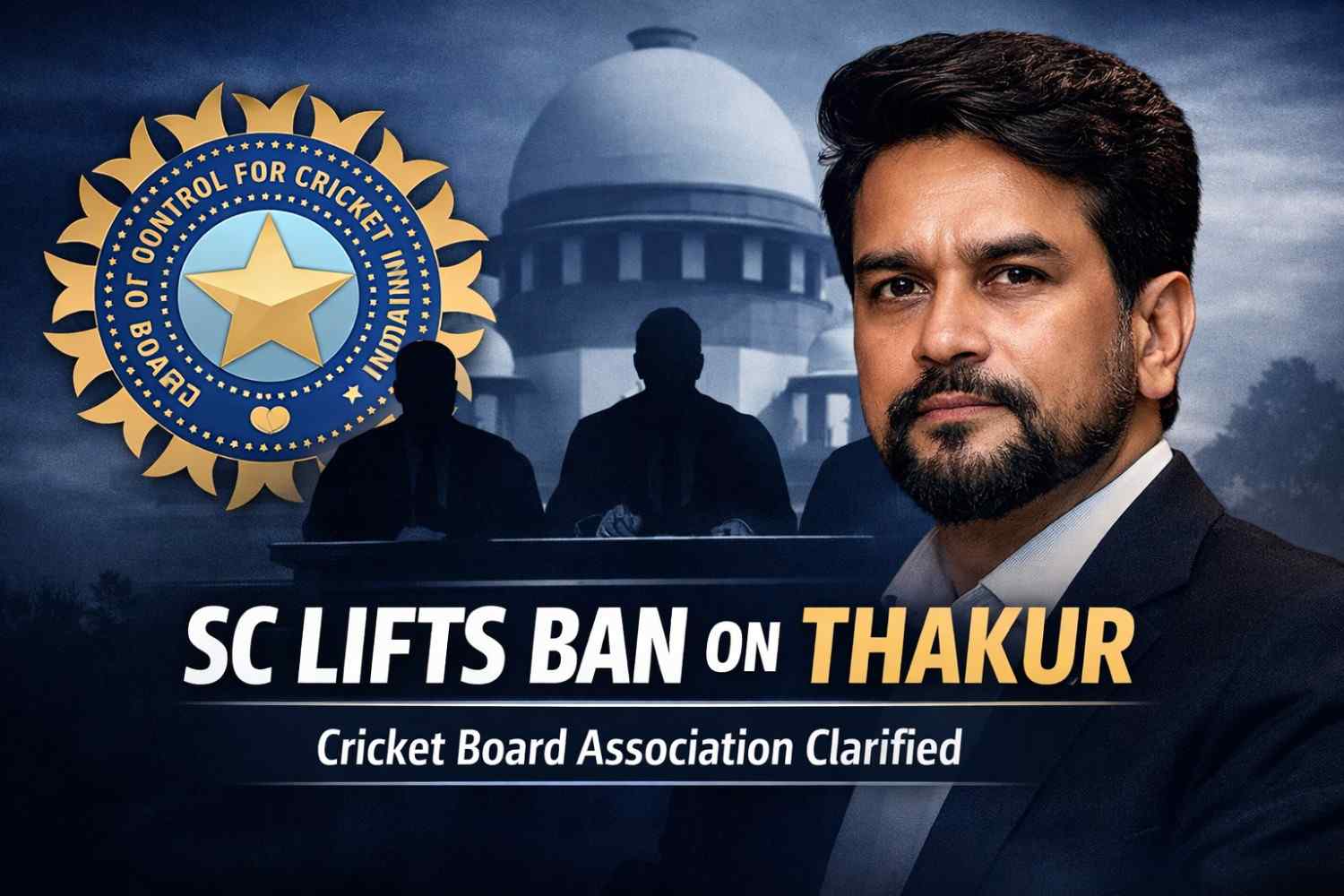
In a landmark clarification, the Supreme Court of India on Thursday lifted the longstanding restriction barring Anurag Singh Thakur, the former President of the Board of Control for Cricket in India (BCCI), from associating with the working of the board. A Bench led by Chief Justice of India Surya Kant and Justice Joymalya Bagchi held that the 2017 “cease and desist” order was not intended as a lifetime disability and could no longer bind Thakur.
The roots of this legal episode stretch back to 2017, when the Supreme Court intervened in BCCI’s administration in the wake of the Lodha Committee reforms. The Court had directed Thakur – then BCCI President – to “forthwith cease and desist from being associated with the working of the BCCI” for defying directions issued to implement governance reforms. This was a consequential fallout of resistance to reforming entrenched administrative practices within Indian cricket’s apex body.
Thakur’s initial ouster from the BCCI presidency was linked to perceived defiance of the Court’s orders on cricket governance reforms. Though contempt and perjury proceedings were initiated against him, they were later dropped after he tendered an unconditional apology. However, the formal cease-and-desist direction remained on record – effectively freezing his association with BCCI affairs for nearly nine years.
During Thursday’s proceedings, the Bench clarified that the 2017 directive was situational, not perpetual. The order was premised on a specific context – ensuring full compliance with the Lodha reforms during a crucial transitional phase. The Bench observed that extending a perpetual disqualification on the basis of that Order would be disproportionate and beyond the scope of the original mandate.
“The ban was not intended to be a lifelong bar … it will now stand recalled such that Mr. Thakur is free to associate with the BCCI in accordance with its rules and regulations.”
– Supreme Court Bench of CJI Surya Kant & Justice Joymalya Bagchi
The Bench noted the principle of proportionality as central to its reasoning – holding that a nine-year prohibition on association was excessive once the original concerns had been addressed.
This clarification clears a major legal hurdle that has shadowed Thakur’s sports administration ambitions for close to a decade. With the restriction now officially set aside, Thakur is legally permitted to associate with BCCI affairs in line with its internal regulations and eligibility norms.
Legal observers say the decision reflects judicial caution against permanent disability based on a time-bound order, particularly where corrective measures have already been taken and punitive proceedings have lapsed. It underscores the Court’s evolving stance on proportional restraint vis-à-vis administrative governance disputes.
The ruling is significant for both the intersection of sports governance and constitutional adjudication and for the larger question of how courts should frame corrective orders in institutional reform cases. It also potentially revisits the boundaries of judicial intervention in autonomous bodies such as the BCCI, especially when original objectives have been met or overtaken by time. With cricket administration entering a new era of governance norms and commercial pressures, this clarification may influence future litigation concerning reform compliance and eligibility disqualifications in quasi-regulatory institutions.