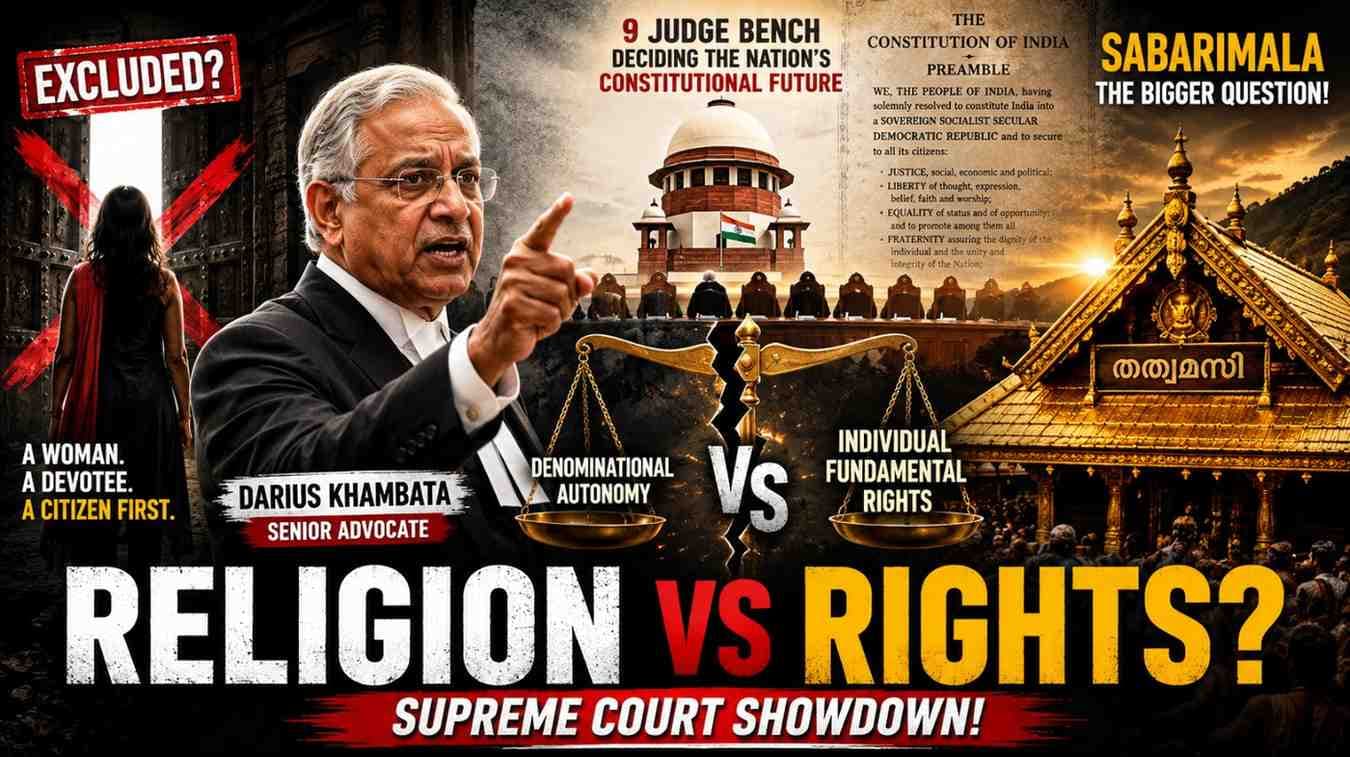
The ongoing legal discourse surrounding the Sabarimala temple took a significant turn in the Supreme Court as Senior Advocate Darius Khambata challenged the notion of "denominational autonomy." Arguing before the nine-judge bench in the reference case, Khambata posited that the Constitution does not envision a hierarchy where a religious group's collective rights can supersede the fundamental rights of an individual believer to practice their faith.
At the heart of the argument is the interplay between Article 25(1), which guarantees the right to freedom of religion to "all persons," and Article 26, which gives religious denominations the right to manage their own affairs in matters of religion. Khambata argued that Article 26 is not an "absolute island" and must be read in harmony with the individual's right to access a public place of worship.
Khambata’s submission touches upon the controversial "Essential Religious Practices" (ERP) test. He argued that if a practice—such as the exclusion of women of a certain age group—violates the fundamental dignity and equality of an individual, the "denominational right" to maintain that practice must give way. He cautioned that granting denominations an "unfettered right" would create pockets of legal immunity where social reforms could never penetrate.
The advocate further emphasized that the "reformative" nature of the Indian Constitution is one of its basic features. Article 25(2)(b) specifically allows the State to provide for social welfare and reform or the throwing open of Hindu religious institutions of a public character to all classes and sections of Hindus. According to Khambata, this constitutional mandate clearly indicates that individual inclusion is a priority over exclusionary denominational traditions.
This argument is a direct response to the claim that "Ayyappa devotees" constitute a separate religious denomination with their own distinct customs that should be immune from judicial scrutiny. Khambata countered this by stating that a "believer" is the primary unit of the Constitution, and a denomination is merely a collective of such individuals. Therefore, the collective cannot use its power to strip an individual member (or a class of members, like women) of their fundamental rights.
The outcome of this reference will have far-reaching implications beyond the Sabarimala temple. It will define the extent to which the judiciary can intervene in the internal practices of religions like Parsi fire temples, mosques, and other Hindu shrines. If the Court accepts Khambata’s logic, it would solidify a "rights-based" approach to religious freedom, where individual dignity serves as the ultimate litmus test for the validity of any religious custom.
In conclusion, the arguments presented by Darius Khambata highlight a transformative constitutional vision: one where the "temple of justice" ensures that no "temple of worship" can exclude a citizen based on discriminatory traditions. As the nine-judge bench continues its deliberations, the focus remains on whether the Constitution protects the religion or the person practicing it.