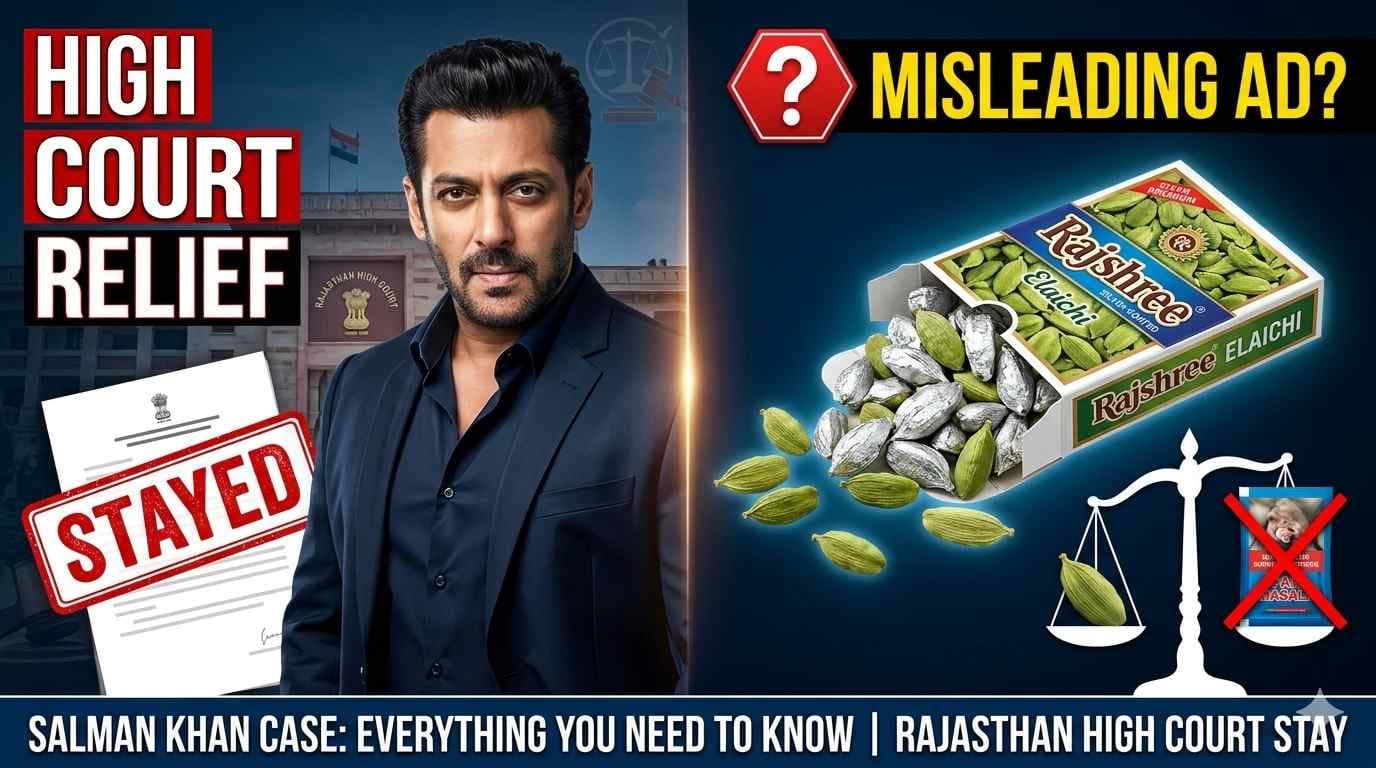
The Rajasthan High Court has granted actor Salman Khan significant legal relief by staying the proceedings in a consumer court case regarding a "misleading" advertisement for Rajshree Elaichi. Justice Anuroop Singhi issued the order in response to a writ petition filed by Khan, which challenged the ongoing trial and the bailable warrants issued against him by the District Consumer Disputes Redressal Commission in Jaipur. The actor’s legal team argued that the consumer forum exceeded its jurisdiction and that the actor, as a brand ambassador, was being unfairly targeted for endorsing a mouth freshener product.
The dispute originated from a complaint filed by advocate Yogendra Singh Badiyal, who alleged that advertisements for "Rajshree Elaichi" were a form of surrogate advertising for pan masala, a product known to be injurious to public health. The complainant argued that such promotions violate the Consumer Protection Act, 2019, by creating a false impression of safety through the endorsement of "silver-coated elaichi." In early 2026, the District Commission had issued an interim order to halt the ads and subsequently issued bailable warrants against Khan for alleged non-compliance and non-appearance in the matter.
In the High Court, Khan’s counsel contended that the actor had only endorsed the "elaichi" (cardamom) product and had never promoted pan masala or tobacco-related substances. They further argued that according to the Consumer Protection Act, matters concerning misleading advertisements fall under the exclusive jurisdiction of the Central Consumer Protection Authority (CCPA) rather than local consumer commissions. By bypassing these statutory channels, the lower court had reportedly adopted a "coercive and disproportionate" approach, including the unusual suggestion of forming a police task force to ensure the actor's presence.
The High Court’s decision to stay the proceedings comes shortly after a parallel development at the National Consumer Disputes Redressal Commission (NCDRC), which also put a hold on the execution of the warrants. The judiciary noted concerns regarding the service of orders, as Khan’s team claimed they were never formally served with the initial interim ban. This multi-forum legal victory for the actor effectively halts all coercive actions and trial steps at the district level until the higher courts can determine the validity of the consumer forum's jurisdiction.
Beyond the specific case of Salman Khan, this ruling touches upon the broader legal debate regarding the liability of celebrities in surrogate advertising. The Court’s intervention highlights the necessity of following proper legal protocols when dealing with brand ambassadors who may not have direct control over a company’s marketing strategies or product manufacturing. The stay ensures that the legal status of celebrity endorsements is evaluated through a standardized judicial process rather than through localized consumer complaints that might lack the mandate to regulate national advertising standards.
With the next hearing scheduled for late April, the legal focus now shifts to whether a local consumer commission can indeed hold a brand ambassador liable for surrogate marketing. The outcome of this case will likely set a major precedent for other celebrities who face similar litigation over "elaichi" or "soda" ads that are linked to prohibited products. For now, the Rajasthan High Court’s stay provides a necessary buffer, ensuring that the trial does not proceed under flawed procedural grounds while the fundamental questions of law remain unanswered.