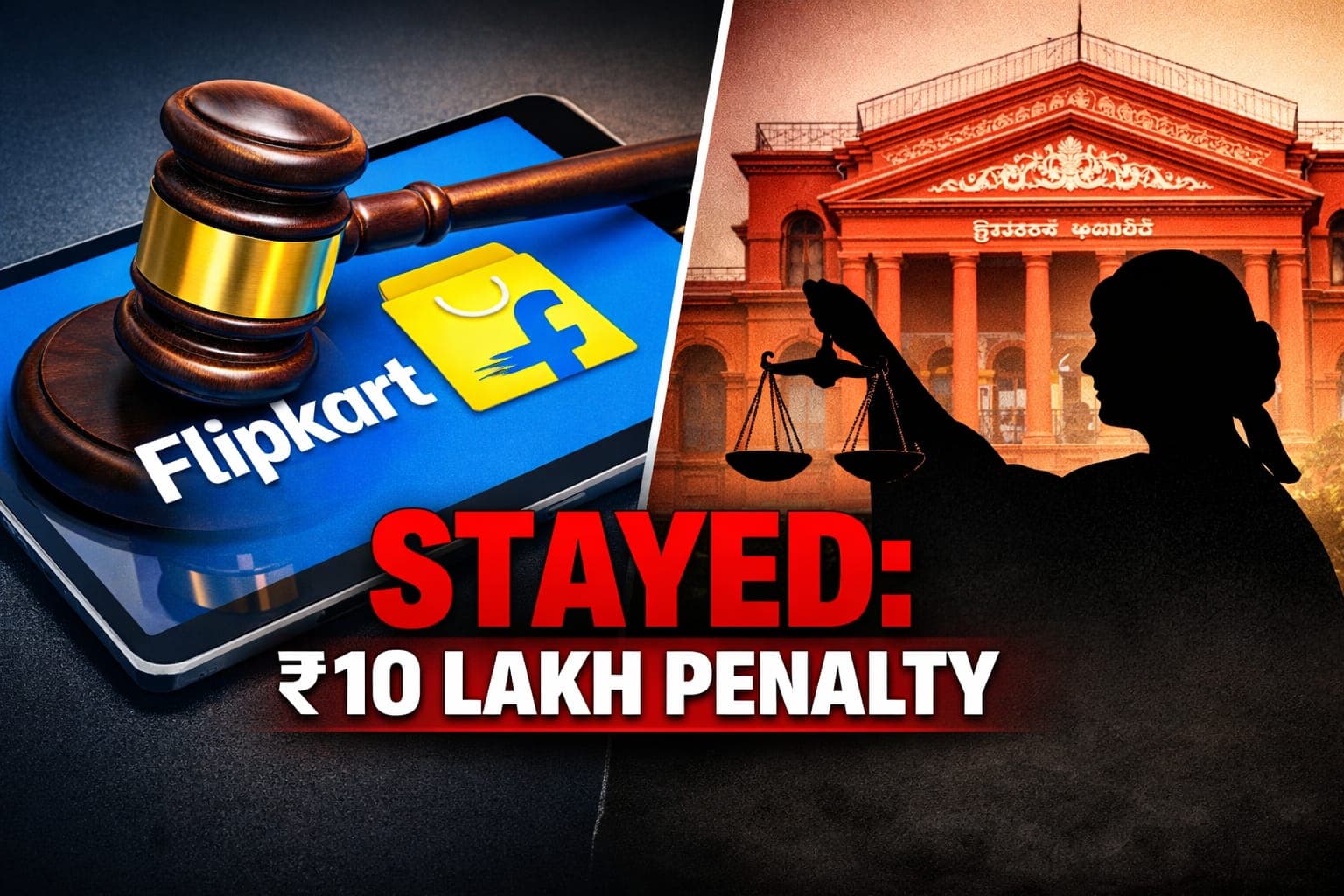
In a significant development for the e-commerce sector regarding "intermediary liability," the Karnataka High Court has granted interim relief to Flipkart Internet Private Limited. The Court has stayed a ₹10 lakh penalty recently imposed by the Central Consumer Protection Authority (CCPA) over the alleged unauthorized sale of walkie-talkies on the platform.
The order was passed by a Single Judge Bench of Justice BM Shyam Prasad on February 2, 2026. Along with the stay on the monetary penalty, the Court also put on hold the CCPA’s direction requiring the e-commerce giant to conduct periodic self-audits of its listings.
The case traces back to January 2026, when the CCPA—the national watchdog for consumer rights—took action against major online marketplaces, including Flipkart and Meta Platforms (Facebook Marketplace).
The CCPA found that these platforms were hosting listings for walkie-talkies that did not meet mandatory regulatory disclosures. Under Indian law, walkie-talkies are regulated devices that often require:
- Wireless Operating Licenses from the Department of Telecommunications (DoT).
- Equipment Type Approval (ETA) Certification.
- Specific disclosures regarding the operating frequency range.
The CCPA’s investigation concluded that the absence of these details misled consumers into believing that the devices were lawful for unrestricted use by the general public. Consequently, the Authority labeled these listings as "misleading advertisements" and "unfair trade practices" under Sections 2(28) and 2(47) of the Consumer Protection Act, 2019.
For these violations, the CCPA slapped a penalty of ₹10 lakh on Flipkart and ordered a mandatory "self-audit" mechanism to prevent such listings in the future.
Challenging the CCPA’s order before the High Court, Flipkart, represented by Senior Advocate GS Kannur, raised a fundamental legal question: Who is responsible for the product details—the platform or the seller?
Flipkart’s arguments centered on three main points:
1. The Role of an Intermediary The petitioner argued that as an e-commerce marketplace, it is merely an "intermediary" under the Information Technology Act. It provides a platform where third-party retailers list their products. Flipkart contended that the responsibility for ensuring a product complies with specific licensing laws (like those for walkie-talkies) rests solely with the retailers, not the platform.
2. Jurisdiction of the CCPA Senior Counsel Kannur argued that the CCPA exceeded its jurisdiction by holding the platform liable for the omissions of individual sellers. He highlighted that under the existing consumer protection framework, the compliance obligations for product specifications and licenses are the duty of the "seller" listed on the website.
3. Proactive Compliance The Court was informed that Flipkart has already taken down the controversial walkie-talkie listings. By removing the products immediately upon receiving directions, Flipkart argued it had shown "due diligence" as required by law.
After hearing the preliminary submissions, Justice BM Shyam Prasad noted that the petitioner’s primary grievance was the "assumption of jurisdiction" by the CCPA despite the intermediary status of the platform.
The Court’s oral order stated:
"In consideration thereof, the interim order is granted staying the direction of payment of penalty of Rs. 10,00,000/- until the next date of hearing, and consequentially, the further direction to the petitioner for periodical self audit is also stayed for the present."
The Court has called upon Deputy Solicitor General Shanthi Bhushan H to accept notice on behalf of the Central Government and the CCPA. The matter is now scheduled for further hearing on February 11, 2026, where the government is expected to file its response.
This case highlights a growing friction point in Indian law: the balance between consumer protection and the "Safe Harbour" protection given to internet platforms.
What is Safe Harbour? Under Section 79 of the IT Act, platforms like Flipkart, Amazon, or Facebook are generally not held liable for third-party content or products, provided they follow "due diligence" and remove illegal content when notified.
The CCPA’s Stance The CCPA, however, is increasingly taking the view that e-commerce platforms cannot be "silent spectators." The Authority believes that since these platforms manage the payment, delivery, and advertisement of these products, they have a higher degree of responsibility to ensure that "dangerous" or "regulated" goods (like walkie-talkies that could interfere with restricted frequencies) are not sold openly without warnings.
Key Personalities in the Case
- For Flipkart: Senior Advocate GS Kannur, briefed by a team from JSA Advocates & Solicitors led by Senior Partner Dhiraj Nair.
- For the Respondents (CCPA/Union of India): Deputy Solicitor General Shanthi Bhushan H.
While Flipkart has secured a temporary win by getting the penalty and the audit requirement stayed, the final judgment in this case will be a landmark for the e-commerce industry. If the High Court eventually rules in favor of the CCPA, it could force all online marketplaces to implement much stricter—and more expensive—vetting processes for every product listed on their sites. If Flipkart wins, it will reinforce the "Intermediary" protection that allows these platforms to grow without being held responsible for the millions of items sold by third-party retailers.
The legal community now looks forward to the hearing on February 11 to see how the government justifies the CCPA's jurisdiction over digital marketplaces.
- Case Title: Flipkart Internet Private Limited v. Central Consumer Protection Authority and Another
- Case Number: WP NO. 3046/2026 (GM - RES)
- Bench: Justice BM Shyam Prasad Next Hearing Date: February 11, 2026