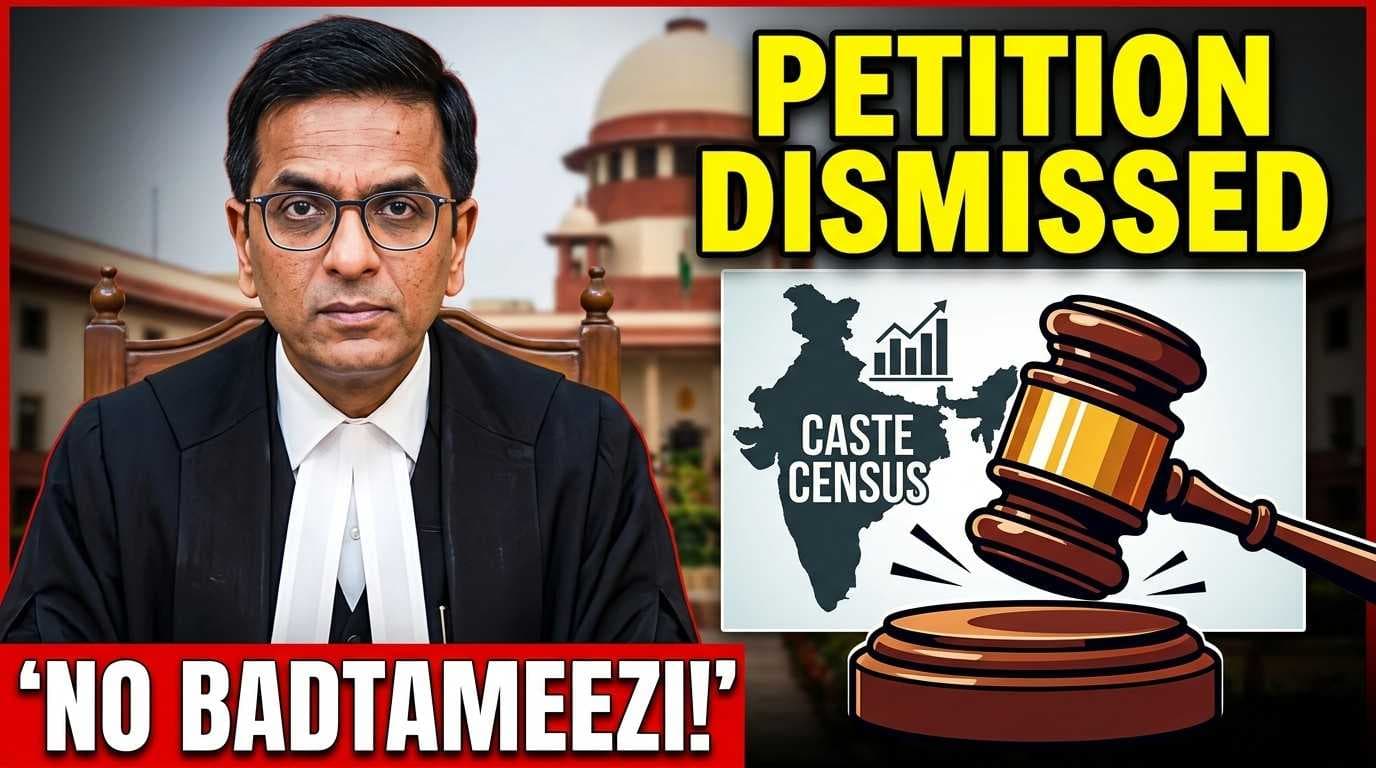
The Supreme Court of India has dismissed a petition seeking to halt the caste-based census, expressing strong disapproval over the disrespectful tone used within the legal filing. The bench, led by the Chief Justice of India, took particular issue with the phrasing of the petition, describing it as containing "badtameezi ki language" (ill-mannered or rude language). The Court emphasized that while litigants have the right to challenge government policies, the sanctity of the judicial process must be maintained through professional and dignified communication, leading to the immediate rejection of the plea.
Beyond the linguistic concerns, the apex court reiterated its stance on the caste census, noting that such exercises fall within the policy domain of the executive. The petitioners had argued that the census could deepen communal and caste-based fractures within society; however, the Court maintained that it cannot interfere with administrative decisions unless there is a clear violation of constitutional mandates. The dismissal reinforces the principle that the judiciary will not act as a barrier to data collection efforts intended to inform social welfare and affirmative action policies.
The Court’s sharp reaction to the "badtameezi" in the petition serves as a stern warning to lawyers and litigants about the importance of courtroom etiquette and the drafting of pleadings. The judges remarked that the use of derogatory or unprofessional language not only undermines the case but also insults the dignity of the institution. By dismissing the plea on these grounds, the Supreme Court signaled that the "how" of a legal challenge is often as significant as the "what," especially in high-stakes matters involving public policy and social statistics.
This ruling follows a series of failed attempts by various groups to block the caste census in different states. The judiciary has consistently held that gathering data on the socio-economic status of various communities is a legitimate state exercise aimed at achieving substantive equality. The Court’s refusal to entertain the petition ensures that the ongoing census projects can proceed without further judicial roadblocks, provided they comply with privacy and data protection standards established in previous landmark judgments.
The dismissal also highlights the Court's intolerance for petitions that appear to be motivated by sensationalism rather than sound legal reasoning. The bench noted that a Public Interest Litigation (PIL) should be a serious endeavor to protect the rights of the marginalized, not a platform for using inflammatory language against state authorities. This decision is expected to compel future petitioners to exercise greater caution and decorum when drafting challenges to sensitive government initiatives.
Ultimately, the Supreme Court's decision underscores the balance between free speech and judicial discipline. While the merits of a caste-based census continue to be a subject of intense national debate, the legal path for such an exercise remains clear for now. The judgment serves as a dual-purpose precedent: it affirms the executive's right to conduct a census for policy-making while simultaneously upholding the highest standards of professional conduct within the Indian legal system.