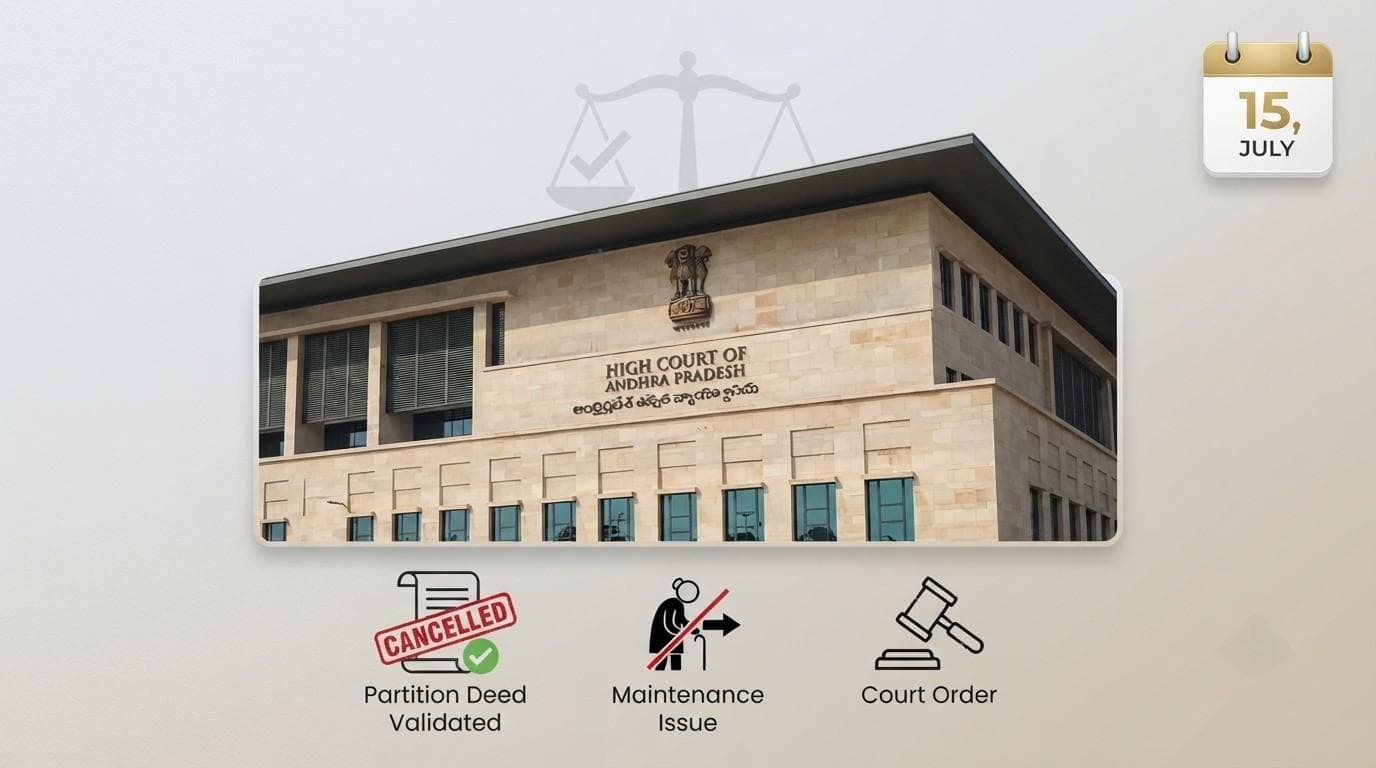
The Andhra Pradesh High Court, through Justice Venkateswarlu Nimmagadda, allowed a writ petition filed by a son and his wife challenging the order of the Appellate Tribunal under the Maintenance and Welfare of Parents and Senior Citizens Act, 2007, which had directed the cancellation of a registered partition deed executed between the son and his mother.
The dispute originated after the parties executed a registered partition deed on 30 March 2018 in respect of their joint family properties. The mother later approached the Tribunal seeking cancellation of the deed, alleging that the son had failed to maintain her. The Tribunal dismissed her application, but the Appellate Tribunal allowed her appeal and ordered the deed to be set aside. The son and his wife challenged that order before the High Court.
Examining the scope of Section 23(1) of the Act, the Court observed that the provision empowers the Tribunal to declare a transfer of property void if a senior citizen, after the commencement of the Act, transfers property by way of gift or otherwise, subject to a condition that the transferee shall provide basic amenities and physical needs to the transferor, and the transferee fails to fulfil that obligation. The Court emphasized that the power under Section 23(1) can be exercised only where there is a transfer of property by a senior citizen coupled with a stipulation for maintenance.
Applying these principles to the facts, the Court found that the document sought to be cancelled was a partition deed, not an instrument effecting a transfer. The petitioners had contended that both parties possessed pre‑existing rights in the properties and that the deed merely defined and separated those rights. The material on record did not show that the mother had transferred her property to the son under the deed. Consequently, the essential foundation for invoking Section 23(1) – a transfer by a senior citizen in favour of a transferee – was absent.
The Court further noted that the partition deed dated 30 March 2018 contained no stipulation requiring the son to maintain the mother or to provide her with basic amenities and physical needs. In the absence of any such condition, the statutory requirement under Section 23(1) remained unfulfilled. Even if a violation of any alleged condition were assumed, such a violation could not be canvassed under Section 23 of the Act or the rules made thereunder.
The Court clarified that merely because disputes relating to maintenance have arisen between the parties, it cannot be a ground to annul a partition deed. Such disputes may entitle the mother to seek maintenance or any other relief available under the Act, but they do not confer jurisdiction upon the Tribunal to invalidate a transaction that does not answer the description of a transfer as contemplated under Section 23(1).
Justice Venkateswarlu Nimmagadda concluded that the Appellate Tribunal’s order directing cancellation of the partition deed could not be sustained. The writ petition was allowed, and the order of the Appellate Tribunal was set aside, thereby preserving the validity of the partition deed executed between the son and his mother.