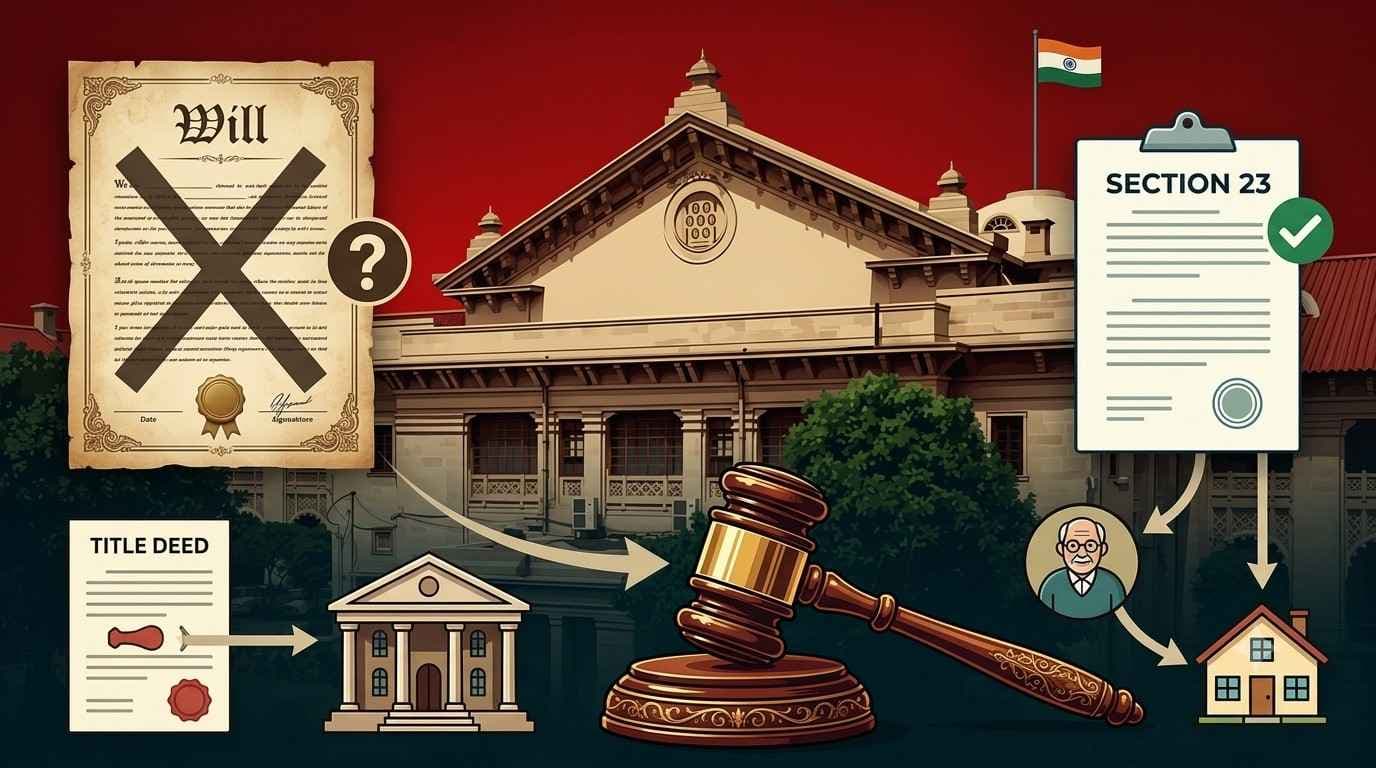
Allahabad High Court Clarifies Scope of Section 23 of Senior Citizens Act
The Allahabad High Court, in the matter of Satish Chandra Gupta v. State of U.P. and 11 others, considered the ambit of the Maintenance and Welfare of Parents and Senior Citizens Act, 2007. The petitioner approached the court seeking protection under the Act and a declaration that a Will executed by his father was forged. He contended that, because the Will was alleged to be forged, no rights could flow from it and he remained the lawful owner of the land. The petitioner had filed a representation under Section 22 of the Act, invoking the Tribunal’s jurisdiction.
The court examined the relevant provisions. Section 22 provides a mechanism for senior citizens to make an application for maintenance and welfare. Section 23, however, deals specifically with the voiding of a transfer of property. According to the court’s reading, Section 23 applies only where a transfer of property was made on the condition that the transferee would provide basic amenities and physical needs to the transferor, and the transferee subsequently fails or refuses to fulfil that condition. In such a case, the Tribunal may declare the transfer void.
The bench, comprising Justice J.J. Munir and Justice Indrajeet Shukla, observed that the jurisdiction of the Tribunal under the Act is limited to the matters enumerated in Section 23. The court stated, “with respect to the protection of the property of a senior citizen, only the limited jurisdiction conferred under Section 23 of the Act of 2007 is available.” Consequently, any property dispute that does not satisfy the pre‑requisites of Section 23 falls outside the Tribunal’s authority.
The court further held that the Tribunal lacks the power to declare a title deed non est or to adjudicate questions of title that arise from allegations of forgery, fraud, or invalidity of testamentary documents. It emphasized that every property dispute pertaining to the validity of a conveyance or transfer deed involving a senior citizen cannot be made the subject of adjudication under the Act unless it qualifies under Section 23. The observation was that allowing the Tribunal to decide such matters would amount to a transgression of jurisdiction, as the statute has not vested such authority in it.
Applying this principle to the facts, the court noted that the petitioner’s claim rested on the alleged forgery of a Will and the consequent assertion of title. Since the dispute did not involve a transfer made on the condition of providing basic amenities and physical needs, the conditions of Section 23 were not satisfied. Therefore, the Tribunal could not entertain the petitioner’s representation under Section 22 for the purpose of deciding the title dispute.
The court also took note that civil suits concerning the title of the land were already pending before the appropriate civil forum. It emphasized that the remedy for disputes over title, including claims of forged documents, lies in the ordinary civil courts and not before the Tribunal constituted under the Senior Citizens Act.
Having concluded that the Tribunal lacked jurisdiction to decide the title dispute, the Allahabad High Court dismissed the writ petition. The order affirmed that the petitioner must pursue his claim through the civil suit already pending, and that the statutory authorities under the Maintenance and Welfare of Parents and Senior Citizens Act, 2007 cannot be roped into adjudicating matters beyond the narrow scope of Section 23.
The decision clarifies the limits of the Tribunal’s power under the Act and reinforces the principle that statutory bodies must confine themselves to the jurisdiction expressly conferred by legislation. It serves as a precedent for future cases where parties attempt to invoke the Senior Citizens Act to resolve title or testamentary disputes that do not meet the specific criteria laid out in Section 23.