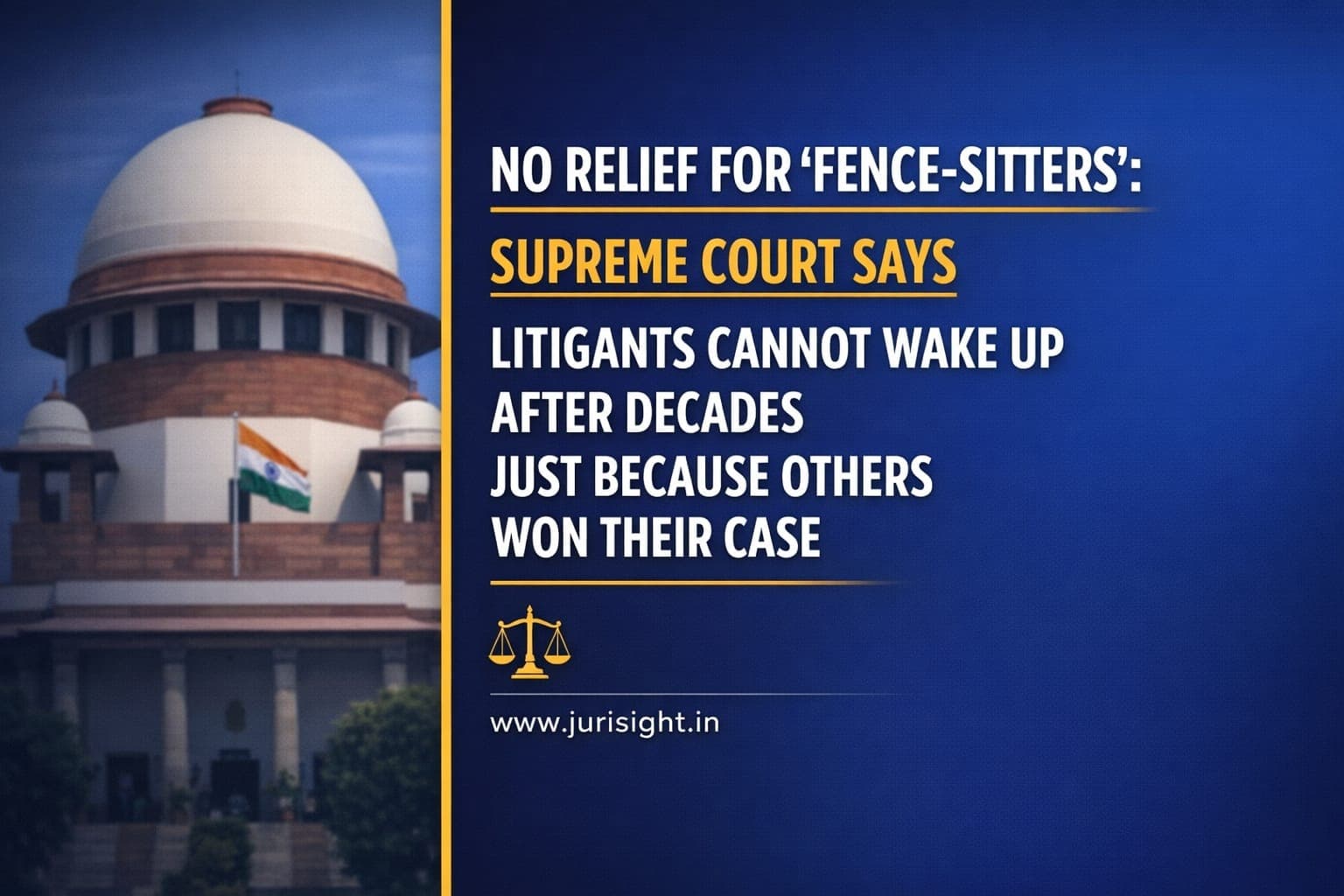
In a significant judgment reinforcing the principle of "finality of litigation," the Supreme Court of India has held that employees or litigants who wait for a long time and only approach the court after seeing others succeed in similar cases cannot claim the same relief as a matter of right.
A Bench comprising Justice Vikram Nath and Justice Sandeep Mehta observed that while the law generally treats similarly situated persons equally, this principle does not apply to those who have "acquiesced" (accepted the situation) or slept over their rights for years. The Court termed such individuals as "fence-sitters" who cannot be allowed to reopen settled issues through back-door entries or repetitive representations.
The case involved a group of primary school teachers in Gujarat (Damor Nanabhai Manabhai & Ors. v. State of Gujarat) whose services were terminated way back in the 1990s. After a long and winding legal battle that saw multiple rounds before the Primary Education Tribunal and the Gujarat High Court, their claims were finally dismissed by a Division Bench of the High Court in 2011.
Years later, in 2021, the Gujarat High Court passed an order in a separate case involving a teacher who was still in service and seeking a higher grade pay scale. Taking advantage of this 2021 order, the petitioners—whose cases were already closed years ago—filed a Special Leave Petition (SLP) in the Supreme Court. They argued that since they were "similarly situated" to the person in the 2021 order, the government should be directed to consider their representations as well.
The Supreme Court dismissed the petitions, noting that the petitioners were trying to revive "dead" issues. The court highlighted several reasons why the plea was misconceived:
- Lack of Parity: The petitioners were terminated teachers whose cases ended in 2011. The 2021 order they were citing related to a teacher who was still in service and fighting for pay scales. Therefore, they were not "identically situated."
- Reopening Settled Issues: The Court noted that the petitioners had already challenged their terminations in the past and lost. By filing a new petition based on a recent 2021 order, they were essentially trying to bypass the finality of the 2011 judgment.
- No Vacancies: The State Government informed the Court that as of March 31, 2025, there are no vacancies for the post of primary teachers in the relevant district, making the requested relief practically impossible.
Relying on the landmark precedent of State of Uttar Pradesh v. Arvind Kumar Srivastava (2015), the Bench explained the legal position regarding delayed claims:
"Those persons who did not challenge the wrongful action in their cases and acquiesced into the same and woke up after long delay only because of the reason that their counterparts who had approached the court earlier in time succeeded in their efforts... would be treated as fence-sitters."
The Court clarified that "laches" (unreasonable delay) and "acquiescence" (sitting quiet while your rights are violated) are valid grounds to dismiss a claim, even if someone else eventually won a similar legal battle.
The Supreme Court also sent a strong message to High Courts and Tribunals regarding the practice of passing "direction to consider representation" orders.
Often, when a case is old, courts simply ask the government to "consider the representation" of the petitioner. The Supreme Court called this a "device" used to revive stale claims. The Court held that before asking an authority to "consider" a claim, the judge must first ensure that the issue is still "live."
"If the claim pertains to a stale or dead issue, the court must put an end to the matter rather than enable avoidable, successive rounds of litigation," the judgment stated.
In a notable observation, the Bench emphasized that the Bar (lawyers) has a duty to protect judicial time. The Court stated that lawyers should:
- Disclose the full procedural history of a case, including past failures.
- Draw the court's attention to orders that have already reached finality.
- Advise clients against filing repetitive petitions that seek to reopen concluded matters.
The Bench remarked that this is essential to maintain the "discipline of finality" required by the justice delivery system.
The judgment serves as a stern reminder that the law assists those who are vigilant about their rights, not those who sleep over them. By dismissing the SLPs, the Supreme Court has made it clear that "finality" is a cornerstone of the Indian legal system, and once a dispute is legally settled, it cannot be resurrected decades later just because a new favorable judgment has been passed in a different case.
Case Details:
- Case Title: Damor Nanabhai Manabhai & Ors. v. The State of Gujarat & Ors.
- Case Number: SLP (C) No. 5619 of 2024 (with connected matters)
- Bench: Justice Vikram Nath and Justice Sandeep Mehta
- Date of Order: December 02, 2025