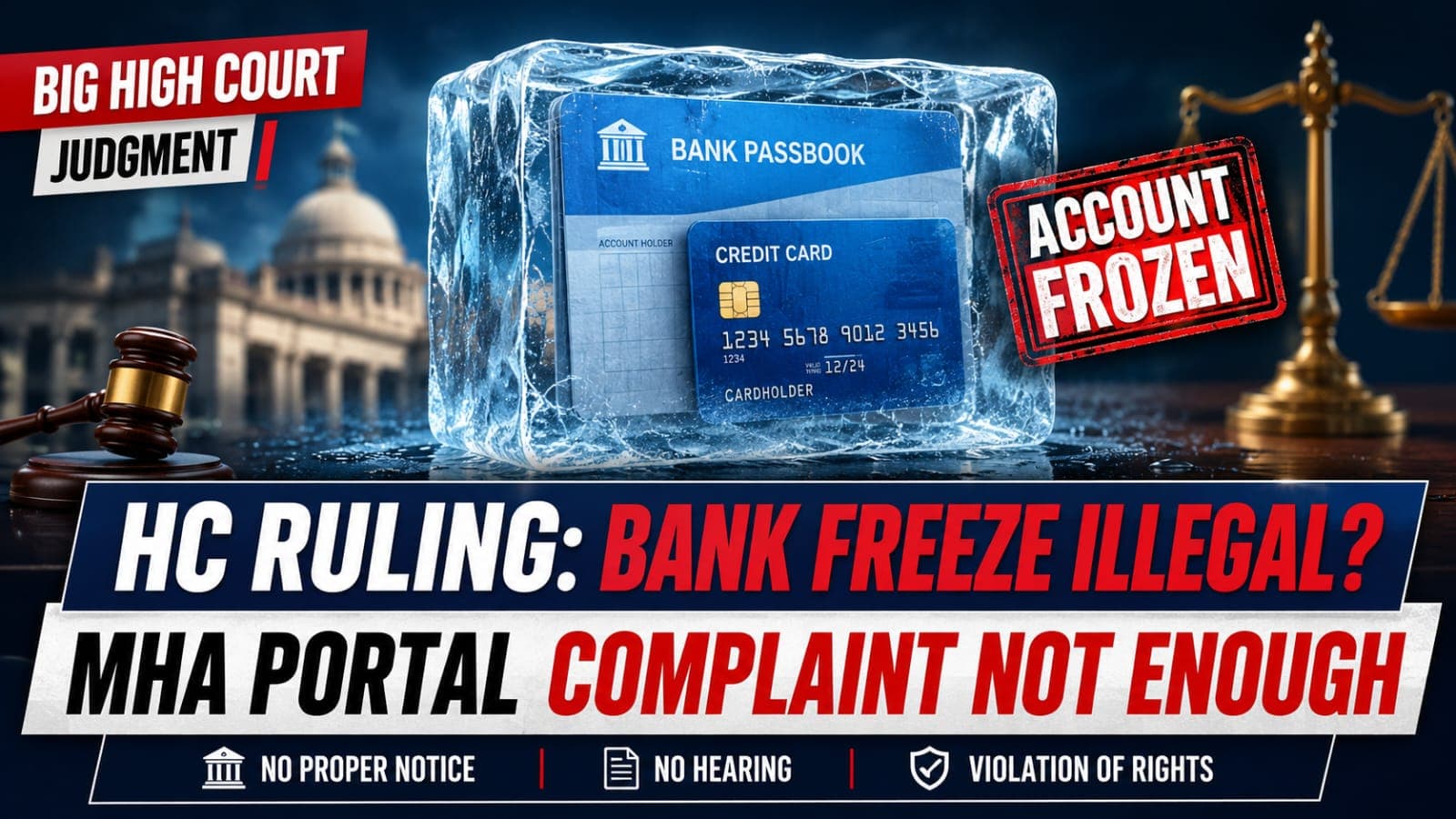
The High Court clarifies that law enforcement cannot bypass the procedure established under the Bharatiya Nagarik Suraksha Sanhita (BNSS) simply because a complaint was lodged on the national portal.
In a major relief for bank account holders and businesses, the Calcutta High Court has delivered a significant judgment regarding the arbitrary freezing of bank accounts. The Court has ruled that a "mere complaint" registered on the Ministry of Home Affairs (MHA) National Cyber Crime Reporting Portal is not a sufficient legal ground for police authorities to order a debit freeze on a bank account.
Justice Krishna Rao, while hearing a petition filed by Xenixt Technologies Private Limited, observed that the power to freeze accounts must be exercised strictly within the boundaries of the law. The Court emphasized that law enforcement agencies must follow the procedural safeguards mentioned under the Bharatiya Nagarik Suraksha Sanhita (BNSS) the new procedural law that has replaced the Code of Criminal Procedure (CrPC).
The petitioner, Xenixt Technologies Private Limited, approached the High Court after finding their bank accounts frozen. The freeze was initiated following a complaint lodged on the MHA’s cybercrime portal (cybercrime.gov.in).
Based on this online complaint, the investigating authorities had sent instructions to the bank to stop all debit transactions from the petitioner's account. This led to a complete halt of the company’s business operations. The petitioner argued that no First Information Report (FIR) had been registered against them, and no formal order from a competent court or Magistrate had been obtained before taking such a drastic step.
The Calcutta High Court took a stern view of the practice where accounts are frozen indefinitely based solely on automated alerts or portal complaints. The Court noted several key points:
- Procedural Compliance is Mandatory: The Court stated that while investigating cybercrimes is essential, it cannot be done by ignoring the law. Under Section 106 of the BNSS (corresponding to Section 102 of the old CrPC), a police officer has the power to seize property, but this power is subject to reporting the seizure to a Magistrate.
- Portal Complaints are not Evidence of Guilt: A complaint on the MHA portal is an entry point for investigation, not a final verdict. The Court highlighted that merely because someone has named an account in a portal complaint, the police cannot automatically assume that all funds in that account are "proceeds of crime."
- Impact on Business and Livelihood: The judgment recognized that freezing a business account without following due process is a violation of the right to carry on trade and profession. It can lead to financial death for a company even before any charges are proven.
The ruling brings much-needed clarity to the transition from CrPC to BNSS. Under the new law, the requirement to inform the jurisdictional Magistrate about the seizure of a bank account remains a vital safeguard.
In this specific case, the Court found that the authorities had failed to demonstrate any direct nexus (connection) between the alleged crime and the entire balance in the petitioner's account. Furthermore, the authorities had not obtained the necessary judicial oversight to justify a long-term freeze.
Justice Krishna Rao directed the immediate de-freezing of the bank accounts of the petitioner. The Court clarified that if the police truly believe that specific funds are linked to a crime, they must:
- Follow the formal procedure of registration of a case.
- Report the seizure to the concerned Magistrate.
- Provide evidence of a "suspicious nexus" between the account and the offence.
For thousands of people across India whose accounts are often frozen due to a single suspicious transaction sometimes involving very small amounts this judgment serves as a powerful precedent.
Often, "mule accounts" are used by cybercriminals to layer money, and innocent secondary or tertiary recipients find their accounts frozen by the Cyber Cell. This ruling reaffirms that:
- Banks cannot act blindly: Banks should ensure there is a valid legal requisition before freezing accounts.
- Police must be accountable: The "freeze first, explain later" approach is not legally sustainable.
The Calcutta High Court’s decision is a victory for the rule of law in the digital age. By making it clear that a portal complaint is not a "blank check" for the police to paralyze a citizen's finances, the Court has balanced the needs of investigation with the fundamental rights of the individual.
This judgment will likely be cited in many similar cases across the country where legitimate businesses are struggling against arbitrary bank freezes.
Disclaimer: This article is for informational purposes only and does not constitute legal advice.